

Rodney Jackson first visited Nepal in 1976, and was the first to radio collar a snow leopard. At 83, he remains active as the founder of Snow Leopard Conservancy. Environmental journalist Ramesh Bhushal spoke to Jackson when he was in Kathmandu recently.
Ramesh: Bhushal: What first brought you to Nepal in 1976, and how did you end up working on snow leopards?
Rodney Jackson: In 1976, nobody knew anything about snow leopards. My visit to Nepal was just a side trip on my way back to Africa, where I was born. I had wanted to study the common leopard there, but I came to Nepal instead, where I met incredible people. The Himalaya cannot compare with Africa except for holding a large population of wildlife.
George Schaller had tried to study snow leopards but made limited progress. In 1981, I received the Rolex Award for Enterprise, which funded my radio-collaring work. I had originally hoped to work in Ladakh, but when I visited Mugu I knew I had found the right place to write a paper that appeared on the cover of National Geographic.
When did you first see a snow leopard?
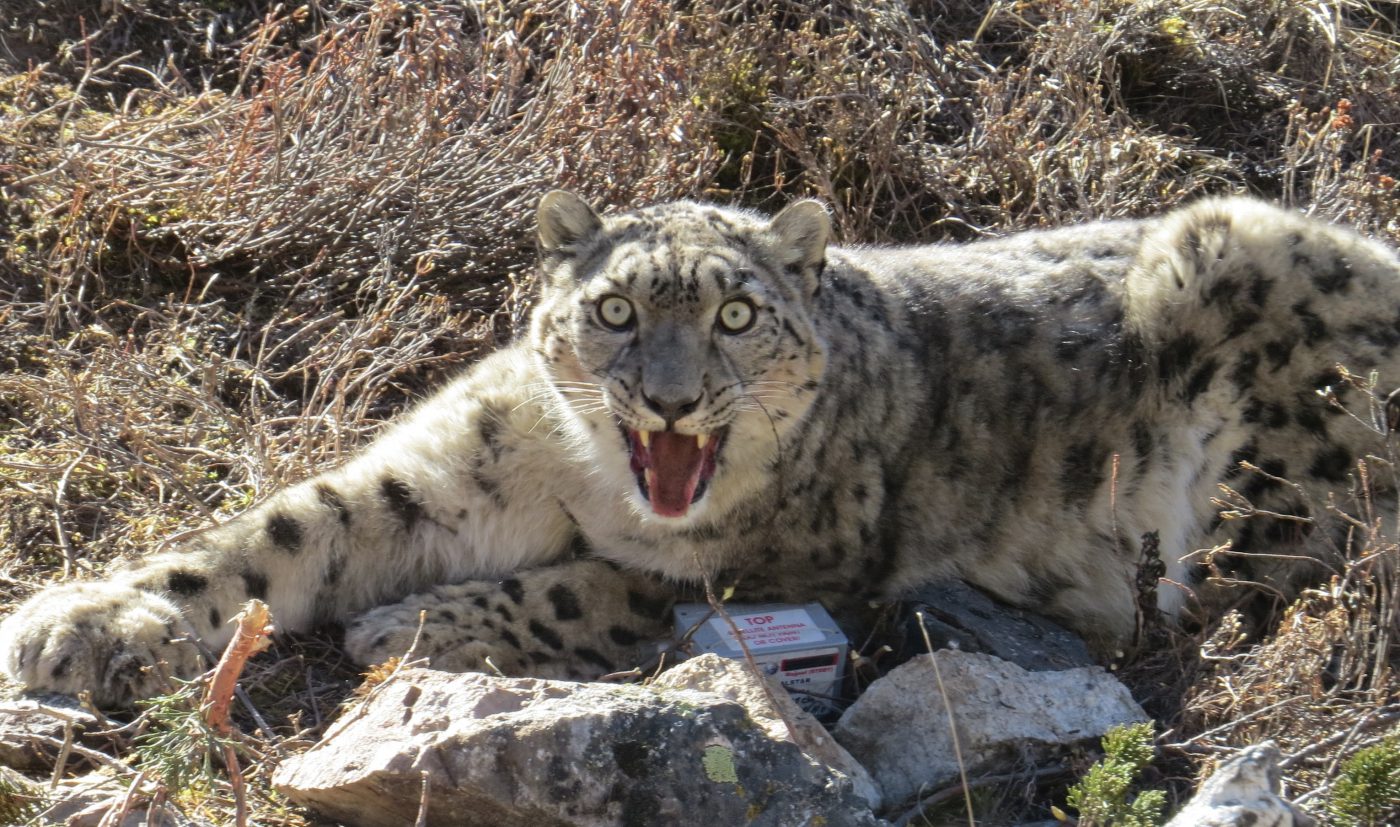
It took a long time. My closest encounters were when we trapped them for telemetry, five altogether. The fur was so soft and deep, a beautiful whitish-yellow on the undercoat. Recalling that moment of touching a snow leopard still sends a shiver down my spine. Even seeing one through a scope at three or four hundred meters, they have this intense stare. They look straight through you to see who you are.
After 50 years, what more do we know about them?
That they move completely unseen yet have a great impact. Like any predator, they hunt what is easiest to kill, and livestock have lost all their anti-predator behaviour. Because of that conflict, people saw snow leopards as pests. My goal has been to help communities see them as an asset from which they can benefit.
Why does a snow leopard kill so many livestock inside a corral without eating them?
Because the setup is unnatural. In the wild, when it attacks blue sheep, it gets one and the rest scatter. In a corral, the livestock cannot escape. A snow leopard’s hunting behaviour is triggered by movement, so whenever something moves, it must attack to immobilise it. It gets caught in a loop of predatory reflex. Killing 30 or 40 goats takes enormous effort, leaving the cat completely out of breath. Then people arrive, see dead sheep and goats with nothing eaten and tooth marks on their throats, and conclude it is an evil animal that sucks blood.
Fifty years on, we still do not know how many snow leopards there are.
Scientists love numbers, and so do governments. But does it really matter whether there are 200 or 300 in an area? That does not improve conservation. Villagers who are losing livestock and receiving no compensation are not concerned with exact figures. Direct conservation action should have become the priority at least two decades ago.
Arriving at a single global estimate is difficult. Sending an international team into every country is nearly impossible because of permits and bureaucracy. Chinese researchers now estimate their population at about 4,000 (nearly double the figure from the early 2000s). Massive resources go into estimating populations, while far too little goes toward protecting communities and reducing conflict.
What emerging technology looks promising for monitoring?
Camera trapping is still the main tool. Scent and hair posts remain difficult; if two cats visit consecutively and you do not collect the hair immediately, the samples mix and you end up analysing an ‘imaginary’ leopard that does not exist. Non-invasive scat collection has improved: if you collect in cool temperatures so the DNA does not degrade and verify it is a snow leopard, you can run individual analysis. Drones also have potential. However, the real priority for technology should be conflict detection and mitigation, not counting.
Should the snow leopard be listed as “Endangered” or “Vulnerable” on the IUCN Red List?
The push to keep the snow leopard listed as Endangered is mostly about funding, because endangered species attract more donor money. Globally, across all 12 range countries, the snow leopard is Vulnerable. In Nepal, however, a population of about 300 animals could still be considered nationally endangered, especially if genetic connectivity across the border with China is lost.
International researchers have not been allowed to work in China since around 2006 or 2007. Mongolia has good data, with about 980 animals, which is slightly lower than earlier estimates. India, Nepal, and Pakistan have more robust and transparent data. Bhutan and India are rigorous, although local researchers sometimes remain skeptical of one another’s models.
Bhutan uses solar fences doubling as deterrent fox lights and phone-charging stations to help reduce conflict. Is that feasible?
It can be. However, standard fox lights flash in a fixed pattern, so cats habituate to them quickly. Even randomised flashing fails if the light stays in one spot and nothing ever happens to the predator. I have been encouraging groups to link fox lights and camera traps to a higher-level alert: if a camera detects a leopard lingering for more than five or ten minutes, it triggers a loudspeaker blasting a recording of an angry villager shouting. Snow leopards would react to that. We should also test simple visual barriers, like wrapping thick plastic around corrals. A predator usually will not attack unless it can see its target; if it cannot see inside, it will not jump in blindly.
Where are we heading in the next 20 years?
I feel good about places where conflict with humans is being actively mitigated. When the conflict stops, the cats show themselves, and local youth can track signs, manage tourism, and take visitors out. The snow leopard survives under incredibly harsh conditions in only twelve countries. In 20 years, it is going to become iconic, like the lions of Africa, an animal people across the world want to see.
Adapted from himalayaspeaks.com