
 EKAL SILWAL |
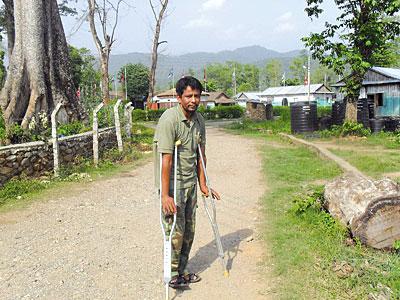
'A man who lost his leg during the conflict, who does not know the whereabouts of his missing family, is wandering on the street.' This is the caption of a drawing by Sanju Kumari Tharu, a student in Class Seven at Shree Saraswati Primary School, Jamuniya, Bardiya. Sanju's is one of the drawings on display at Patan Dhoka that captures the trauma of family members who lost their loved ones or witnessed atrocities during the decade-long violent Maoist conflict as well as those who witnessed atrocities during the war.
There's still no final word on the nearly 1,400 people who have been labeled 'missing'. For the families of the missing the war is not over until they find out what happened to their loved ones. Five years since the war ended, neither the government nor the Maoists have told these families what they did to their kith and kin after arresting and 'disappearing' them.
The family members of the missing who gathered for a discussion on 'Living with Ambiguity: Addressing the Psychosocial Needs of the Families of the Missing in Nepal', organised by the International Committee of the Red Cross (ICRC) in the capital on Wednesday, wanted an answer: either give us back our loved ones or tell us what you did to them. Most of the 1,377 recorded as missing by ICRC were forcibly disappeared by government forces. For the victims' families, the pain and suffering is acute irrespective of who the perpetrators were.
The Comprehensive Peace Agreement of November 2006 speaks of disclosing the whereabouts of those disappeared by government forces and the Maoists. No doubt high priority had been accorded to a very sensitive matter but sadly, the priority remains on paper.
The discussion attempted to draw attention to the psychosocial needs of the families who are still searching for their missing. These families, especially the women, are undergoing a lot of trauma.
Chandrakala Upreti of Dhamboji in Banke district is the mother of two sons and a daughter. Her husband, Bhupendra Upreti, was allegedly arrested by the army on 9 December, 2003. He never returned. Chandrakala received interim relief of Rs 100,000, but even this paltry sum invited derisive comments from within her community. "O, now Chandrakala is richer by one lakh rupees," one said.