
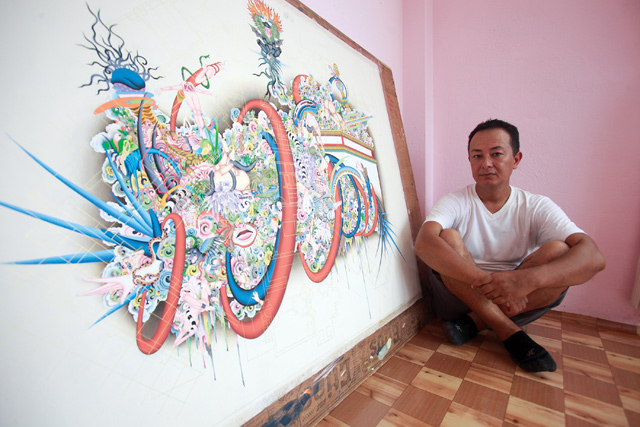
Renowned thangka painter Urgen Dorje gave his son, Ang Tsherin Sherpa, an ultimatum: either get better grades in school or stay home and learn the ancestral art of thangka painting. Sherpa instantly opted for the latter hoping it would be the easy way out, only to realise that it was going to be the most grueling six years of his life.
“I was forced to learn this very rigid traditional technique, I was never really inclined to it," recalled Sherpa who at age 13 used to wake up at the crack of dawn, every day, to memorise the scriptures.
Finding no room for exploration, the young man deviated from the structured and pre-determined art form. Sherpa set out to find his own voice challenging the rigid rules of devotional art.
“The form is supposed to be exact in traditional art; when we change this form does the essence of the deity stay in that form? So, is the deity in the form or in us?” Sherpa asks rhetorically. One of his works is a digital manipulation of the image of a deity that has been transformed into a swirling figure of colors.
Infusing his own ideas, while retaining most of the traditional techniques, Sherpa’s creations tactfully explore Tibetan deities, spirits and narratives in a modern-day setting. “This is a tradition that helps millions of people but it is not the only way. Sometimes you have to find your own path,” said Sherpa, who now lives in Oakland and was on a brief visit to Nepal this week.
Lauded for his intricate detailing and skilful depiction of contemporary issues, Sherpa has exhibited in prestigious venues like New York’s Rubin Museum of Art, Rossi & Rossi in London. The artist comes to Kathmandu to work with his uncle and cousin when he gets bigger consignments for artworks for large scale exhibitions.