

For the longest time, most Nepalis lacked adequate food and were undernourished. Fast forward three decades, and the country is starting to grapple with obesity.
At the pace with which the proportion of overweight people is growing, half of Nepal’s adult population will be obese by 2050, according to a forecast study published this week in the health journal The Lancet. This is much higher than next-door India where about one-third of its vast population is projected to be obese.
Alarm bells should be ringing because the study shows a rise in obesity over the last 35 years. Nearly 12% of men were obese in 1990, and this had risen to about 30% by 2021, and is expected to rise to 52.5% by 2050. As for women, about 14% were obese in 1990, and this more than doubled to 28% in 2021, and will reach 48% in the next 25 years (graph).
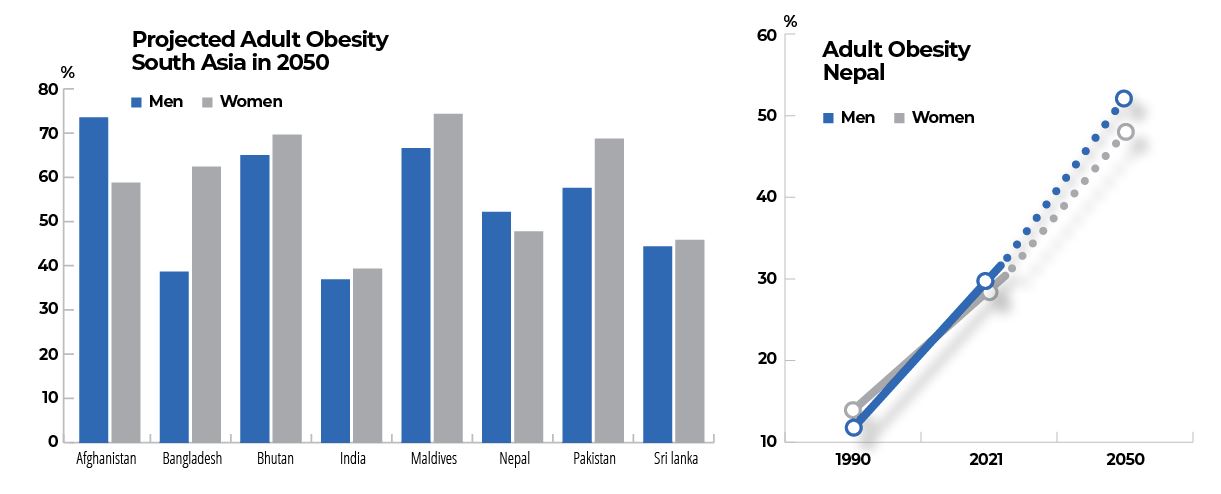
As for obesity in children, the collective figure for South Asia in 1991 was 0.9% which is expected to increase to 8.3% by 2050. Similarly, the figure for overweight children in the region was 3.3% in 1991 and is projected to reach 9.3%.
“Obesity is the mother of all diseases, it is the biggest public health concern draining our already limited resources,” says public health expert Aruna Uprety. “Changing eating habits including the intake of junk food and a sedentary lifestyle is making more and more Nepalis overweight.”
Obesity has been associated with diabetes, high blood pressure, stroke, heart, kidney and liver diseases, visual impairment, dementia, infertility, and certain cancers. Increasing obesity means dietary plans and fitness have become big business, even though many people cannot lose weight fast enough.
Read also: A deadly sugar rush, Yugottam Koirala
In 2017, in came a new drug that has become a game changer: the anti-diabetic medication Ozempic developed by the Danish pharmaceutical company Novo Nordisk. By chance, it was also found to be effective for weight loss, and Ozempic export and licenses gave the company a market value of $570 billion, making it larger than the Danish economy.
“Ozempic is a classic case of a serendipitous discovery,” explains Buddha Basnyat of the Oxford University Clinical Research Unit. “It was supposed to be a drug for diabetes, and not intended for weight loss. But it was so effective, it threatened to put weight loss regimens in danger of going out of business.”