

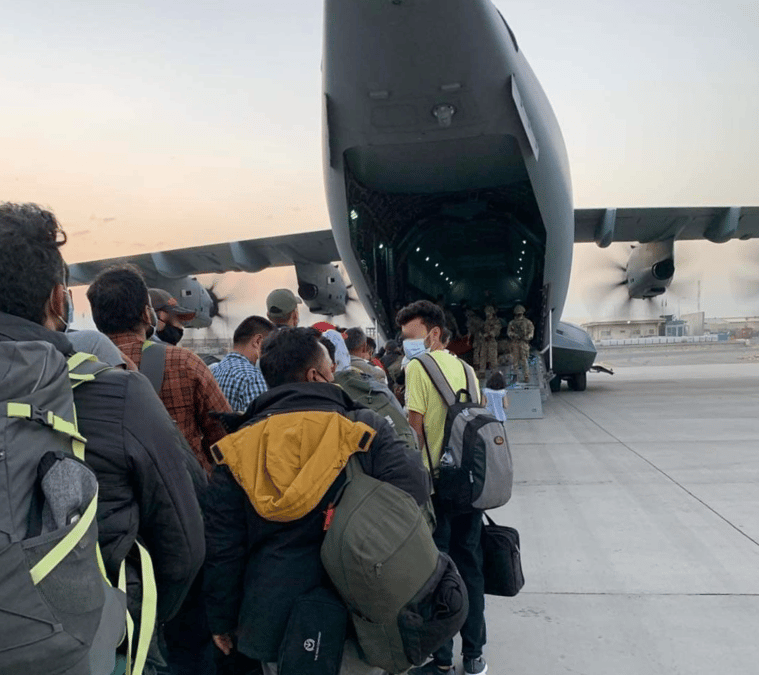
Almost two years after the war in Afghanistan ended, Nepali security guards who worked to protect the British Embassy in Kabul are still largely unemployed, facing uncertainty, and some even being targeted for deportation.
One week after a raid which led to the arrest and detainment of 10 evacuees who served as guards at the British Embassy, international media attention has led the UK government to pause deportation processing and release some of the detained evacuees.
Throughout the war in Afghanistan, Nepali security guards served as the first lines of defence, protecting the lives of military personnel, officials, and citizens of foreign governments. They risked their lives and, in some cases, watched their friends die in the line of duty.
Many of the Nepali guards who worked at the British Embassy had faith that the UK government or their company, GardaWorld, would evacuate them safely – and they did. But their job security and income for the future of their families was completely lost.
Private defence contracting, the hiring of armed combat and security services by private companies, has become an increasingly common method to lower the costs of war and military interventions in the 21st century. The labour required for prolonged military interventions, such as the war in Afghanistan, is outsourced to countries such as Nepal, whose GDP relies heavily on remittances from foreign labour migration.
Given the legacy of the Gurkhas who have been serving in the British army for more than 200 years, international private security companies supplying labour to foreign embassies in Afghanistan looked mainly to Nepalis and Indians of Nepali descent to meet the security demands, as detailed in the book Under Contract: the Invisible Workers of America’s Global War.
According to the Department of Foreign Employment, approximately 12,500 Nepali migrant workers have received non-renewed, first-time labour permits for Afghanistan since 2001. Those who took informal routes are not included in this figure.
For Nepali guards, many of whom are retirees from the Nepal and Indian militaries, work in Afghanistan was lucrative. Many knew it would be dangerous but lack of opportunities with comparable salary in Nepal meant that they agreed to take on the job. This also benefited the private defence companies and governments that contracted them, as Nepali guards were willing to take lower salaries.
Niraj, an evacuee, explained that working in Afghanistan after retirement from the army meant that he could better support his family and give his children quality education. While the evacuees interviewed said that they were happy with the salary, they knew that it was lower than what was deserved considering the conditions, risks, and duties of the job.
As the Taliban advanced across new territories in Afghanistan, many of the Nepali guards still did not have a full picture of what was going on. It was not until a few hours before boarding a repatriation flight that they were told of the Taliban takeover.
Nepali guards who worked at the British Embassy in Kabul guarded the compound until the last minute, after most of the British forces and officials had already been evacuated. On 15 August 2021 they boarded a Royal Air Force plane to Dubai before reaching the UK.
Upon reaching the UK, they had received 6-month emergency visas and were placed in military housing facilities. While many returned to Nepal only two days after arriving in the UK, some were able to contact immigration lawyers and secure legal pathways to stay there.
Read also: Nepal and the Taliban’s second coming
All third country guards working at the British Embassy, including the Nepali guards who were recently targeted for deportation, had an opportunity for resettlement in the UK under the Afghan Citizens Resettlement Scheme (ACRS), as listed on the UK government website. The ACRS states that ‘the scheme will prioritise those who have assisted the UK efforts in Afghanistan...’