

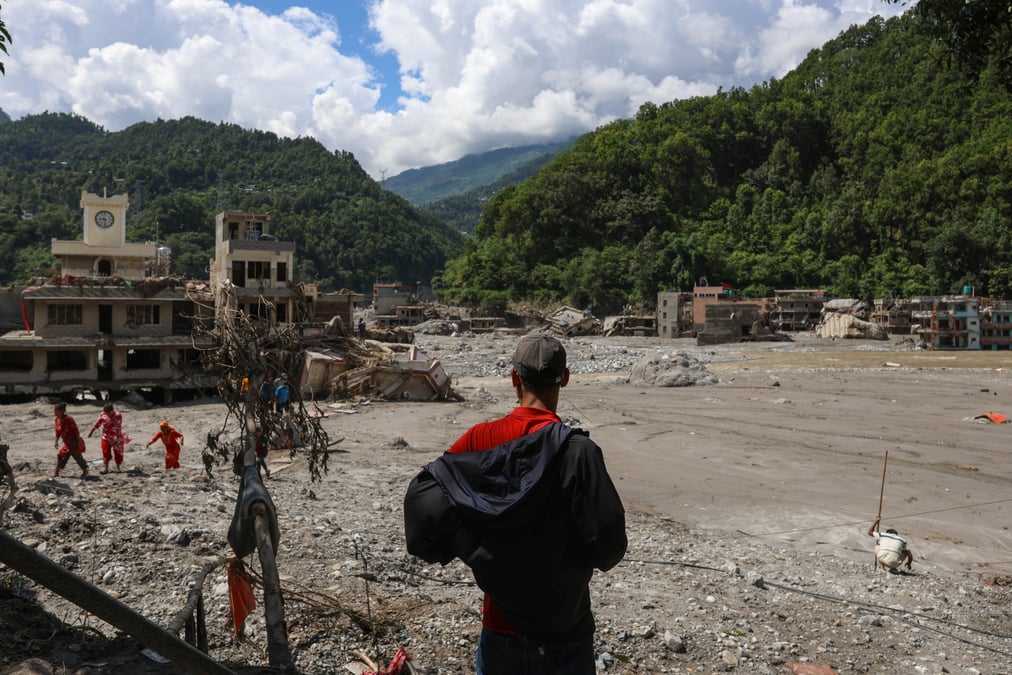
The news arrived the way water does: quietly at first, then in a roaring torrent.
It was 9AM, and I had just woken up, still groggy and reaching for my phone, when the first video appeared on my feed. Brown water where a street used to be. A bridge folding like paper. A bus swept sideways, its passengers' hands visible through windows that were frames of a nightmare.
And then, beneath the videos, the questions. Friends asking: Is this real? Is this AI? Our minds now un-believe the real.
Just weeks ago, I wrote about ice in this paper about the frozen, vertical world of Mt Everest, the Khumbu Icefall creaking blue and ancient in the thin air, the silence of snowfields stretching toward a sky that seemed to have forgotten the existence of noise.
Now the ice has written back. Not in the language of summits and flags, but in the language of melt, mud and gravity.
THE THIRD POLE
The Hindu Kush Himalaya is called the Third Pole because it holds the largest ice reserves outside the Arctic and Antarctic regions. Scientists tell us this frozen world is warming faster than the global average. Science is abstract. What happened in Nepal this week is not.
Imagine a single droplet of meltwater at the snout of a Himalayan glacier. It gathers with other droplets, pooling into a lake held back by nothing more than loose rock and ice, a moraine dam. The lake is turquoise and still. It is also a time bomb waiting for an earthquake, an avalanche, gravity or a sudden surge of melt on a hot day.
This is what hydrologists call a Glacial Lake Outburst Flood (GLOF). And they are happening with increasing frequency across Nepal. The river does not ask for a passport. It does not pause at borders. It flows from the Tibetan Plateau through Nepal’s narrow gorges, into the Tarai and the Indian plains, spreading finally across the Bangladesh delta. It carries silt and sorrow and the strange democracy of water. Borders are drawn on land. Water has never respected them.
I am still staring at my phone. The footage is grainy. The water is the colour of churned earth. A woman clings to a rope stretched across what was once a road. A child's shoe floats past, small and bright and devastating. I cannot hear the roar, but I can feel it. The sound of boulders colliding underwater. The sound of foundations giving way. The sound of a planet's circulatory system failing.
And beneath the footage, the questions continue. Is this real? Can AI do this? We have been taught that the unbelievable is probably fake. Deepfakes have colonised our skepticism. Generated images have eroded our trust in our own eyes. The mind's default is now suspicion, even when the body knows better. Even when the water is real, the mud is real, the bodies are real.
The tragedy is not just the flood. It is that we have lost the reflex of believing our own eyes. Nature, it turns out, is still capable of producing the unbelievable. The flood does not care if we believe in it. It rises regardless. It destroys regardless. It is real whether or not the video loads.
Nepalis in the Khumbu and Bangladeshis in Barisal watch the same waters rise. Between them: borders, languages, passports, politics. Above them: the same sky rivers. Below them: the same meltwater, seeking the same ocean.
We have spent centuries drawing lines on maps, building nations out of paper and pride. But the water cycle is the planet's great equaliser. Vasudhaiva Kutumbakam, the world is one family. We have spent so long forgetting this. The flood is a brutal reminder.
How do I hold this grief? I am safe here, for now, in this moment, in this room. My feet are dry. My coffee is warm. The flood is elsewhere, reduced to pixels and captions and comments. I scroll. I pause. I scroll again.
This is the guilt of the witness. To see suffering through a glass rectangle, put it down and continue eating breakfast. There is no resolution to this. There is only presence. Only the difficult, necessary act of staying with what we have seen — of refusing to look away, even when looking feels unbearable.
A child in Bangladesh cups rainwater in her palms and drinks.
A monk in Nepal watches the river turn brown and prays.
A glacier in Tibet drips, silently, into the dark. We are all downstream now.
Zakir Kibria is a Bangladeshi writer, policy analyst and entrepreneur based in Kathmandu. mailto:zakir.kibria@gmail.com
If you are looking to support communities affected by the flood in Nepal, donate to the Prime Minister's Disaster Relief Fund here. Additional information here.