
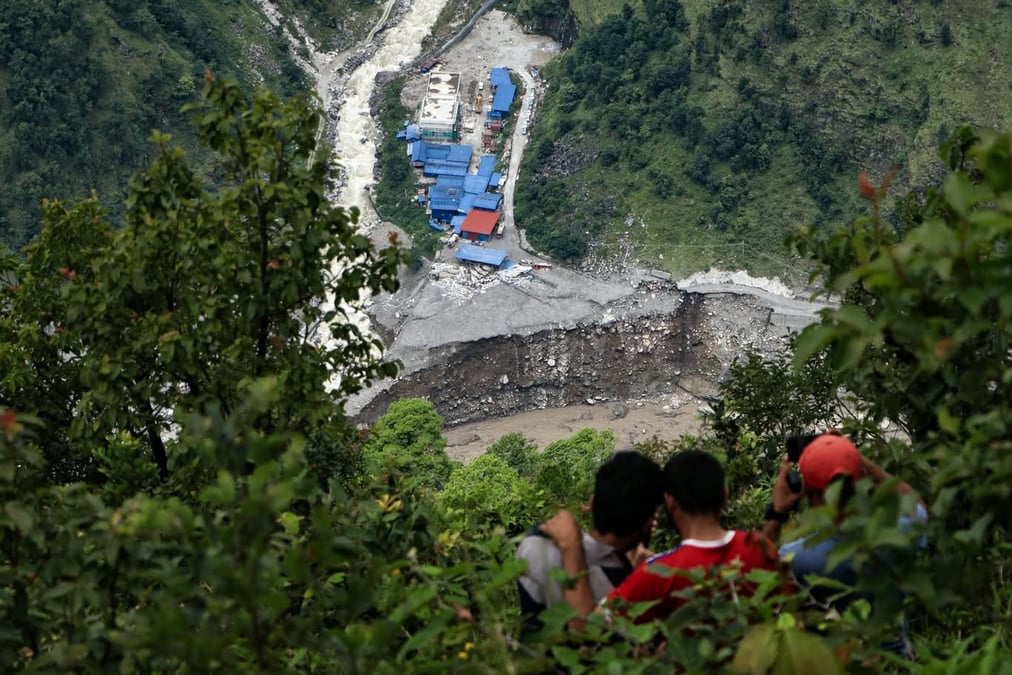
It has been a devastating week in Nepal following the deadly flood on the morning of 26 August that tore through the Bhote Kosi River in a matter of minutes, leaving more than 1,200 dead and over 4,500 missing.
This tragedy transcends Nepal and signals blatant climate injustice. Nepal contributes less than 0.01% of global carbon emissions yet is exposed to disproportionate vulnerability from its consequences.
Nepal has doubled its forest cover in 30 years, increasing its carbon sink. It has the second highest EV adoption rate in the world. It is a model for a strong commitment to nature conservation. Solar panels have long sat on the rooftops of Nepali homes without subsidies or schemes to incentivise them.
Yet, corporate greed and climate negligence on a global scale have ultimately led to Nepal’s people paying a tab they never ran up. In the aftermath of this flood, we have repeatedly iterated that this was clearly not a ‘natural’ disaster.
The ice-rock avalanche that triggered this disaster warrants a serious global discussion on direct climate justice. The extractivist, negligent activities, including settlements across floodplains, caused the high death toll.
The technical language of ‘adaptation finance’, without full clarity on what it means, leaves us to reckon with both defining our own parameters and a neoliberal world order that offers international aid, assistance, grant-based loss and damage finance, in a time when financial reparations are owed in the aftermath of such climate-induced catastrophes.
Rebuilding with borrowed money only deepens fiscal deficits and sovereign risk, while the same high-emitting countries and corporations profit as creditors from those loans.
Climate justice is thus a financial and moral obligation that requires specificity. And Nepal has just made its own position concrete.
On 1 September, Nepal’s government formally asked the board of the Fund for Responding to Loss and Damage — the mechanism established at COP27 and operationalised at COP28 — for urgent, direct support following the Bhote Kosi flood, explicitly citing the country's negligible contribution to global emissions against the disproportionate climate impacts it continues to absorb as a result of unchecked, unsustainable capitalism.
Prime Minister Balendra Shah said in a statement on Tuesday: “There is no doubt that this disaster has occurred due to climate change. Climate change is a global contribution and its response is also a global responsibility."
This is the first time Nepal has approached the Fund for Responding to Loss and Damage, and officials expect the board to compensate the country, not lend to it, because the claim and the risk are already well-established. That is the crucial distinction that will now test the world.
Nepal is not asking the Fund to translate sympathy into paperwork over the course of its normal December board cycle. The letter asks explicitly for a special, rapid decision before then. Whether the Fund proves able to act on that timeline, or whether Nepal is left waiting months for a mechanism built for exactly this kind of catastrophe, will say a great deal about whether Loss and Damage finance is a genuine instrument of climate justice or another slow, procedural gesture.
Nepal does not have the luxury of pausing recovery until reparations arrive, but the advocacy for proportional, clear international climate finance accountability must be a consistent and ongoing effort.
If the Fund can only move at its predesignated pace even when a member state explicitly says time is of the essence, it will signal to vulnerable countries whether this mechanism was built for emergencies it was created to answer, or only for the slower, more comfortable rhythm of international bureaucracy.
Nepal's own persistence here — revisiting its case for climate justice at the ICJ in 2024 and now pressing this fund directly — is the model of sustained, sovereign advocacy that this moment demands, regardless of how the fund itself responds.
This reckoning must extend to the proposed aid from around the world, and how the government has responded to that help. Geopolitical and development interests have historically treated these vulnerable moments as periods for negotiation or exercise of soft power.
Initially, offers for foreign search-and-rescue teams from other states were turned down, citing the coordination chaos of competing foreign teams after the 2015 earthquake. There were 76 international teams and over 2,200 personnel crowding Kathmandu’s single-runway airport. And 53 foreign SAR teams collectively pulled just 19 people from the rubble, while local informal networks moved faster and saved many more lives.
The decision signals decisiveness that prioritises sovereignty and coordination of emergency relief efforts that mitigate bureaucratic hurdles.
Nepal’s agency is not latent, and the generosity and hospitality that the international community has cited as further reasons for why we do not deserve this miss a crucial point: we are resilient out of a choice to remain hopeful and sovereign.
But sovereignty is not only a claim to make against foreign governments and multilateral banks, it is an obligation the state owes its own people too.
The truth that no one in power seems willing to say out loud is that this will not be reversed. No amount of Loss and Damage financing is going to slow the rate at which Himalayan permafrost is melting due to greenhouse gas buildup in the atmosphere.
So the question that matters most is not only what the world owes Nepal, but also what Nepal’s leadership is doing right now to build a country that can survive what is imminent.
Speeches on the international stage are a legitimate and necessary part of climate diplomacy, but it cannot be the entire strategy. And it certainly should not be a substitute for a government speaking honestly to its own citizens about a future that has already changed.
Nepal’s current government, including a home minister with extensive experience in disaster relief, has promptly responded to the crisis, alongside an active civil society, to collect donations, supplies and coordinate rescue efforts. Nearly 20,000 security personnel have been deployed and have rescued 8,730 people.
A coalition of local organisations and businesses in Kathmandu have come together collecting relief materials to deliver directly to survivors. There is a pattern of this government that predates the flood: a centralising instinct in how power gets exercised here even before disaster strikes.
In the aftermath of the flood, Nepalis within and outside Nepal, as well as the international community and foreign governments have been asked to pledge donations, supply specific provisions, and adhere to the one door policy for funds during this phase of emergency response.
A one-door policy for money mirrors a broader habit of directing everything upward and inward rather than building the capacity of local governments to respond on their own authority. The underlying structures of inequality this disaster has exposed, along caste, land tenure, gender, and geography, did not appear on 26 August.
With this government, the language of disaster response has changed, but relief and rehabilitation conducted without local authority and independent oversight, with little direct communication with those still waiting for relief updates, can recreate the same hierarchy.
Rasuwa has absorbed countless damaging hydropower projects, where local voices have been ignored in the name of progress or development, and people sidelined in the name of green growth. It is not alarmist to speak up against a series of projects that, in the name of development and progress, have also enabled climate injustice.
If it is to mean anything, climate justice has to be both a financial and moral obligation that falls upon neoliberal states, organisations and the growth paradigm that is causing catastrophes like this in the first place.
Nepal’s position is gaining international attention, as the world watches its government coordinate a focused recovery.
The task in front of us for economic recovery is not one of championing a growth model that has proved its limitations against the earth’s capacity for endurance, but of highlighting the alternatives: metrics, seed systems, river-based regions, decolonial land claims, a circular economy that can build towards global competitiveness while preserving itself.
Astha Guragain is a researcher and educator of economics, specialising in local economic development.