
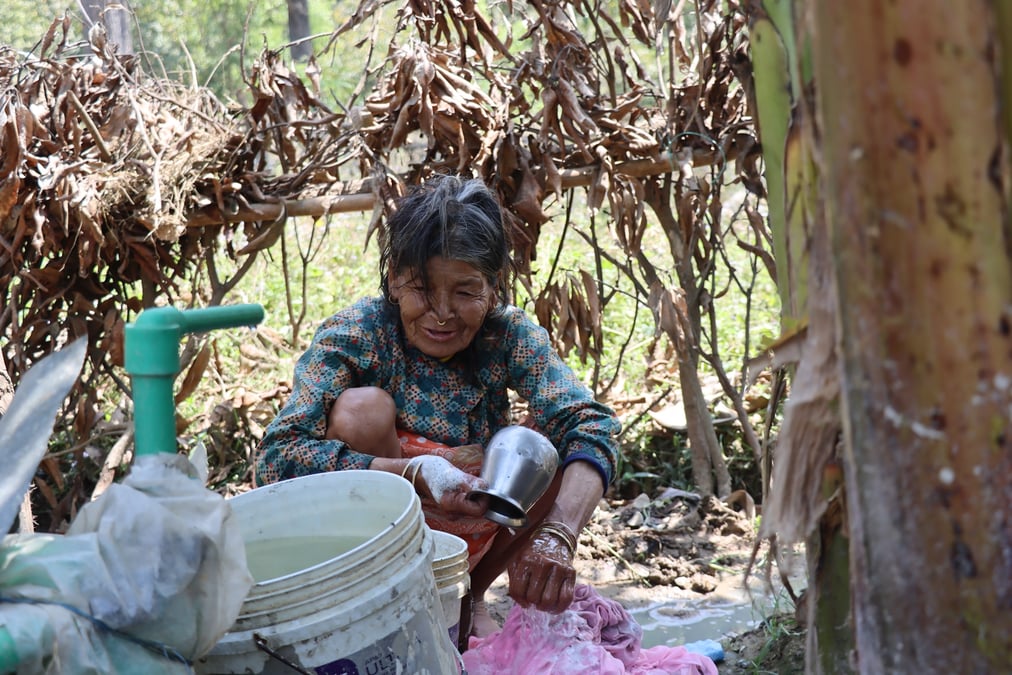
For years, the most resonant promise in Nepal’s local elections has been deceptively simple: one tap of drinking water for every household.
Across Nepal communities have installed plastic pipes for household taps, removing the drudgery of walking for hours to distant springs to collect water.
Recent studies in Sindhuli, Syangja and Kailali districts ahow that having a tap does not necessarily mean adequate water supply.
The question has quietly shifted from whether a household has a connection, to whether that tap actually delivers water when it is most needed: during the long dry months.
Most community water schemes in Nepal follow a familiar pattern: locate a spring, build a collection structure, lay pipes, construct a reservoir, and run connections to households. This approach has improved access for millions. But it rests on an assumption that the spring will keep flowing, reliably, throughout the year.
Climate change is dismantling that assumption.
Many perennial springs are now seasonal. Extended droughts, erratic rainfall, forest fires, loss of traditional ponds are eroding the natural processes that recharge these sources.
The consequence is that many households receive water for only a few hours a day or in a limited quota, depending on what a community reservoir has managed to store.
For families with some financial cushion, this is an inconvenience. They install household storage tanks — a 1,000l tank costs around Rs25,000 — and manage. For poorer households, it is simply unaffordable.
For many, actual water security depends not on the tap itself, but on whether a family can afford the extra infrastructure when that tap runs dry.
Furthermore, a landslide, a forest fire, or a flood can stop water delivery for days or weeks. When that happens, households without reserve storage must walk, sometimes more than an hour each way, carrying water in jars.
This burden does not fall equally. It is hardest on women, who bear the primary responsibility for water collection; on the elderly; and on households dependent on livestock, where limited water undermines sanitation, hygiene, and livelihoods.
Equal distribution of taps does not produce equal access to water. What separates the water-secure from the water-insecure is not the presence of a connection, but the capacity to prepare for uncertainty. This is not deliberate discrimination. It is structural and invisible.
THE SOURCE
A water supply scheme cannot be considered complete at the point where a spring is tapped. The source itself — the landscape that feeds it, the forest that holds moisture in the soil — must become the first priority, not an afterthought.
When a municipality invests millions in pipes and reservoirs, a comparatively modest additional investment in protecting the recharge area can determine whether that system serves communities for decades or begins to fail within years.
Spring conservation — identifying recharge zones, protecting forest catchments, restoring degraded slopes, adopting nature-based solutions — must become a core component of every water supply project, not a standalone environmental concern.
Traditional practices offer lessons here too. Small ponds, recharge structures, and careful stewardship of forest landscapes-built resilience into water systems long before modern infrastructure arrived. Reviving these approaches can retain moisture, reduce forest fire risks, and keep springs alive through the dry season.
Nepal has made remarkable strides in expanding water coverage, and that progress deserves recognition. But the challenges ahead will not be solved by counting taps.
If household storage has become essential infrastructure in a climate-stressed system, then treating it as a private purchase means quietly accepting that water security is something money can buy — and that the poorest families simply go without.
Municipalities and water user committees can change this. Supporting vulnerable households in accessing reserve tanks is a targeted, practical step. A truly water-secure community needs protected and recharged sources; climate-resilient infrastructure; adequate community storage; and household-level support for families who cannot invest on their own.
The true measure of success is whether families can access sufficient, safe water during the hardest months of the year — not just when the rains are generous, but when the dry season bites and the springs are low.
A tap at every doorstep is an important milestone, but without reliable flow, it is only a symbol of access, not security.
Ngamindra Dahal, PhD, is Senior Research Fellow and the Chair of the Nepal Water Conservation Foundation.