
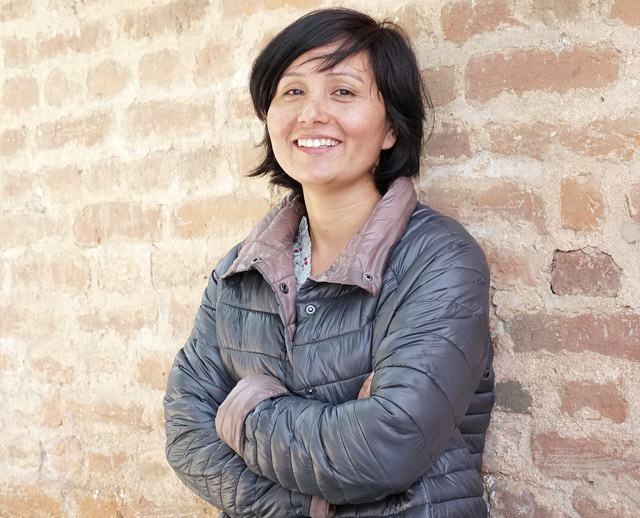
Clad in a hefty down jacket and a pair of rugged jeans, Nisha Budha looks like an average Kathmandu urbanite. But she is anything but average.
Born in a village near Jumla Bazar, Budha grew up in a family and community steeped in patriarchy, alcoholism, dated norms and taboos. The accumulation of these experiences led the 31-year-old to consciously make some bold decisions with the support of her family.
Her father, a businessman, played an important role by educating all his six children. He took Nisha on trips to India where she gained exposure to a different world, learnt new languages and ways of living.
“I grew up always asking ‘Why can’t I?’ I respect tradition, but I knew there were things in Jumla that were very wrong,” said Nidha Budha, who is profiled in the documentary Daughters of the Curved Moon that was screened at the Film South Asia documentary festival in Kathmandu recently.
Filmed over several years, the documentary is Budha’s coming-of-age story, as she returns to Jumla after six years of living and working as a trekking guide in Pokhara. The film follows the young woman as she questions age-old traditions, and tactfully provide her neighbours logical alternatives. Her progressiveness and no-nonsense approach to life are in stark contrast with the rigid mores of her home as she discusses sensitive issues like sexual health, menstruation and gender inequality.
Daughters of the Curved Moon was produced by Miranda Morton Yap and Sophie Dia Pegru who have successfully conveyed on screen Budha’s vivacious nature and contrast her childlike innocence with what it means to be a woman in Jumla even today.
Daughters of the Curved Moon from Sophie Dia Pegrum on Vimeo.
“My brother and I used to draw lots to see who would get to go with our father to India,” Budha told us during a break at the documentary festival. Her father enrolled her in a school in Chandigarh, where she learnt the value of education the hard way.