
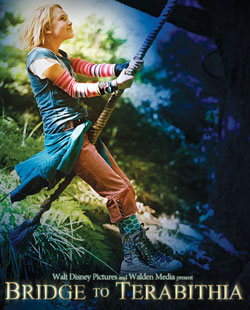
 When the promos for Bridge to Terabithia appeared, director G?bor Csup? and others repudiated them for making the film look too fantastical and relegating the realism behind the story. Not that other fantasies don't deal with real issues. Surrealists like Luis Bu?uel have even argued that fantasy is, in effect, simply a state of hyperreality. But harping on the realism of Terabithia has a particular legacy.
The film is adapted from Margaret Paterson's controversial masterpiece. The American Library Association listed it the ninth most frequently challenged book of 1990-2000. Censors have called for it to be banned from public schools and libraries, not so much for its imaginations as for its real-life preoccupations. Death, child sexuality, and agnosticism are the main charges prigs have made against the book.
The story is simple enough, but its emotions and ramifications are complex. Rural boy Jess (Hutcherson) is a miserable outcast until a spunky, free-spirited girl, Leslie (Robb), befriends him. Through Jess's drawings and Leslie's words, together they create the imaginary world of Terabithia, where they rule and where their daily predicaments are magically resolved. Until, that is, a tragedy shatters their world.
The fantasy part is the easy bit. The actual challenge for the filmmakers was to translate the nuances of Paterson's writing into cinema. It was inevitable that final judgment would be made not on how vividly Jess's and Leslie's imaginations are interpreted, but on how sincerely the film portrays the heart-wrenching poignancy of the book without seeming alarming.