
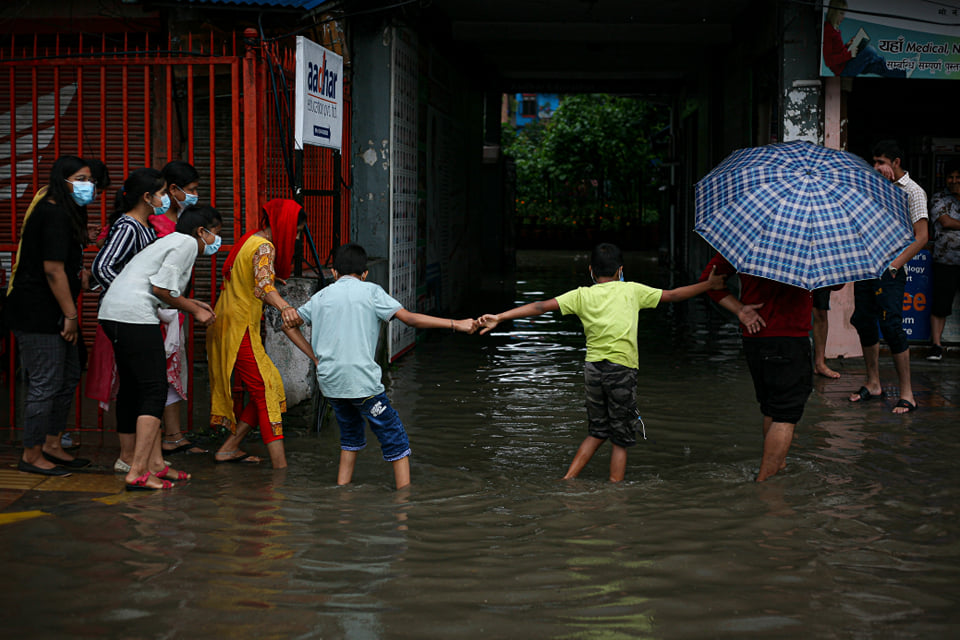
On 31 July this newspaper carried a report titled ‘Kathmandu’s Flash Floods Are 4 Decades in the Making’. The analysis by Tom Robertson stated that there was nothing ‘sudden’ about floods in Kathmandu Valley, and they would get much worse.
We derive no satisfaction in saying, ‘we told you so.’ On the night of 5 September the capital received over 100mm of rain in just 3 hours early on Monday morning. The rain was heaviest recorded in the Valley for decades.
Monsoon modelling by the South Asia Climate Outlook Forum had predicted 20% higher than normal rainfall in most of Nepal this year, but the total precipitation has been even heavier than that in many places causing death and destruction. The rains have been sustained and relentless, and we saw nearly as much rain as Kathmandu gets in the whole of September falling on just Sunday and Monday.
Scientists are much more categorical than they have ever been in drawing a correlation between such extreme weather events and the climate crisis. A warming atmosphere means more water vapour in the air, which translates into more than normal rain.
This year saw record-breaking downpours in the Ahr Valley of Germany, floods in China’s Henan province in July killed 300 people, and remnants of Hurricane Ida dumped 80mm of rain in just one hour on New York, leaving 50 people dead across northeastern US, including three Nepalis.
Meanwhile, Siberia, the Canadian Arctic and California baked in unprecedented heat waves and droughts, with wildfires sweeping across them for a second northern summer in a row. Nepal itself had a five month drought last winter which sparked historic forest fires that engulfed the whole country in smoke.
Nearly 80% of Kathmandu’s annual rain falls in just four months: June-September. People in Nepal and the Indo-Gangetic plains have learnt to live with the annual floods, and need them to replenish their farms with nutrients valuable for next year’s crops.
Kathmandu has seen cloudbursts before. The destructive floods of 1981 dumped 170mm of rain in 24 hours on Godavari, unleashing floods on the Bagmati’s tributaries. Makwanpur saw an unimaginable 540mm of rain in 24 hours, and the resulting debris flows filled up the Kulekhani reservoir and wiped out half its life-span.