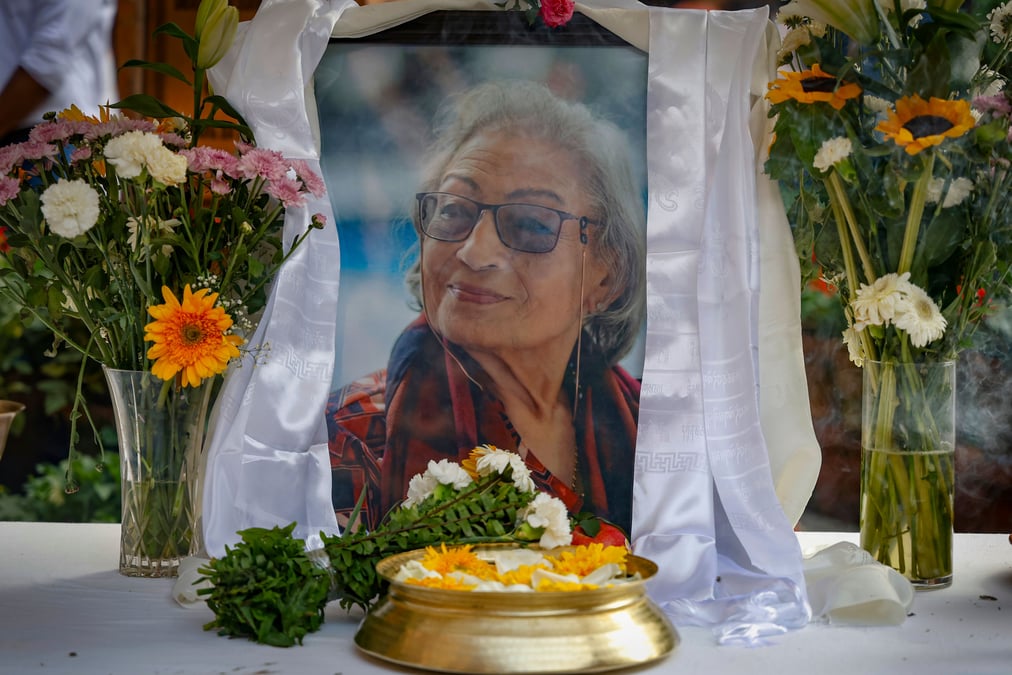
It is no exaggeration to say that the vision and drive of Ambica Shrestha has changed the face of modern Nepal.
Tourism leader, businesswoman, philanthropist, and a tireless fighter for women’s rights, equitable entrepreneurship and cultural conservation, Ambica showed us how to do it by creating Dwarika’s, one of the most celebrated heritage hotels in Asia.
Although soft-spoken, gracious, always quietly elegant, Ambica’s literacy, education and empowerment movements radically improved the status of women that we enjoy today. The benefits of her unyielding determination and implacable resolve will live with us for years to come.
Ambica’s 92-year lifetime spanned some of the nation’s most turbulent decades and dramatic changes.
Nepal was hurtled into the modern era from its centuries of ‘medieval’ isolation under a succession of regimes who found it expedient to keep the borders tightly controlled. Few travellers, traders and pilgrims had penetrated into the towns, temples and rice terraces of the ‘emerald valley,’ mingling with the spectacularly skilled artists and artisans of the Malla Newar residents.
Generations forged Kathmandu’s uniquely rich heritage, an enduring inheritance captured in the restoration and revival embodied in Dwarika’s premises and
.Transformations that she witnessed include the overthrow of Rana rule, the opening of Nepal to foreigners, the restoration and fall of the Shah monarchy, the trauma of the Royal massacre, the 10-year Maoist insurgency, and all the political turbulence that accompanied the making of the new Federal Democratic Republic of Nepal’s constitution.
Born into a distinguished Newar family in the Himalayan kingdom of Sikkim, Ambica was the eldest daughter of Khadga Bahadur Pradhan and Padhma Kesari. She reminisced: ‘I had a comfortable upbringing. My favourite food was Kwati Ko Jhol Momo and I used to fight my seven brothers and sisters for the momos.’ Her parents were prosperous and enlightened, sending her to be educated in the elite British Indian convent of Loreto in Darjeeling.
‘It was a sharp learning curve,’ she told me not long before her death, a twinkle in her eye. We were sitting in her habitual spot in the sunny hotel courtyard, the timbre of her distinctive voice still rings in my ears. There were less dogs at her feet than before – her beagle, alsation and labradors were aging too. Family members hovered, successive generations married far and wide but still kept close with many crucially involved in her multifarious activities.
Ambica is survived by Sangita and Vinita, her two daughters and their families which total five grandchildren and five great-grandchildren, as well as extensive tentacles of Himalayan relatives.
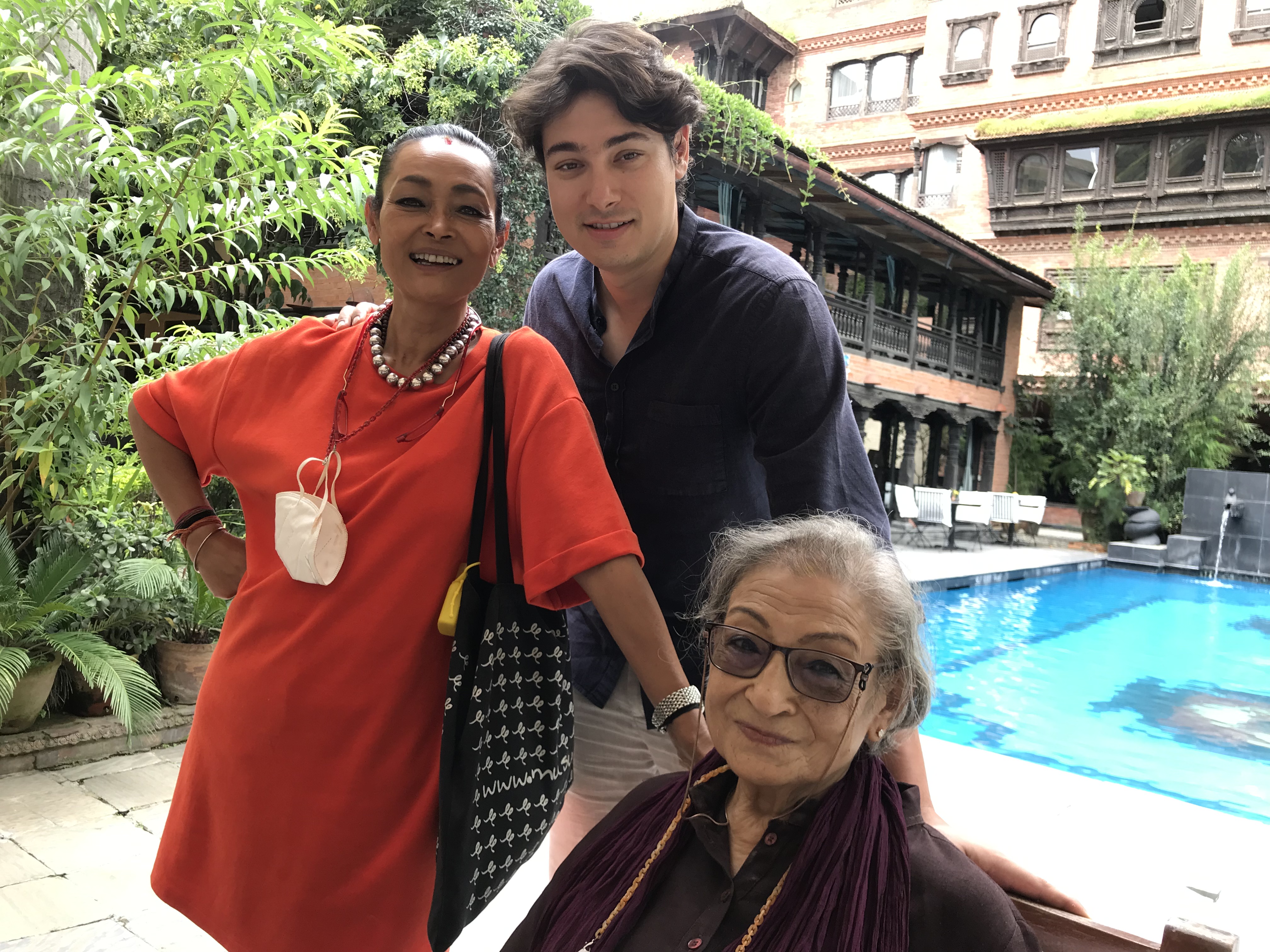
‘At school, myself and an Indian princess were the only brown faces amongst the sea of pale English and European girls at Loreto. We faced difficulties as the only non-Christians and had to do extra work studying the catechisms. Early on I recognised the need to exert myself and denounce the evils of discrimination, but of course I ended up really appreciating the education I received at that school.’
The easy laughter, compassionate and ever-gracious demeanour conceal
for justice and her lifelong battle for the rights of women. Her abiding social activism credo can be defined by her advice to Nepali women: ‘There is no work that cannot be accomplished by women and every woman should be aware of that. All should know that if we can give birth to a child, we can also give birth to a new world. So every female should give education to their children and get educated themselves ... Women should help other women to develop confidence and move forward.’Ambica studied in Patna University and taught in St Joseph’s convent in Kalimpong before moving to Kathmandu in 1955 to marry businessman Dwarika Das Shrestha.
When foreign visitors started to trickle into the mysterious high Hindu kingdom in the early 1950s, the innovative and open-minded Dwarika foresaw the potential of tourism. He opened Kathmandu’s first hotel, the Paras Inn, in a family house at the top of New Road adopting the adage ‘guest is god’.
The well-told story goes that Dwarika encountered exquisitely carved house struts and columns being chopped for kindling whilst out jogging, and was shocked into rescuing these treasures to preserve for future generations. He hastened to buy wood-carved windows and columns from any historic home that he heard was being dismantled to make way for modern concrete constructions.
A young widower, Dwarika fell deeply in love with the photograph of Ambica that arrived as a prospective bride. The eldest of ten children of a conservative Makhantole clan, Dwarika was attracted by her educated background as well as her looks. Ambica said: ‘I was given time to meet and talk to him before the marriage.’
With their liberated views, Ambica’s marriage to Dwarika was considered controversial by his orthodox Newar family who did not approve of educated ‘outsiders’.
The Valley was a different world and Ambica remembered those early days: ‘Women were treated as enslaved people. My husband used to support me as he was against such systems. We were even ostracised for revolting against traditional family norms.’
Ambica recalls the time the family were lined up to admonish them on return from a spin around town on Dwarika’s new motorbike, furious because she had left the house without their permission.
With Dwarika by her side, Ambica persisted in her subtle insurrections - such as wearing provocatively sleeveless clothes. Her excellent English language skills also set her apart. ‘I think I was so bold because I had the opportunity to learn about different religions.’
Continuing her fight for rights, Ambica completed her Bachelor of Arts degree in Kathmandu, taught English at the Kanti Ishwori girl’s school in the late 1950s, ran language training at the British Council and programmes for the American Library. She volunteered in women’s groups and helped in Bir Hospital wards, stripping saris into bandages with her sewing group. In the 1960s ‘I was the first public affairs officer of the United States Information Service, at a salary of Rs.80 per month!’ In 1969 she became the first women president of the Nepal Jaycees youth movement of any country in the world.
Dwarika’s younger sister Bina Pradhan recalls: ‘It was a successful marriage of two extraordinary people, both ahead of their time. He gave her enormous freedom, and she was a tremendous asset to his clever business ideas. They worked as partners, hand-in-glove, together.’
Dwarika and Ambica had one son and two daughters, but tragedy struck when their boy was killed in a motorcycle accident on the Dhobi Khola bridge in Dillibazaar. Stuck in an unusual jam in those days of very little road traffic, they walked forward to investigate the cause, only to realise the crash involved their own son Pawan Das Shrestha, aged 24 years. I never heard Ambica ever mention this personal catastrophe.
In 1964 Dwarika created a building in his garden, incorporating the many antique pieces he had collected, using authentic building methods and vernacular styles. I remember the 10-room wedge-brick guesthouse decorated with sculptures and handicrafts, with the fiercely efficient Swiss manager, Anne Marie Spaar and Hari Ram the cook housekeeper.
Ambica’s growing family lived in a converted cow barn at the back of the current site. Officially registered in 1977 as a hotel, it was Sangita who suggested the name, Dwarika’s, to honour her father’s incomparable legacy of architectural preservation.
Their travel agency Kathmandu and Travels opened in 1969 with offices in Basantapur, and was followed by Nepal Trek and Natural History Expeditions in 1970. As tourism grew, Dwarika and Ambica were perfectly placed to propel Nepal into the limelight as a high-quality cultural tourism destination. With her flair for promotion, Ambica was always helpful when we found ourselves together as the only women delegates marketing Nepal at international industry conferences – I was selling Tiger Tops, Mountain Travel and Tiger Mountain and our marketing alliance has lasted to this day.