
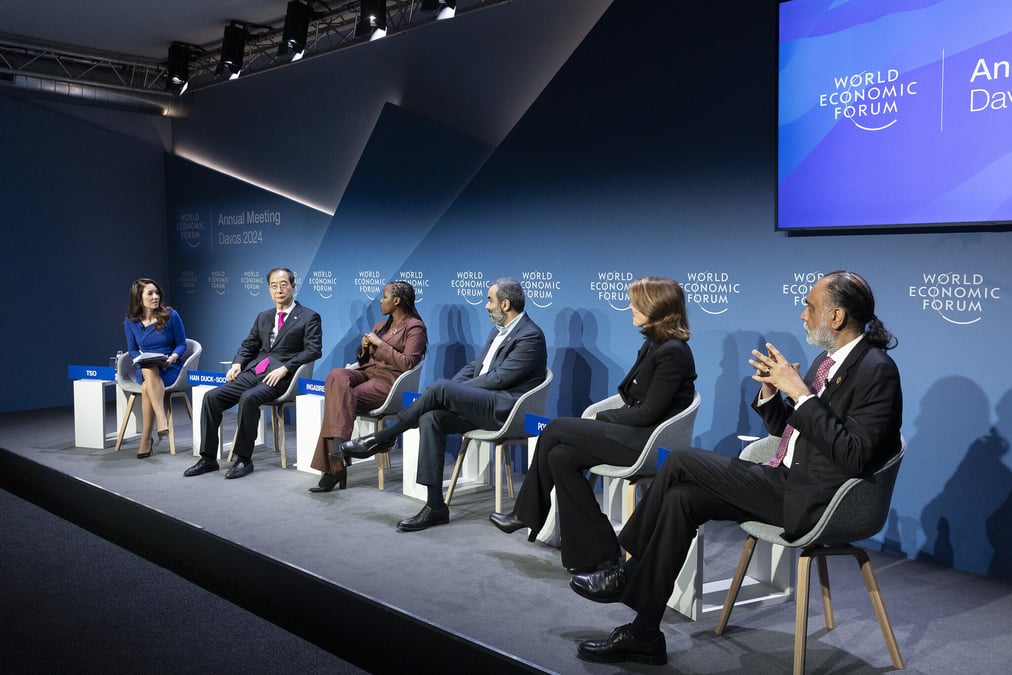
Since returning from this year’s World Economic Forum meeting in Davos, I have been asked repeatedly for my biggest takeaways. Among the most widely discussed issues this year was artificial intelligence – especially generative AI (‘GenAI’). With the recent adoption of large language models (ChatGPT) there is much hope – and hype – about what AI could do for productivity and economic growth in the future.
But our world is dominated far more by human stupidity than by artificial intelligence. The proliferation of megathreats – each an element in the broader ‘polycrisis’ – confirms that our politics are too dysfunctional, and our policies too misguided, to address even the most serious and obvious risks to our future.
These include climate change, failed states which will make waves of climate refugees even larger, and recurrent virulent pandemics that could be even more economically damaging than Covid-19.
Making matters worse, dangerous geopolitical rivalries are evolving into new cold wars such as between the United States and China, and into potentially explosive hot wars, like those in Ukraine and the West Asia.
Around the world, rising income and wealth inequality, partly driven by hyper-globalisation and labor-saving technologies, have triggered a backlash against liberal democracy, creating opportunities for populist, autocratic, and violent political movements.
Unsustainable levels of private and public debt threaten to precipitate debt and financial crises, and we may yet see a return of inflation and stagflationary negative aggregate supply shocks. The broader trend globally is toward protectionism, de-globalization, de-coupling, and de-dollarisation.
Moreover, the same brave new AI technologies that could contribute to growth and human welfare also have great destructive potential. They are already being used to push disinformation, deepfakes, and election manipulation into hyperdrive, as well as raising fears about permanent technological unemployment and even starker inequality. The rise of autonomous weapons and AI-augmented cyber-warfare is equally ominous.
Blinded by the dazzle of AI, Davos attendees did not focus on most of these megathreats. This came as no surprise. The WEF zeitgeist is, in my experience, a counter-indicator of where the world is really heading. Policymakers and business leaders are there to flog their books and spew platitudes. They represent the conventional wisdom, which is often based on a rear-window view of global and macroeconomic developments.