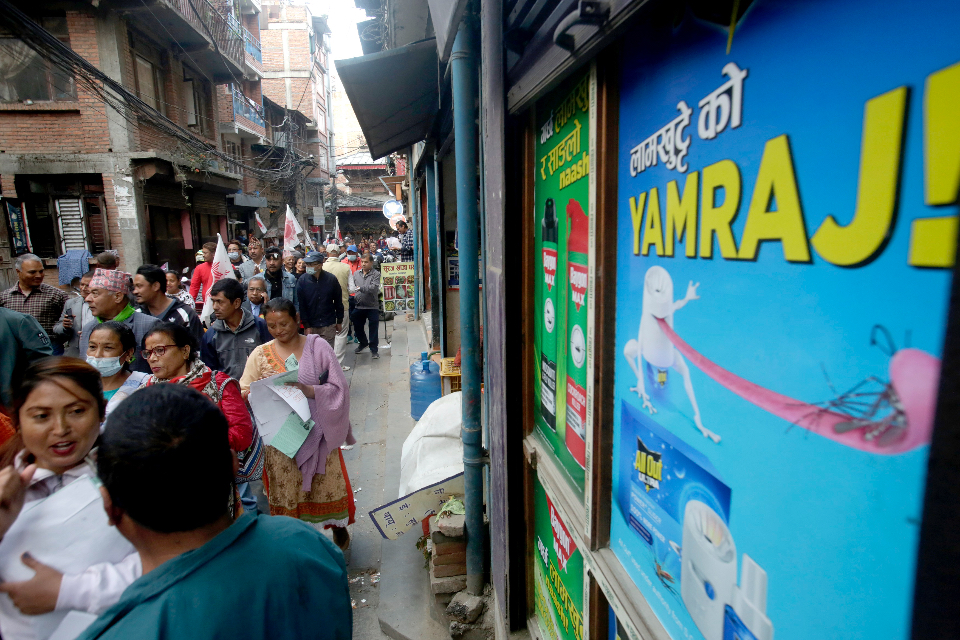
“For too long we have been taken for a ride by politicians. It is time we took politicians for a ride.”
Campaigners on speakers to the accompaniment of traditional instruments made rounds late afternoon this week in Kathmandu.
As the countdown begins to Nepal’s parliamentary and provincial elections, their top political leaders and other aspirants appear to be more excited about the polls than their voters.
On 20 November many of the country’s 17,988,570 registered voters will head to the polls to elect 275 members to the House of Representatives and 550 members to Nepal’s 7 provincial assemblies. Of them, 165 Members of Parliament will be voted in directly, while the remaining will be selected from the list of Proportional Representation (PR) candidates.
Similarly, 330 provincial seats will be filled through direct voting while the remaining seats will go to PR candidates.
There are 2,412 candidates, of whom only 225 are women contesting the parliamentary election under the first past the post (FPTP) election system, and 867 of them have registered independently. Similarly 3,224 FPTP candidates, of which 280 are women, will contest provincial elections.
Of the total registered voters, 50.8% are male, while 49.2% are female. A little more than a third of voters are between 26-40, making up the largest age group in the electorate. Nearly 20% of all voters are concentrated in Bagmati Province, while Karnali has the fewest voters at 5.6%.
On Election Day, Nepalis will cast votes via four ballot papers, two each for the FPTP and PR elections of Parliament and provinces.
During local elections in May, Nepal’s five-party ruling coalition extended the alliance it formed to oust former Prime Minister K P Oli into an electoral partnership. It paid off: Prime Minister Sher Bahadur’s Nepali Congress (NC) won big, it allowed Pushpa Kamal Dahal’s Maoist Centre to gain a stronger foothold, and gave the new Unified Socialists the relevance it needed.
But not everyone fared as well. Madhes-based parties like Upendra Yadav’s JSP split from ex-Maoist Baburam Bhattarai after a less-than-stellar showing in the polls, which brought Dahal and former Bhattarai back together. Mahanta Thakur’s LSP also underperformed.
Rabindra Mishra stepped down from the progressive Bibeksheel Sajha party after dismal election results to join the royal-right RPP which is more in line with his views on monarchy and federalism. The JSP and LSP also switched allegiances between the coalition government and the opposition at the last moment, and the RPP has allied with the UML.
In the run up to 20 November, there was some doubt about whether the governing coalition would hold. Analysts and some top NC leaders felt the party could win on its own, and did not need to team up with the Maoists.
One of the great mysteries of these polls is why Deuba clings on to the Maoists to the detriment of his own party. One theory: it is geopolitics. Beijing is supposedly bent on reuniting the Maoists and UML, while the US and India are trying their best to prevent a monolithic Communist party.
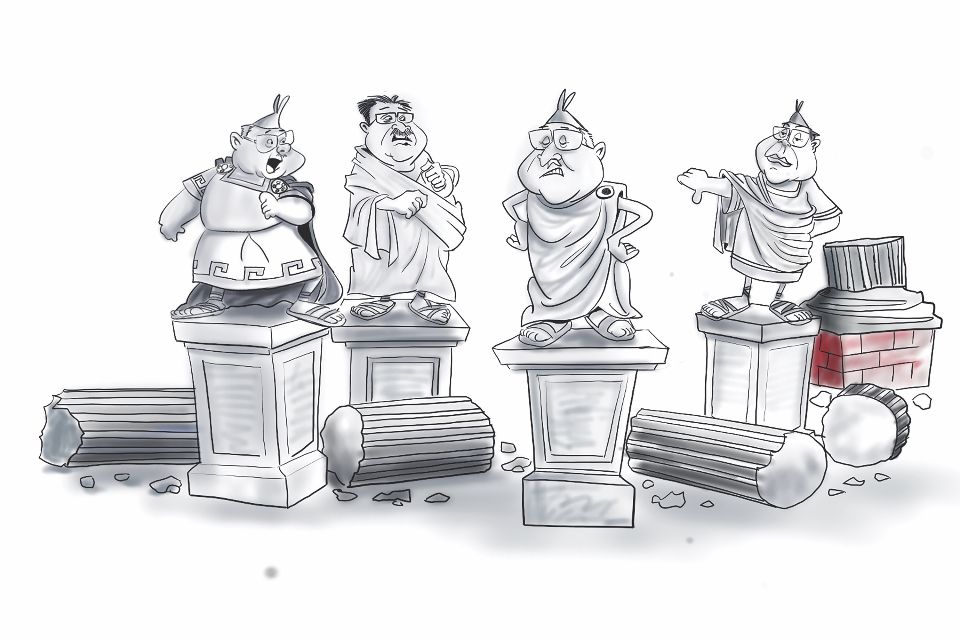
Whatever the reason, this has meant we have strange bedfellows on the hustings. Deuba and Dahal are on the campaign trail together. Deuba has ostracised colleagues who refused to support coalition candidates and are contesting as independents. The UML’s Oli has also ousted party rivals.
In the days leading up to the election, each of Nepal’s political parties and candidates have unveiled election manifestos, outlining their stance on the economy, employment, education and healthcare, infrastructure, the environment, social security, election reform.
But as it stands, the election has been defined by unusual, fickle political alliances more than ideology and real commitments to tackle urgent environment, economic and employment crises.
The Big Boys
Prime Minister Sher Bahadur Deuba of the Nepali Congress (NC) is contesting from the sole constituency of his home district Dadeldhura, from where he has been elected to office six times. Deuba will face his former secretary Karna Bahadur Malla of the rebel Nepali Congress (BP) who is backed by the opposition UML. He also faces four independent candidates, notable among them 31-year old engineer Sagar Dhakal.
NC Central Committee member and the Prime Minister’s wife Arzu Rana Deuba is on the list of PR candidates, unlike in 2017 when she contested the election directly from Kailali’s fifth constituency. Rana Deuba lost the election to the UML’s Narad Muni Rana after being branded a ‘tourist candidate’.
Dilli Raj Pant, member of the provincial assembly of Sudurpaschim Province 5(B), is on the party’s parliamentary ticket this time, the Prime Minister’s nephew Prakash Deuba seeks Pant’s seat in the provincial assembly.
Opposition leader and former Prime Minister K P Oli of the UML is running in Jhapa-5, where there are a total of 25 candidates in the fray, including Khagendra Adhikari of the NC.
The Unified Socialist’s Madhav Kumar Nepal and Jhalanath Khanal are vying to represent Rautahat-1 and Ilam-1 respectively. Nepal currently represents Kathmandu-2 in parliament, while Khanal is the incumbent of Ilam-1 and will be challenged by Mahesh Basnet, who is currently an MP from Bhaktapur.
JSP leader Upendra Yadav is contesting from Saptari-2, while LSP chair Mahanta Thakur will run from Mahottari-3.