
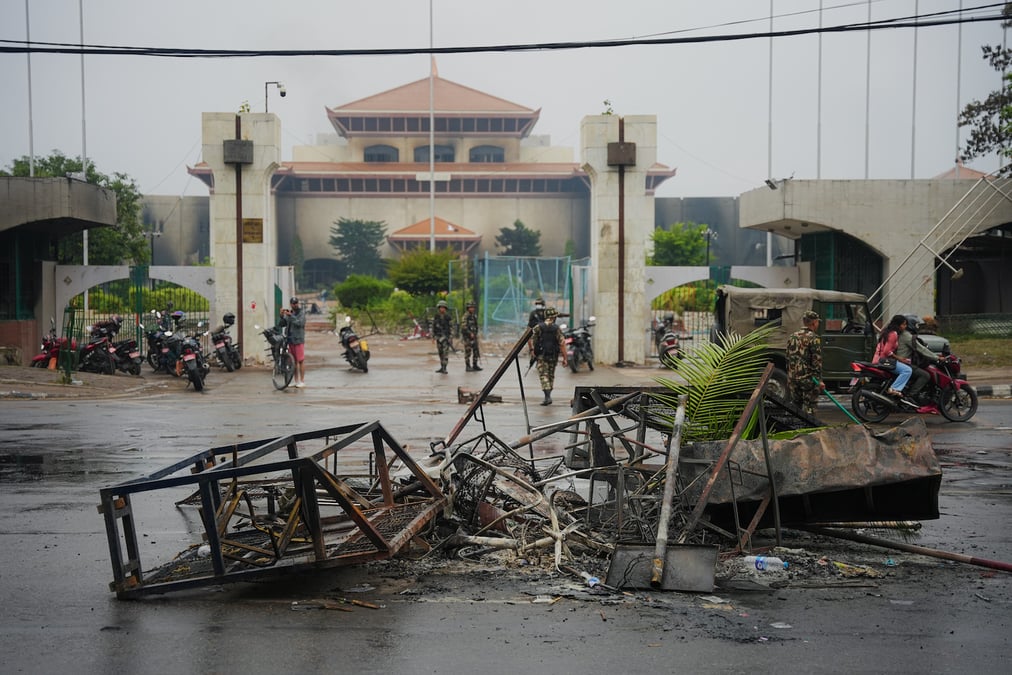
The 2022 Survey of the Nepali People was conducted in July, just weeks after the formation of the Rastriya Swatantra Party (RSP). The follow-up in January-February 2026 gauged public reaction to the GenZ protest movement of September 2025, providing a rare before-and-after window into how a citizen-led political rupture reshapes perceptions of governance and accountability.
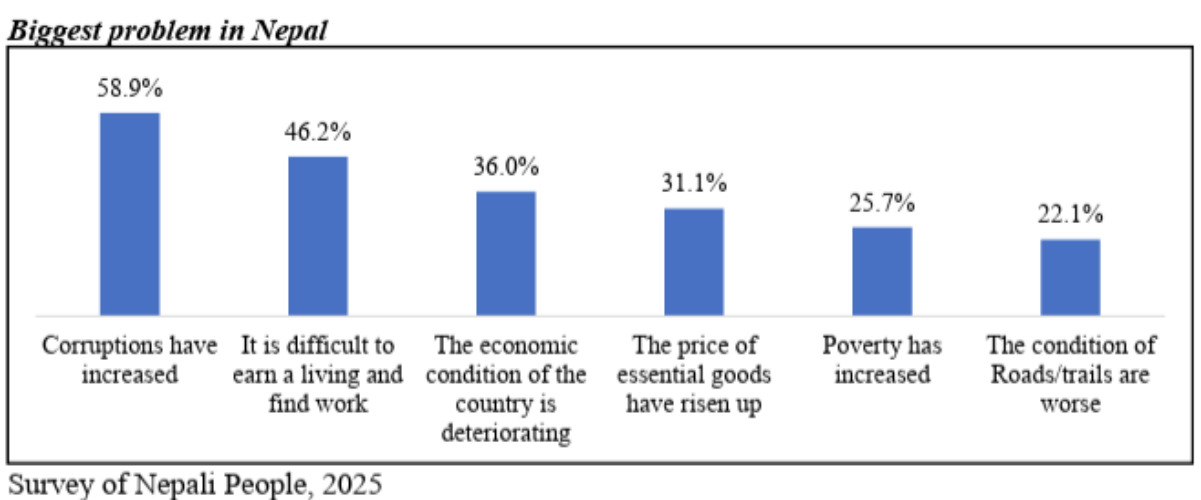
Findings from the survey highlight the dominance of corruption as a public concern. A clear majority of respondents believed that corruption had increased, making it the most frequently cited national problem.
Economic concerns followed closely, with nearly half reporting difficulties earning a living or finding employment and over a third expressing concern about the country's worsening economic condition. Rising prices of essential goods were also widely cited. Although concerns about poverty and deteriorating infrastructure were mentioned less frequently, they remained important issues for a substantial share of the population.
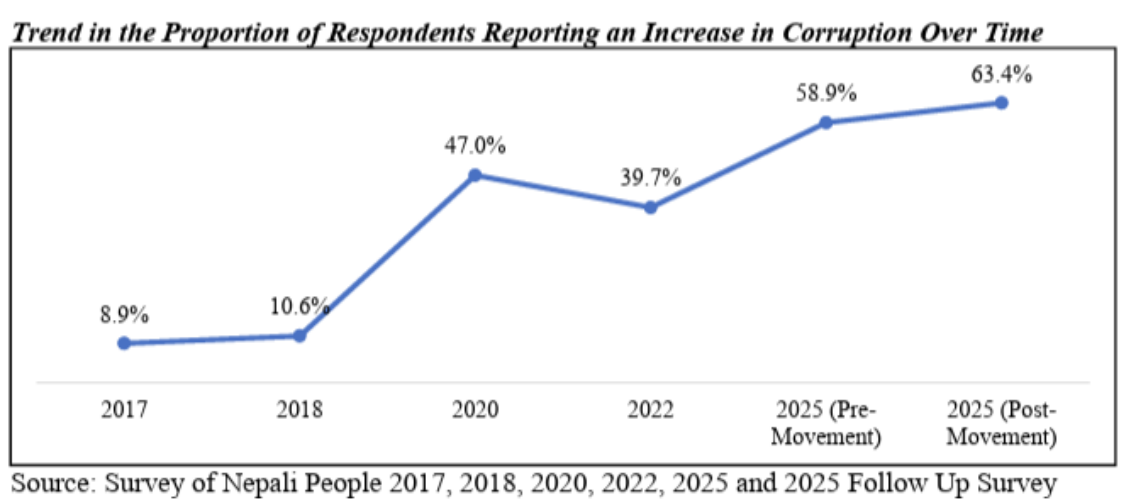
Trend analysis reveals a dramatic transformation in public perception of corruption. In the early rounds of the SNP survey, relatively few respondents identified corruption as a major national problem, with economic issues receiving greater attention. But concern about corruption rose sharply in 2020, remained elevated in 2022, and reached its highest levels in the 2025 survey and Follow-up survey.
The Survey showed that nearly 54% of respondents were optimistic about the GenZ movement moving the country in the right direction, with $0% disagreeing.
However, the follow-up this year found that only 17.5% percent of respondents thought the country was moving in the right direction, down from 23.7% before September 2025, with 70% saying they thought the country was going the wrong way.
Perception of corruption rose from 58.9% to 63.4% after the GenZ protests with 40.5% saying the economy was not doing well – up from 32.9% last year. Respondents saying that conditions in their local regions had improved plummeted to 10.1% compared to 54.4% before the GenZ movement.
Respondents also felt that health and education services had deteriorated in the past year. Most respondents were aware of the GenZ movement and nearly 80% felt it was a response to high level of corruption, while 63% thought it was triggered by the ban on social media platforms.
PERCEPTION OR REALITY?
The Survey results on corruption raises an important question: has corruption actually increased, or is it the public perception of corruption that has increased?
Public perception is often shaped not only by direct experience but also by broader social, political, and economic influences. One key factor is the rapid expansion of internet access and social media use in Nepal since 2022. Greater digital connectivity enabled more citizens to access news, commentary, and public debates on governance. Social media platforms, in particular, have amplified discussions around misconduct and abuse of power.
This made corruption more visible. Incidents that might previously used to go unnoticed were widely shared and discussed. While this enhanced transparency, it also amplified perceptions of wrongdoing — even when evidence was incomplete or contested.
Economic challenges following the pandemic contributed to rising perceptions of corruption. Since 2020, Nepal has experienced sluggish economic growth, limited job creation, and reduced income opportunities. These pressures have been felt particularly strongly by younger people and new entrants to the labour market, many of whom face growing uncertainty about their economic future.
During such periods, trust in institutions often weakens, and citizens become more likely to question whether public resources and opportunities are being distributed fairly. In this context, perceptions of corruption can intensify even in the absence of direct personal experience.
Data from Transparency International show that Nepal’s performance in the Corruption Perceptions Index has remained relatively stable in recent years, with scores hovering around 34–35 (on a scale of 0–100, where higher scores indicate lower perceived corruption). These modest fluctuations indicate gradual change rather than any sharp deterioration in corruption levels.
In the global context, Nepal’s score remains below the world average, and like many countries scoring below 50, it continues to face notable governance challenges. However, global trends themselves are largely stagnant, with most countries showing little improvement over the past decade.
Taken together, these patterns suggest that rising public concern in Nepal may be driven less by a sudden increase in corruption and more by heightened awareness, stronger scrutiny from media and institutions, and growing public expectations of accountability.
Survey questions included ones on whether respondents provided extra cash, goods, or gifts to access public services. The latest data show that only a small proportion of respondents report such experiences. For instance, just 2.2% of respondents reported making unofficial payments while paying taxes.
At first glance, this appears to contradict widespread perceptions of increasing corruption. However, it highlights the distinction between personal experience and collective belief. Individuals may not directly encounter bribery, yet still perceive corruption as widespread based on indirect information and public discourse.
It is also important to acknowledge the limitations of self-reported data. Since bribery is illegal, respondents may be reluctant to disclose such behaviour, even in anonymous surveys. These figures may therefore underestimate the true extent of corruption.
In this context, international indices provide a complementary, though still imperfect,measure of corruption trends. The gap between low reported personal experiences and high perceived corruption ultimately reflects a deeper issue: trust. When confidence in institutions declines, perceptions of corruption tend to rise, regardless of direct evidence.
Public perceptions in future will largely depend on how effectively corruption is addressed, and how transparently these efforts are communicated. The government recently reopened investigation into several high-profile corruption cases and pursued actions against senior political and administrative figures, developments that contrast with earlier periods when accountability efforts were often perceived as targeting only lower-level officials.
These measures signal a stronger willingness to confront corruption at higher levels. However, their impact on public trust will depend on whether they are viewed as impartial, credible, and consistently applied. If investigations are perceived as selective or politically motivated, they may deepen rather than reduce public skepticism.
Media and civil society will also play a crucial role. Responsible reporting, fact-checking, and informed public dialogue can help ensure that discussions around corruption remain grounded in evidence rather than speculation.
Ultimately, the prominence of corruption as Nepal’s leading public concern reflects a complex interplay of factors, including increased awareness, economic pressures, political narratives, and rising expectations of the public. It signals a more engaged and vigilant citizenry — one that is increasingly unwilling to tolerate governance failures.
Whether this heightened concern leads to meaningful reform remains to be seen. What is clear, however, is that corruption now occupies a central place in Nepal's national conversation. The growing public demand for accountability has already demonstrated its capacity to reshape electoral politics, challenge long-established political parties, and create space for new political actors. How governments and institutions respond to these expectations will have lasting implications for public trust, democratic legitimacy, and Nepal's future political trajectory.
About the Surveys: The Survey of Nepali People (SNP) is a nationally representative longitudinal public opinion survey conducted jointly by Kathmandu University School of Arts (KUSoA), Inter Disciplinary Analysts (IDA), and The Asia Foundation (TAF). The series covers six rounds: 2017, 2018, 2020, 2022, 2025, and a 2025 Follow-Up survey.