
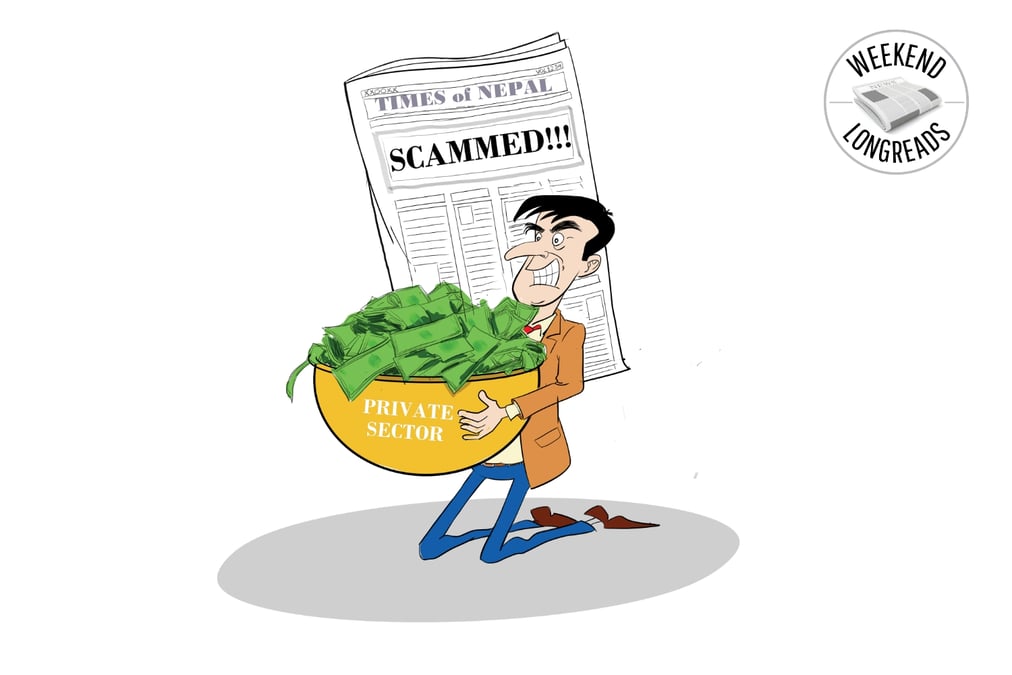
The discourse around corruption in Nepal is mainly about politicians and bureaucrats accepting bribes and kickbacks. The private sector usually does not get as much blame.
But the prevalent climate of cronyism in Nepal means that the politicians and businesses are often hand in glove. The private sector is generally considered to be in favour of free market competition to encourage investment and innovation so that wealth is generated.
But insider trading, cartelling, and conflict of interest have become a given in Nepal’s private sector, and it all happens with the blessings of the government. In fact, tycoons have become legislators and politicians have become businessmen.
“Such collusion kills the free market, and does not allow entrepreneurship and innovation to flourish,” says Kush Kumar Joshi, former president of the Federation of Nepal Chamber of Commerce and Industries (FNCCI).
An example of this is the Dangote Group of Nigeria, which was planning for a cement factory in Nepal. A Dangote executive told us that Nepal’s cement cartel got the government to sabotage their plans.
Earlier, the same cartel tried to do the same thing to the Chinese companies Hongxi and Huaxin, arguing that Nepal’s cement industry was capable of meeting domestic demand and did not require foreign investment. Ultimately, Hongxi partnered with Nepal’s Shivam and Huaxin with former FNCCI president Suraj Vaidya.
In 2019, industrialists successfully lobbied lawmakers to prevent foreign investment in agriculture by amending the Foreign Investment and Technology Transfer Act. Two years later, foreign investment in agriculture was opened, but only if 75% of the products were exported.
There is a long history of local lobbyists obstructing the entry of multinationals, like J Walter Thompson advertising agency and the international shipping company Maersk. Microbreweries, which can be operated by restaurants, have been prohibited at the behest of larger beer companies. The private dairy sector opposed the government-owned Dairy Development Corporation when it tried to begin production in Pokhara a decade ago.
“The business sector is a reflection of Nepali society and government which do not care about ethical business practices,” says former CNI president Hari Bhakta Sharma. “The environment is not conducive to the few businessmen who are honest.”
Lobbying by businesses is not unusual in a democracy, but its basic character should be for the collective good, not individual greed.
“This kind of profit-over-everything mindset is fatal for businesses. Entrepreneurs must prioritise social, worker, and customer welfare,” adds Sharma.
Industrialists have actively lobbied for the removal of policies that prevent loan misuse and require bank loans in specific areas. They have partially reversed such directives.
Until the economic slowdown, Nepal’s fastest growing industry was construction. But even there, cement and steel rod manufacturers colluded by price-fixing. Banker Parshuram Kunwar Chhetri says Nepal’s corporates just do not believe in free market principles, adding: “Their ideas go against competition benefiting consumers. It is all about price fixing, cartels and monopolies.”
Read also: Poor cash-rich Nepal, Sonia Awale
Ideologically, Nepal’s Communist parties are supposed to be against the neoliberal free market, globalisation and the ‘imperialism’ of international financial institutions like the World Bank and the IMF. But cronyism is rife there, too.
Two years ago, the FNCCI and the Confederation of Nepalese Industries (CNI) accused the IMF of interfering in Nepal's domestic economic policy after the Fund demanded economic reforms as conditions for its Extended Credit Facility.
Says economic analyst Sujeev Shakya: “How can we expect an honest and ethical business sector when we as a society tend to laud those who earn money through illicit and corrupt means rather than lament their moral bankruptcy?”
In October 2012, the Chaudhary Group’s CG Electronics warehouse in Kathmandu caught fire. A surveyor certified that the company had suffered Rs580 million damage, which was paid out by United Insurance Company.
The Commission for the Investigation of Abuse of Authority (CIAA) directed the Nepal Insurance Authority to investigate suspected insurance fraud, and found that the fire damage was actually Rs340 million.
The Patan High Court ordered Chaudhary Group to return the excess amount, a decision the company challenged in the Supreme Court. But in March, the apex court also found the Chaudhary Group guilty of insurance fraud.
Chaudhary Group's Binod Chaudhary, Nepal's only known dollar billionaire, is a Nepali Congress central committee member and MP, former president of FNCCI and founder of the CNI.
Then last February, the Central Investigation Bureau questioned Binod Chaudhary and arrested his brother Arun Chaudhary of CG Holdings over their alleged involvement in the illegal acquisition of the state-run shoe factory, following an investigative report by Ukaalo Online.
In 2021, Chaudhary and his family’s offshore business dealings landed them in the Pandora Papers list by the International Consortium of Investigative Journalists (ICIJ) for hidden assets in Panama.
Says Krishna Khanal, assistant professor of business ethics at King’s College: “Cronyism, political collusion, and anti-competitive cartelling are routine in the private sector. There is no other objective than to make money at any cost.”
Conflict of interest is rife in Nepal’s share market. In 2023, Ghorahi Cement owned by Triveni Group issued primary shares at a premium price. There is also evidence that a river was diverted for the construction of its business tycoon Upendra Mahato’s Mediciti Hospital. Bhatbhateni owner Min Bahadur Gurung is also involved in Lalita Niwas land grab scam in Baluwatar.