
The Covid-19 pandemic has now killed more people than the devastating 2015 earthquake. Officially, over 9,700 Nepalis have died due to the coronavirus in the past year and a half, but the real figure is said to be at least three times more.
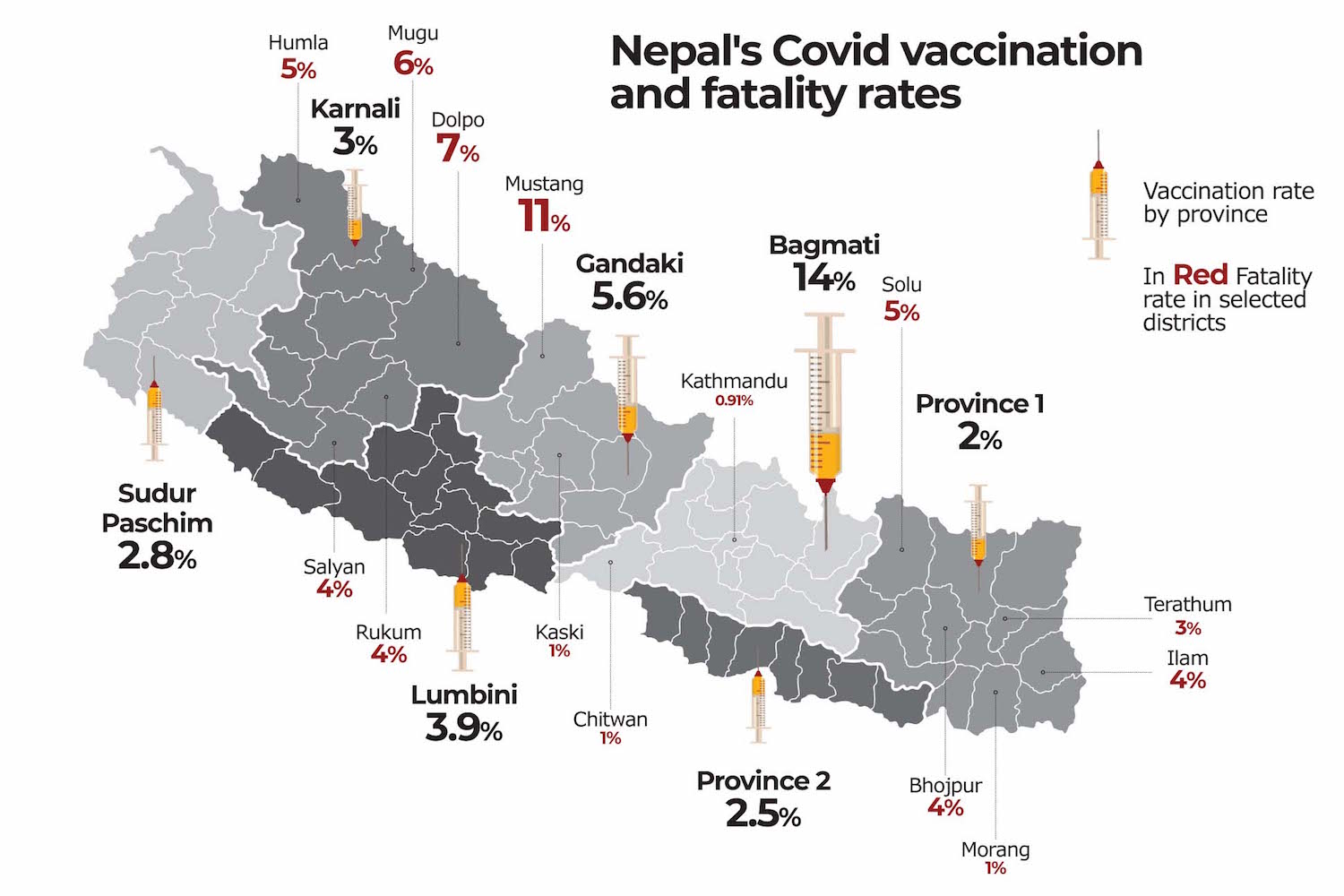
At a glance, it seems that densely populated urban centres with the most infections have recorded the highest fatalities. But analysing the available government data shows that the fatality rate among infected patients is higher in remote areas of the country.
In Bagmati province, of every 1,000 Covid patients, 11.9 individuals have lost their lives, but it is 21.1 in Karnali Province. District-wise, Kathmandu saw 9.1 deaths per 1,000 cases while Mustang recorded a whopping 111.9 fatalities per 1,000.
Public health experts blame limited health care facilities in rural Nepal including ICUs, ventilators, drugs and oxygen for Covid-19 treatment for this huge discrepancy. They also have notably fewer doctors, nurses and other paramedics.
“A majority of coronavirus patients recover but most of those who died did not survive because of the lack of medical oxygen and this is also largely due to uneven distribution of health infrastructure,” says Bijay Acharya of the Massachusetts General Hospital, also associated with the US Nepal Health Foundation.
He adds: “In many places, patients have died on their way to hospitals or while being moved from one to another. Many more people in the villages have likely passed away unable to access the treatment.”
Binita Adhikari, a public health specialist affiliated with the Health Nepal Foundation and the Johns Hopkins Bloomberg School of Public Health agrees. “The fatality rate is high in remote Nepal also because many people who need treatment never reached the hospital. The Covid-19 outcome depends on how soon a person is diagnosed, hospitalised and receives treatment,” she says.
The fact that the entire Karnali Province has only two functional laboratories for Covid-19 testing (Karnali Academy of Health Sciences in Jumla and Surkhet’s Provincial Hospital) means that official figures for total cases in the region are largely under-counted. And this could also have made the fatality rate among confirmed cases higher.
Poor road infrastructure and having to travel distance, sometimes several days, for diagnosis or to access hospital care also adds to the casualties. This also means additional expenses for the poor.
The annual per capita income of people in Karnali is $606, which is nearly half of the national average, and a third of the population there is living below the poverty line. The region’s Human Development Index (HDI) at 0.538 is also much lower than the rest of the country.
Even within Karnali Province, the poorest and the most disadvantaged have been disproportionately affected. The coronavirus mortality in Karnali stands at 2.1%, but in remote Dolpo, the figure rises to 7.01%. There is just one ventilator here at the district hospital, but even that is non-functional in a lack of skilled human resources to operate it. There are only two beds with oxygen.