
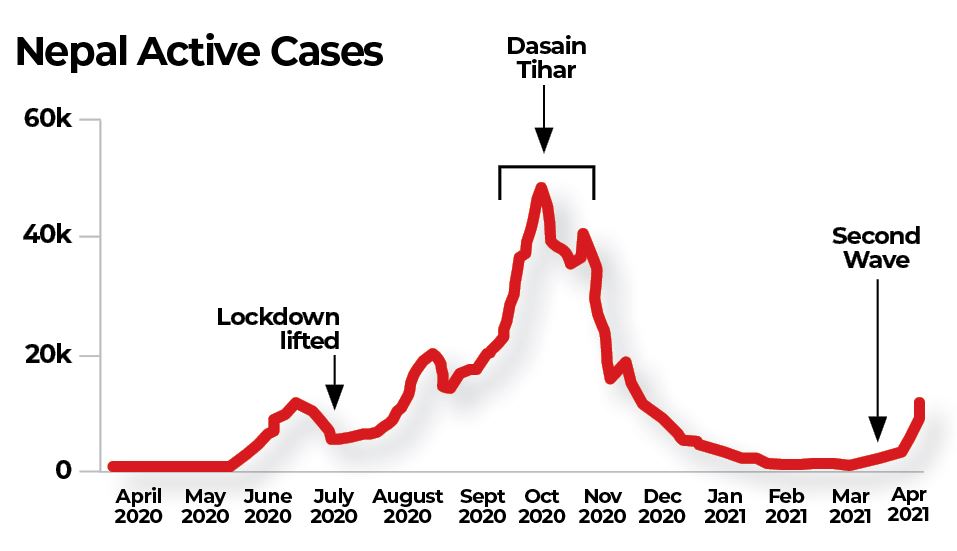
On Wednesday, Nepal’s positivity rate was 24.5%. On 21 October 2020, when the country recorded its highest daily Covid-19 cases, the figure stood at 28.5%. At the pace the virus is spreading, it will not be long before one-third (or more) of daily tests turn positive.
Neighbouring India with 315,802 new cases and 2,102 deaths on Thursday is a shocking reminder of what is next door, across an open border. People are dying waiting for oxygen, hospitals are filled to the capacity, and drugs are in short supply.
It is too late for India to vaccinate its way out of this surge, and major cities have resorted to lockdowns and curfews again. This is not a second wave anymore, it is a tsunami. And, as we saw last year, the wave is lapping at our border.
Yet, here in Nepal, people are going about their lives as if there is no public health emergency. One might even say Nepalis are going out and about with vengeance, unmasked and crowding in markets.
The government has more or less surrendered to the virus, and is putting the onus on citizens to protect themselves. It has shut down schools for a month, but there are still political rallies and festival throngs. Even king Gyanendra coming back from the Kumbh Mela with the virus, and celebrities like Madan Krishna Shrestha testing positive, does not seem to deter the public.
Looking at the numbers, it might look like current active cases are far below the daily average back in October. But the rate of infection is much steeper in the second wave.
We have all but forgotten how during lockdowns, pregnant women couldn’t go to hospitals and how there was food insecurity and the crushing economic fallout.
Lack of preparedness at the border checkpoints, minimal contact tracing and chronic limitation of health institutions persist.
Health Minister Hridayesh Tripathi has reassured the public that there will not be another lockdown if people are more careful. Prime Minister K P Oli in his New Year message said if the public took precautions, a new lockdown could be avoided.
Nepal’s economy was just beginning to recover from the impact of the earthquake and blockade six years ago when the pandemic hit. The tourism sector will now need at least five years to recover, joblessness is at its peak, manufacturing is still seeing negative growth, and agriculture yield will likely decline after a prolonged winter drought.