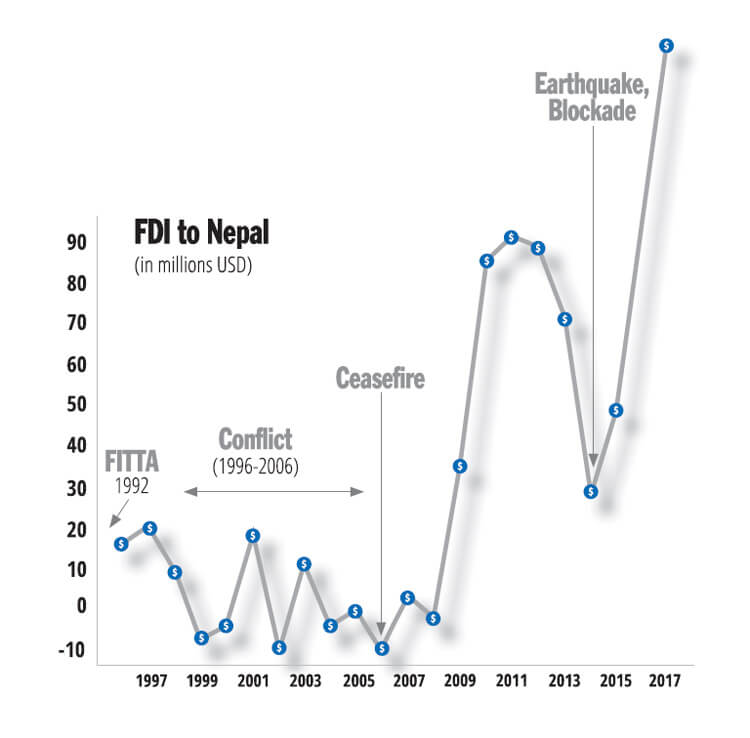
After adopting a liberal free-market policy, passing the first Foreign Direct Investment (FDI) Act in 1992, despite the end of the conflict, and after many ups and downs, FDI never really picked up. Why?
By 1994, some 1,180 new factories were registered and in the four years between 1992-1996, foreign investment commitments increased 10-fold. But the Maoist war started, foreign investors were directly targeted, many closed shop and left, and those who stayed did not expand.

Read also:
Invest in investment, Editorial
Today, more than a decade after the decade-long war, Nepal has political stability but the economy remains stagnant. Nepal received less than $167 million worth of FDI in the first seven months of the new government assuming office – one-third of the amount received during the same period last year. There was a mere $400 million worth of FDI in the last five years.
In the World Bank’s Ease of Doing Business List of 2018, Nepal dropped five spots to 110th position among 190 countries. The Bank cites administrative hassles, a complicated tax system and structural problems as major impediments to investment.
“If we do not change ad hoc regulations at all levels and reduce red tape, it will be foolish to expect more foreign investment,” says FNCCI vice-chair Umesh Lal Shrestha. Former vice-chair of the National Planning Commission Dipendra Bahadur Chettri adds that while the laws and regulations have changed for the better, the proof of the pudding is in the implementation. The bureaucracy is still investment unfriendly.
Read also:
Nepal, Inc., Suman Joshi
A roller coaster ride, Shyamal K Shrestha
Added to it is a pervasive rent-seeking culture among policy makers and civil servants at every level. It is common knowledge that government secretaries do not issue licenses unless they get a kickback. The Melamchi Water Supply Project is stuck in its final stages because the contractors refused to pay off the secretary. Officials of the Nepal Electricity Authority (NEA) in collusion with private cement companies, shut off power to state-owned Udaypur Cement.
“How do you expect businesses to come to Nepal when the first thing officials ask for in an investment meeting is their share?” asks Shrestha.
Bureaucrats compete fiercely for lucrative positions in the Industry Registration and Licensing Section, the Foreign Investment and Technology Transfer Division, and Office of Company Registrar because that is where they can shake down investors.
Read also:
How Nepal can invest in improving the investment climate, Anil Chitrakar
Nepal is also seeking to graduate from its Least Developed Country status to Developing Country status by 2030, but that is unlikely, without achieving the UN’s Sustainable Development Goals, which in turn will require an annual foreign investment flow worth $15 billion because experts say national resources alone will not suffice.
A sluggish bureaucracy and corruption, however, have sent the wrong message to the outside world. Large projects like Melamchi are perennially stuck; the 216MW hydropower project on the Trisuli is yet to begin, eight years after the Korean South East Power Company began work, having already invested Rs6 billion. In contrast, a 102MW hydropower project started four years ago by the same Korean consortium in Pakistan is nearing completion.
General Manager Giriraj Adhikari says: “We are ready to go ahead with the project but officials are taking their time to decide on hedge fund issues. When will that be? No one knows.”
Read also: Overseas Nepalis not impressed, Sewa Bhattarai
The worst precedents were set by the Norwegian company SN Power pulling out of the 650MW Tamakosi III project in 2013 because of the lack of political will on the part of the government, and Australia’s SMEC gave up on the $1.5 billion West Seti Project after trying for 15 years. China’s Three Gorges also withdrew from West Seti due to lack of agreement on a power purchase.
The Finnish company Nepwaste had a proposal to solve Kathmandu’s waste problem and generate electricity with an incinerator project, but is reluctant to advance, first because senior politicians wanted a cut and then because Kathmandu Municipality asked the Finns to deposit the total annual salary of all its workers in its bank account to begin.
Eighteen other large projects involving Chinese and Nepali contractors are in trouble after a Chinese government-owned insurance company reported uncertainty about return on investment in Nepal. Nepal has no policy yet on sovereign guarantee.
Other foreign investors are frustrated by the government’s failure to provide basic infrastructure like roads, power and water. Without a transmission line, Chinese-backed Hongsi Cement is using a 25MW diesel generator.
Read also: Early investors didn’t sell Nepal short, Lisa Choegyal
Napoli Nepali, Kunda Dixit
It is not just the government that is working at cross-purposes to create obstacles for foreign investors, Nepal’s protection-minded private sector is equally to blame. Nepal’s cement cartel tried its best to stop Hongsi from setting up its plant, and was only successful after allying with Shivam. Another Chinese cement company Hwasin is setting up a plant, but only after partnering with industrialist Suraj Vaidya.