
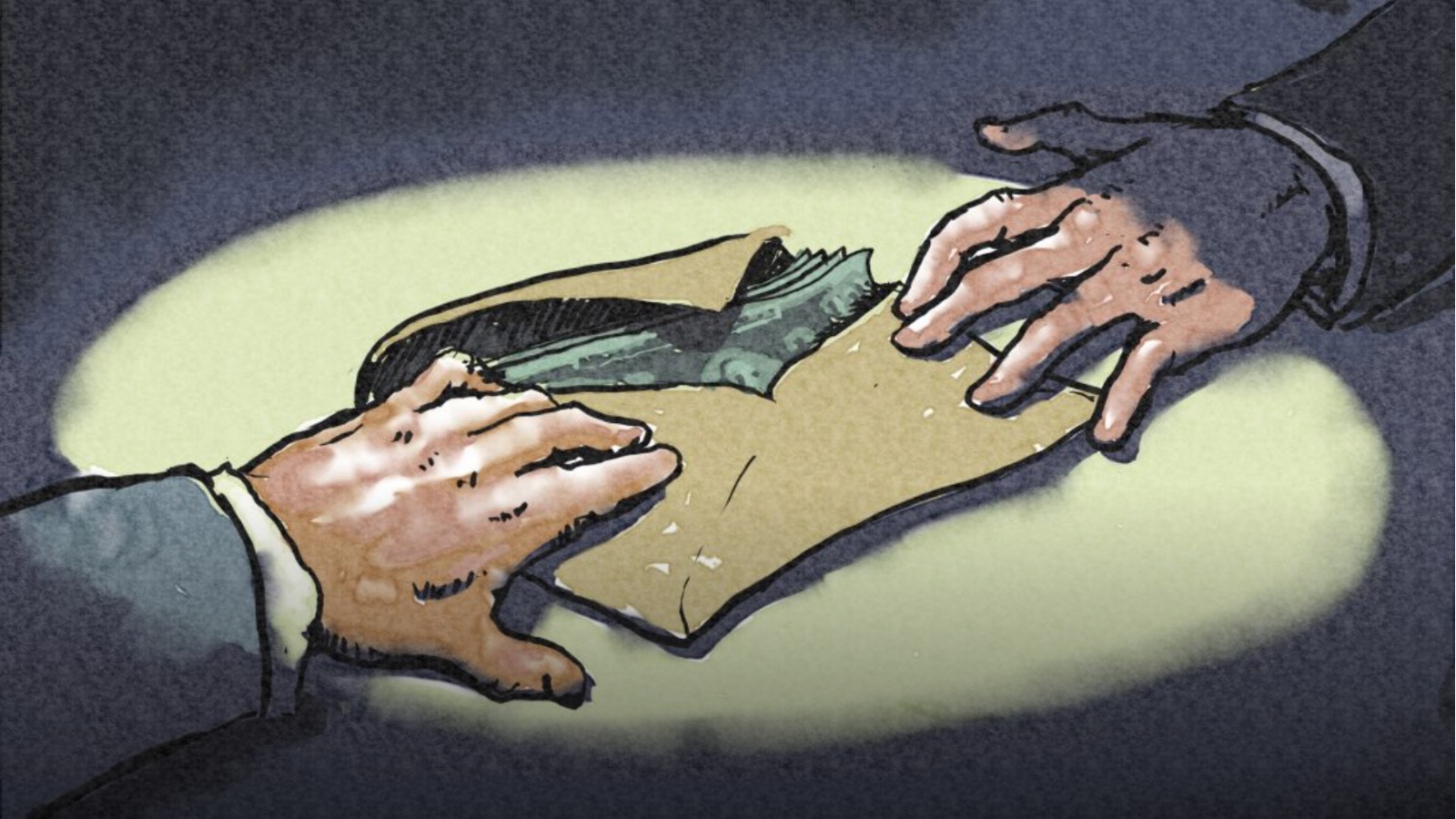
Last September, contractor Sujan Poudel filed a complaint at the Commission for the Investigation for the Abuse of Authority (CIAA) against police deputy superintendent Shyam Kumar Rai, accusing him of soliciting a bribe. The CIAA decided to catch Rai red-handed in a sting operation.
A month later, Poudel went to Rai’s office and surreptitiously planted Rs140,000 in cash in the police officer’s drawer. Immediately after, officials from the CIAA who were hiding outside barged into the office and arrested Rai.
The media ran the news: ‘DSP Rai arrested with Rs140,000 bribe money’. The CIAA took Rai under custody and filed a corruption case at the Special Court. In his statement, Rai accused Poudel of framing him because he had taken action against the contractor for illegal sand mining and quarrying.
As evidence, the CIAA had submitted a video footage of the cash in Rai’s drawer. But when police examined the video, they found that the CIAA team seemed to know exactly where to look for the cash. “Take out money from the drawer,” a member of the CIAA team is overheard saying.
The Special Court analysed the video, and ruled that Rai had indeed been framed by Poudel. The justices said in their judgement: “It seems the CIAA has worked at the behest of special interest groups unhappy with a strict ban on illegal sand extraction,” said one of the judges of the fast-track court established to deal with corruption cases.
Pralhad Dhital, an assistant forest officer of the Kavre District Forest Office, was attending a training organised in Kathmandu last month when Jagatlal Tamang, an entrepreneur of Kavre, repeatedly telephoned him asking for a meeting. Tamang came to Kathmandu and the two went out to a cafe. At the table, Tamang abruptly put Rs20,000 in Dhital’s hand, and suddenly CIAA officials lurking nearby pounced on Dhital.
The media reported: ‘Kavre Forest Official Caught Red-handed accepting Bribe’.
Tamang later confessed that he had indeed decided to frame Dhital after he refused permission to fell 56 pine trees in a private property. He added that CIAA officials helped him write his application and showed him how to carry out the sting operation. As with many other cases, Tamang framed Dhital with the active collusion of the agency mandated to fight corruption. Dhital was suspended from his job.
Not only does this show that media headlines about corruption may be misleading, it has also exposed questionable practices at the CIAA. Records show that the anti-corruption agency is regularly using sting techniques in petty offences to catch small-time criminals. Last November the agency arrested traffic policeman Nabin Kumar Jha of Dhanusha, while receiving a Rs1,000 bribe. Jha was arrested shortly after receiving ‘bribe’ planted on him by a CIAA driver.
In Kaski the CIAA’s Pokhara Regional Office acting on a complaint, planned a sting operation against land revenue officer Dipak Subedi by getting an official posing as someone needing a job done. Subedi was caught while accepting a Rs3,000 bribe from an undercover CIAA official, and agency filed a case against him.
The CIAA has even conducted a sting operation to arrest a messenger at the Land Reform Office in Itahari. In a clear case of entrapment, it offered Arjun Mandal Rs2,000 for a service, which he accepted. He was arrested and charged.
Instead of going after officials and politicians who embezzle billions with impunity, critics say, the CIAA is targetting corruption. They say the agency is carrying out these operations so it can boast about the number of corruption cases it has cracked. Indeed, the CIAA’s annual report for 2018-2019 cites ‘a record number of corruption cases’.
At a press conference in January, CIAA spokesperson Pradeep Kumar Koirala patted himself on the back by saying that the agency had performed “a great achievement” by busting so many corruption cases. Out of 351 graft cases filed by the CIAA last year, 147 were bribery and of these in 40% the accused was apprehended using sting tactics. This year, the number of sting operations has shot up to 181 cases – of which half were cases involving less than Rs25,000 in bribes. Of the total 277 arrested 69 were junior civil servants and 16 were messengers and peons.
“Previously, cases of fake academic credential used to top other corruption cases,” said Gauri Bahadur Karki, former chair of the Special Court, ‘these days, they have been replaced by sting operations.”
Details of the CIAA’s own annual report reveal that the powerful constitutional body that is entrusted with controlling graft and malfeasance in government and ensure good governance is busy with petty bribes, and arresting junior-most government employees.