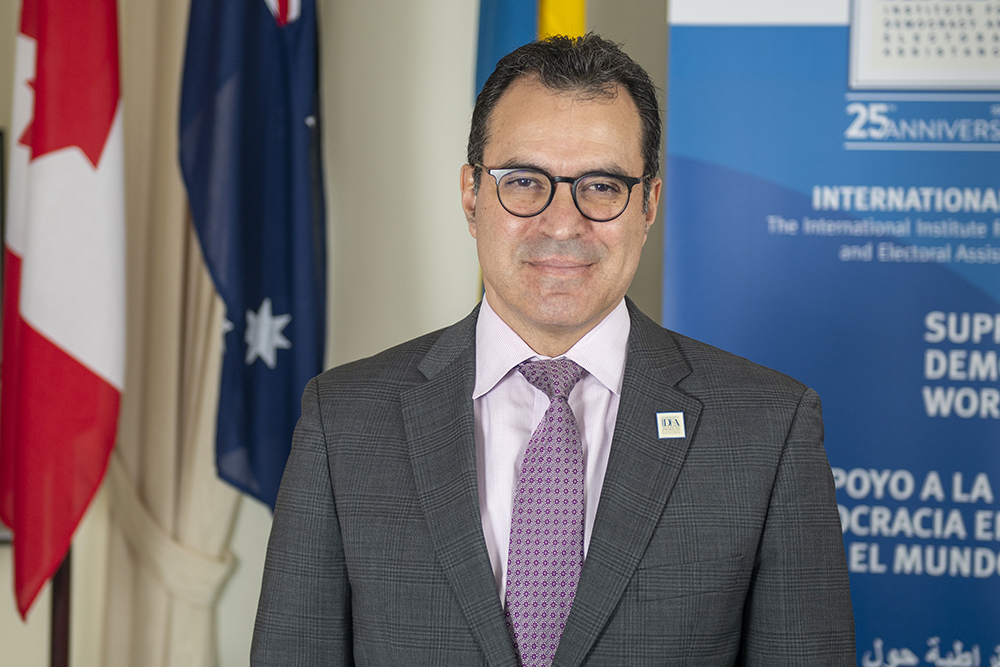
Kevin Casas-Zamora, PhD, is the Secretary General of International IDEA, the Stockholm-based intergovernmental organisation supporting democracy worldwide. He used to be Costa Rica’s Second Vice President and Minister of National Planning and National Coordinator of the United Nations Development Program’s Human Development Report. Nepali Times caught up with
Casas-Zamora during his visit to Kathmandu this week. Excerpts:
Nepali Times: In your recent op-ed for The New York Times, you wrote about democracy in Latin America and anti-corruption populism. You noted that the collapse of party systems would lead to an emergence of outsiders who would accelerate the erosion of democracy. How similar is this scenario to other parts of the world, like Nepal?
Casas-Zamora: It would be very presumptuous of me to start babbling about Nepali politics, but we are seeing a global trend towards the dissolution of the mechanisms that society had created to aggregate social preferences, social demands, like political parties. Latin America might be a particularly acute example, but it is certainly not unique. The World Values Survey covering 80 countries showed the people’s trust in political parties was in the single digits. This is particularly damaging, because one of the big problems that democracy has globally is that democratic communities are being torn apart.
Polarisation is on the rise pretty much everywhere. Disinformation on social media is one of the key centrifugal forces. Inequality is another, and it weakens democratic communities. When political parties are weakened and party systems become fragmented, it becomes very difficult to govern, to build majorities, to implement any kind of agenda. In the end, what do you reap out of that is dissatisfaction. We are seeing a growing gap between growing social expectations, growing social demands and the inability of democratic institutions to respond to those demands. It is in that gap that monsters are growing. And it is in that gap that populism finds fertile ground.
Read also: "Journalism is the frontline of democracy"
When IDEA was established in 1995, there was euphoria about democracy, the Soviet Union had just collapsed, and many thought it was the end of history. Things did not turn out that way. Is there a design defect in the democratic project itself that allows this algorithm-driven populism to gain foothold?
It is an interesting question, and I don’t think so is the answer. The normative case for democracy continues to be very strong. It is the only system that treats people according to their human dignity and respects their agency. That’s not a small thing. But beyond the purely normative argument, there is a very practical one, which is that democracy resolves in an elegant way, something authoritarian systems have great problems resolving: the issue of succession. Democratic systems also have the ability to self-correct. This is really the essence.
And this is where the real value of democracy in practice lies. The pandemic proved very telling in that respect. Three years ago a lot of people blamed the faulty performance of democracy and the messiness. And sure enough there were democracies that performed very poorly, others that did better. But there was this sense that well, democracies are not up to the task, when it comes to a very acute crisis. They’re not efficient enough to respond to the problem, whereas in China, they are very efficient and they do what needs to be done. Well it turns out the performance of democracies with regards to the pandemic is looking much better than it did three years ago. And the performance of China with regard to the pandemic is not looking nearly as good. That’s down to the ability of democracies to self-correct.
If you live in a democracy, and you don’t like the policies that are being enacted in four or five years, you’re going to have a chance to throw the rascals out. You may or may not succeed, but you have that chance. Living under an authoritarian system is like playing the roulette. You might be very lucky, and end up with Lee Kuan Yew and you do great. But you might not be so lucky and end up with Idi Amin.
Still, we need to rethink democracy for a new time. If you take the basic design of democratic institutions, the emergence of political parties about 100 years ago, it hasn’t changed much for the past two centuries. You have this dissonance between the speed and the scale of social change over the past century, and the relative lack of institutional innovation in democracy over the same period. It is time to rethink representative institutions.
One concrete example could be citizens assemblies, selected randomly that are given the task and the information to study an important problem for society and then they are expected to make recommendations, which are then taken up by the political system. They've used it for abortion in Ireland, in France for environmental issues, and that is the kind of innovation that needs to happen.