
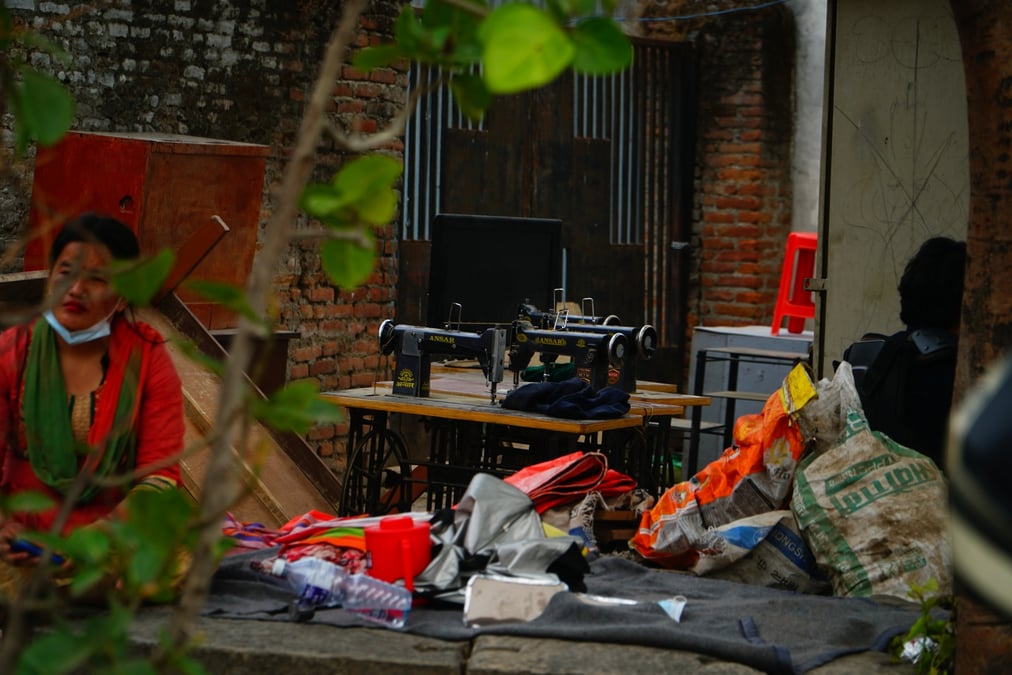
A month into his prime ministership Balendra Shah, who is also handling the Defence and Home Ministry protfolios, sent in security forces on a massive demolition drive of squatter settlements along Kathmandu’s riverbanks.
He had tried to do this as mayor of Kathmandu, but had been thwarted by protests and obstruction by the UML-Congress-Maoist coalitions. As a prime minister who leads a near two-third majority, he has more power now to raze what he sees are strongholds of the legacy parties.
Public reaction is mixed. A fierce propaganda battle is raging in cybersphere between pro-Balen content creators who praise the prime minister’s decisiveness and ridicule fake squatters who own property, and those who see it as a gross violation of human rights.
The government says it is identifying the ‘genuinely landless’ and will relocate them. But reporters say police forced them to delete images of families in flimsy shelters taking cover from Wednesday evening’s storm.
Before the election, the RSP’s Rabi Lamichhane had said the would stand between a bulldozer and the genuine landless if they were evicted. But Prime Minister Shah did not make any distinction when he issued his orders to level settlements this week.
Shah is said to have acted on the squatters without consultation within his party or with the local government.
“The ethos of this government seems to be move fast and break things, but that's not how an elected government works, says analyst Ashutosh Tiwari. “They don't have to do everything in 100 days.”
Critics and activists have questioned why the political leadership chose to begin with demolishing settlements before identifying, relocating and providing alternatives for landless Nepalis.
“The issue of landless Nepalis is tied to housing, employment, discrimination, poverty— it is a microcosm of everything that is wrong in Nepal,” says Tiwari. “The government was able to evict the people safely compared to the last time this happened in Kathmandu, but the decisions made were after the fact and ad hoc, and showed immaturity, haste, and a lack of understanding of complex issues.”
The Prime Minister now wants to take his demolition drive nationwide to squatter settlements along highways and national parks, and has even instructed the Nepal Army to collect data.
For critics, the prime minister is still acting as if he is mayor and pursuing showcase urban beautification as visible proof of his resoluteness in order to appeal to the middle class.
Says political scientist Sucheta Pyakuryal: “A politically mature and administratively well-versed government would not have begun with dismantling before having proper plans and programs in place to accommodate the poor, these actions do not speak very well of this leadership.”
She adds, “The state is everybody’s agency, and it is up to the state to protect the fundamental rights of all Nepalis.”
PM Shah’s decision to unleash bulldozers on slums is symptomatic of a deeper ideological dichotomy — not just between the leaders of the party, but also between the RSP’s own electoral platforms.
There have been other puzzling decisions. Provisions of a draft NRN Bill does not deliver on the RSP’s progressive election pledges and has angered overseas Nepalis who had mobilised support for the party in the election.
The RSP manifesto promised citizenship by descent, and friendlier economic and investment provision, and streamlining the NRN card process. But the proposed draft does not seem to make any mention of citizenship, and includes a one-house ownership limit as well as a 50% tax on the sale of inherited ancestral property.
“RSP saw a lot of value in and capitalised on the NRN voice in the election, and promised them extremely liberal policies regarding for citizenship and investment, but the draft overshadow even existing constitutionally guaranteed-rights to the NRN,” says Pyakuryal.
“Going back on promises made during elections by a party that rose to prominence selling old parties’ lies and lack of accountability can impact RSP’s popularity," says Pyakuryal.
While Nepali migrant workers prop up the economy with remittances, NRN could be a source of investment back home. Says Tiwari: “This draft bill adversely affects the dynamic between Nepali diaspora and the government. Their investment could be much larger than the taxes they pay.
Even within Nepal, raid-style arrests in recent weeks of big corporate figures without proving guilt has shaken private sector confidence, hurting the investment climate. Analysts say this indicates that one arm of the RSP does not seem know what the other arms is doing, and the two are working at cross purposes.
The government’s attempt to bypass Parliament and issue a slew of ordinances even when it has a near supermajority, has also invited criticism — and not just from opposition parties.
Law Minister Sobita Gautam has justified the move saying it needs to act quickly to amend the Constitutional Council Act so that the Chief Justice and others can be appointed with a simple majority.
“By trying to govern through ordinance, the RSP has bypassed both the House and its own lawmakers who form the majority in the House. RSP has, in the past demostrated lack of democratic practices especially during decision-making processes," says Pyakuryal.This feel like showcasing of the same undemocratic culture."
Many have pointed out RSP Chair Lamichhane’s previous public expression of disdain at the rule-by-ordinance tactics of previous governments.
Analysts note that all this is an indication that aside from populist platforms, there is little ideological similarity between Lamichhane and Shah.
“There are fairly well-established procedures in the parliamentary process, by trampling upon those procedures, RSP raises doubts and negatively impacts its reputation,” says Tiwari. “The ordinances are tied to how Oli operated, and now that the government is using Oli’s playbook, the public that gave the party the mandate have questions.”
There are questions about whether policies and decisions are even discussed , in Cabinet meetings, or simply handed down by the Prime Minister.
So far, as chair of the RSP Lamichhane has been careful not to publicly disagree with the prime minister’s decisions. In an interview with Khabarhub this week, Energy Minister Biraj Bhakta Shrestha said that the PM had a ‘non-interventionist approach’ in his Cabinet, and that despite the public narrative, there was ‘strong coordination’ between the PM and the party leadership.
But some of the frustration among party leaders is seeping out. RSP lawmaker Ganesh Karki posted: ‘Whether or not it was a necessity for a party with a near two thirds majority suspend the Parliamentary session and issue ordinances, might be clear later, but this is not a courageous act.’
Karki continued that the ordinances followed the letter of the Constitution, but not its spirit. ‘The letter of the constitution should not restrict its spirit,’ he added.