
Aside from second-guessing what will happen in the restored Parliament on Sunday, the major past-time of urban Nepalis these days is to speculate about the country’s violatile stock market.
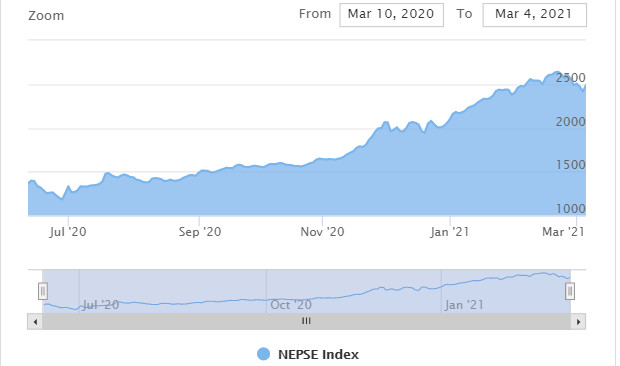
Dring the past six months, the Nepali Stock Market (NEPSE) has soared, which immediately begs the question: is a fall imminent?
The NEPSE Index is at a record high market capitalisation, which is the total value of shares listed in the stock market. Daily turnovers have started crossing the Rs10 billion mark, invetors seem to be raking it in.
All this has happened at a time when the economy is being battered by the impact of the pandemic, which has led to heated debates over whether the market is in a bubble and likely to crash, bringing ordinate ionvestors down with it.
Current highs are the combination of several factors:
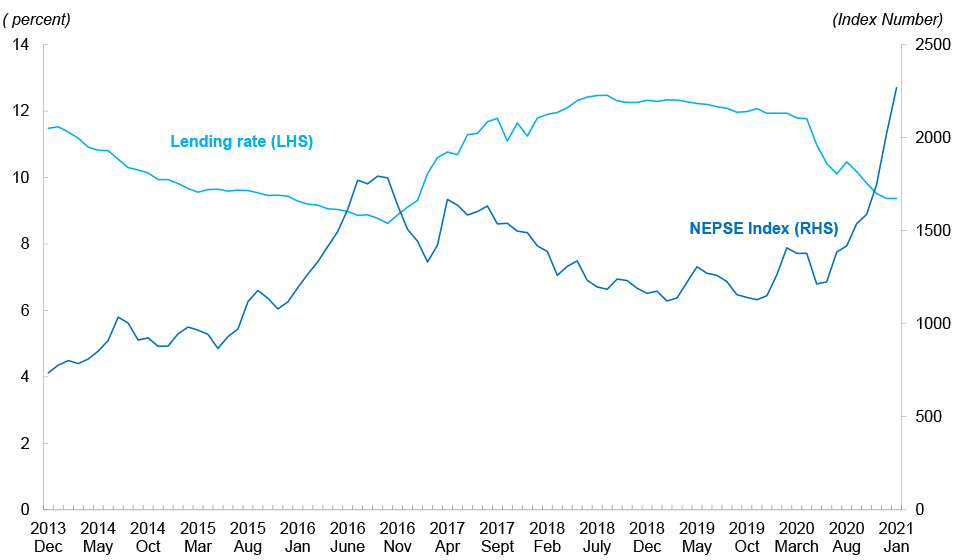
- Low interest rate (see figure 1)
- High liquidity in the banking system
- Dematerialisation (conversion of physical certificates to electronic units) of shares
- Restrictionof ‘kitta-kaat’ in real estate
- Fear of missing out (FOMO)
Low share prices between 2017-2019 have been attributed to the appointment of Yubraj Khatiwada as finance minister. He famously (or infamously for investors) once remarked that investing in stocks was “not productive”.
One factor that has gone relatively unnoticed but has been a game-changer is the advent of ‘online trading’. The possibility to make transactions through the online banking system has ushered in a new breed of investors. Online trading has made the Nepali stock market easily accessible to the public, who can now trade from their living room instead of going to a broker office or bank to make a payment.
This trend was starting to be reflected in the data before Covid-19 gripped the country (figure 2). From October 2019 to February 2020, the number of monthly share transactions doubled from an average of 200,000 to 400,000, which pushed the NEPSE Index to the 1,600s, despite relatively higher interest rate hovering above 11%.
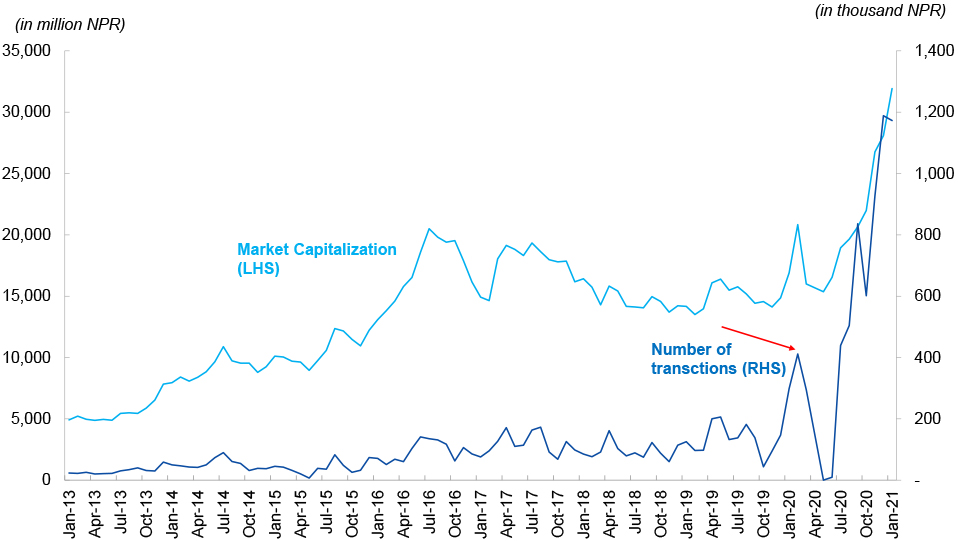
Following Covid-19 restrictions, the number of transactions further increased and reached a whopping 1.1 million per month in recent months. This reflects the unprecedented entry of retail investors who, with a click of a mouse, can invest money that otherwise would be sitting idle, earning savings account interest rates.
This increased participation and diversification of the investor base is also reflected by the data on stock market penetration. DEMAT accounts have increased from 800,000 in mid-July 2017 to 1.4 million in mid-July 2019, and is currently estimated at 2.5 million -- about 8% of Nepal’s total population.