
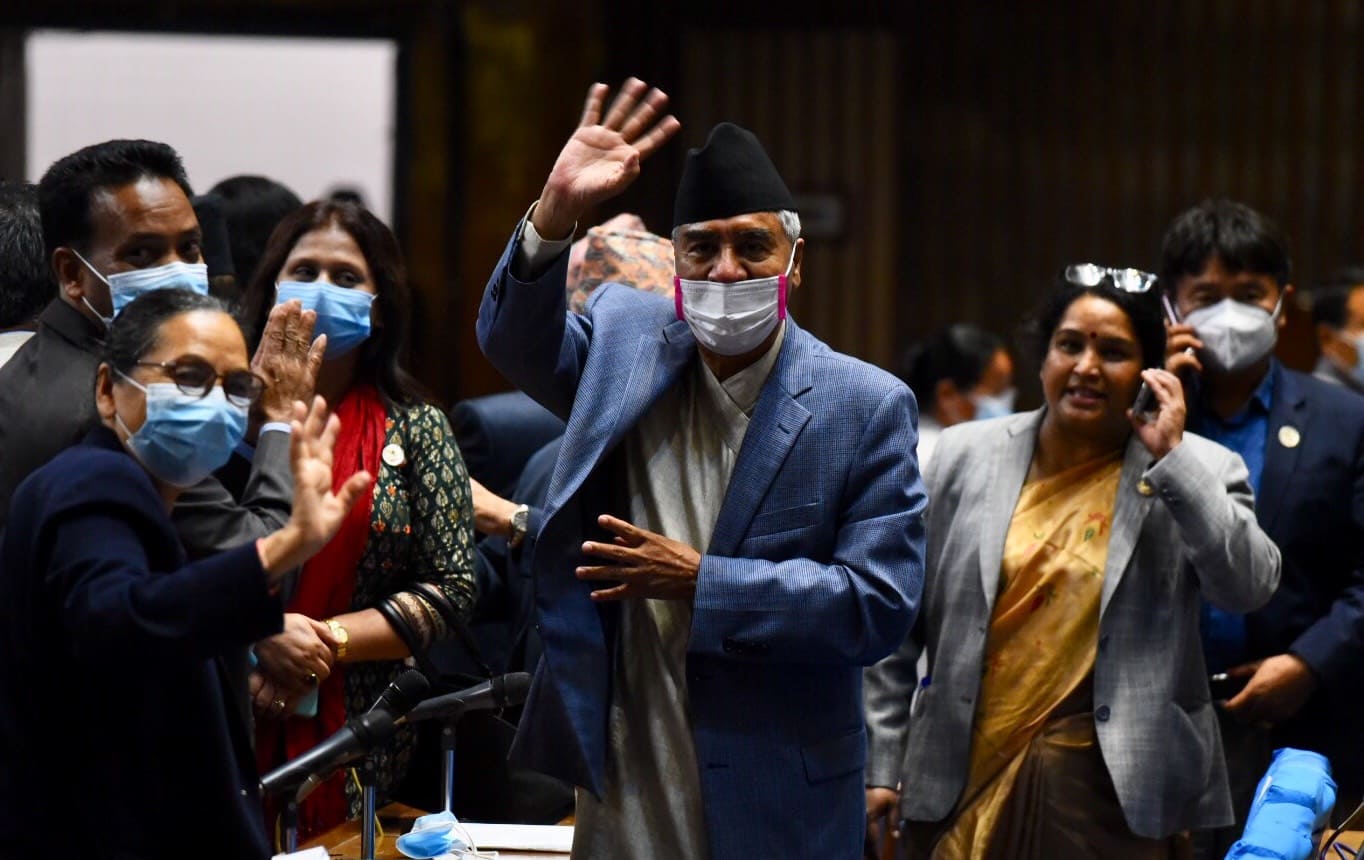
On his first anniversary in office this month, Nepal’s five-time prime minister Sher Bahadur Deuba and his coalition governments get a mixed report card.
Deuba came to power by riding on an internal feud within the leadership of the powerful Nepal Communist Party (NCP) that ruled the country after the UML and Maoists together won the 2017 polls. As the NCP disintegrated, so did the UML, and Deuba replaced K P Oli in July 2021.
It has been a chequered year for Deuba. On the plus side, more than 90% of Nepal’s eligible population is fully vaccinated against Covid-19, the American-aided MCC project got ratified by Parliament after a bruising political battle, local elections were held.
However, just as Nepal was emerging from the Covid-19 pandemic, it plunged headlong into an economic crisis spawned by Russia’s invasion of Ukraine. The economy is in bad shape.
The 5-party coalition in its first cabinet meeting had given itself ten targets that included post-Covid economic prosperity, strengthening the federal democratic system, disaster management and equitable access to public services.
But perhaps the biggest achievement of the Deuba administration has been the relatively successful conduct of local polls in May which was held in 752 local constituencies with 35,045 representatives elected. Holding elections in time should not be regarded as an ‘achievement’, but we have to remember that Deuba had to convince both coalition partners Pushpa Kamal Dahal of the Maoists and Madhav Nepal of the CPN-Unified Socialists who were reluctant about polls because they thought their parties would lose.
Deuba even managed to convince Netra Bikram Chand, erstwhile separatist C K Raut, and Resham Chaudhari who had been expelled from Parliament on allegations of involvement in the Kailali massacre of 2015, not to disrupt the voting.
But Deuba’s second singular achievement was to steer the $500 million MCC infrastructure grant through House ratification despite the political polarisation that it had created. The MCC was stuck in Parliament repeatedly when the NCP with its near two-thirds majority was in power, but Deuba’s deserves credit for deftly manoeuvring the bill through the House.
The MCC was not just important because of the size of the grant, but because the future of Nepal’s hydropower development, distribution and possibility of future export of surplus electricity to India depends on it.