
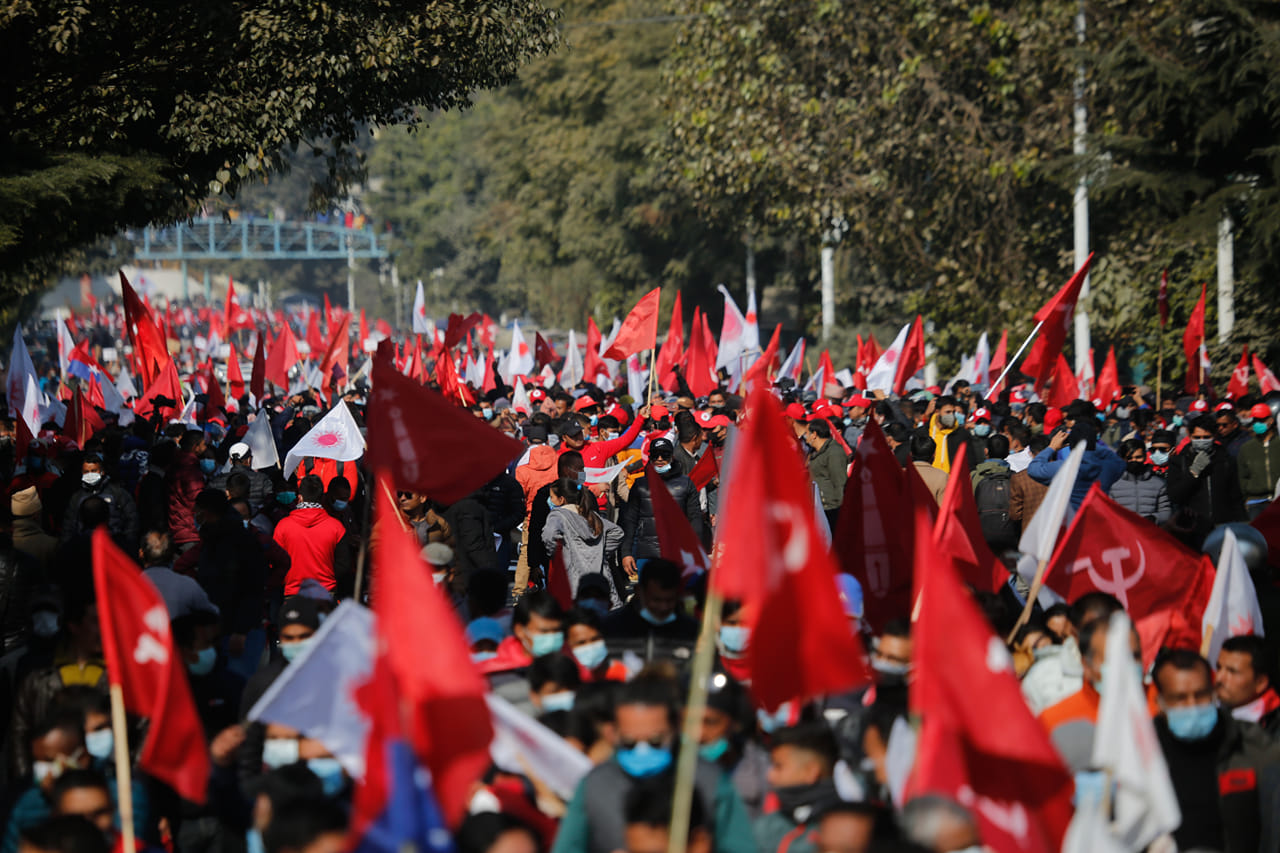
Communist parties the world over are obsessed with anniversaries. October Revolution Day, Mao Zedong’s Birthday, North Korea’s Day of Victory in the Great Fatherland Liberation War, etc.
In Nepal, the Maoist party used to commemorate its ‘People’s War Day’ on 13 February with much fanfare. This year, except for a book launch by former Maoist ideologue Baburam Bhattarai, the anniversary went largely unmentioned and unnoticed.
Perhaps it was intentional, since the warring sides now represent the state, and the Maoists who were till 2006 executing UML cadre, have joined hands in the NCP. They are each other’s throats again, but that is another story.
For the former guerrilla commanders, this is no time to rake things up and mark the anniversary of an armed struggle that ended up killing more than 17,000 Nepalis in ten years.
It was on the night of 13 February 1996 that a group of Maoist guerrillas led by Nanda Kishore Pun and Barsha Man Pun crept up a mountain and attacked a police post in Holeri of Rolpa district. Nanda Kishore Pun is now vice-president of the republic, and Barsha Man Pun was till December Energy Minister in the NCP government.
The ‘revolution’ began a day before Valentine’s with simultaneous attacks on police stations in Gorkha, Kavre, Sindhuli. A week previously, Bhattarai had handed over a list of 40 demands with a two week ultimatum to Prime Minister Sher Bahadur Deuba. Among them: a ban on Hindi movies, scrapping of the 1950 India-Nepal treaty, stopping Gurkha recruitment and curtailment of the power of the monarchy.
Deuba ignored the demands, most of which were beyond his power to fulfill. In any case, the Maoists had no intention of waiting two weeks, and launched the attacks with World War I vintage rifles and khukri.
Deuba was too distracted with infighting within his Nepali Congress party, and ignored the escalating violence in the countryside. When he did react, police retaliation was so brutal and arbitrary it ended up pushing ordinary people, who had wanted no part in the war, into the Maoist fold.
The Maoist rationale for armed struggle was the belief that feudalism was so deeply entrenched in Nepal that parliamentary democracy was no solution. A Mao-style protracted armed struggle was needed to counter the structural violence of the state. This was partly true. The state apparatus had tried to ensure in successive elections in the early 1990s that Samyukta Jana Morcha, the electoral front of the Maoists, would not be able to expand its presence in the party’s stronghold in the mid-western mountains.