
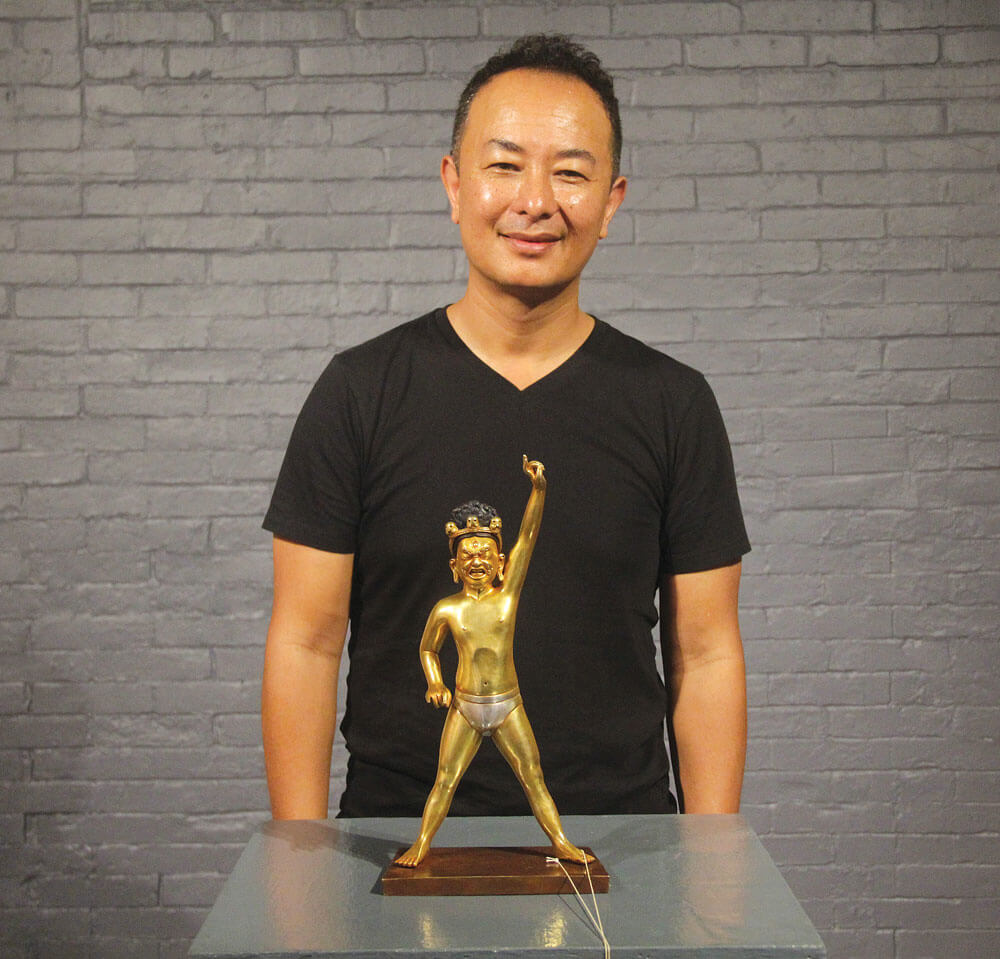
Surrounded by overwhelmingly large ‘Sale’ signs is a tiny object in a large hall. Ang Tsherin Sherpa’s golden statue of a Tibetan deity in underwear is literally the object in focus at an exhibition at Taragaon Museum this week, part of the ‘Object in Focus’ series, designed to give viewers the opportunity to understand art in depth.
“When we are surrounded by many exhibits, we often cannot digest what it all means. So this is our effort to delve deep into an important piece of art,” says museum curator Roshan Mishra. US-based Nepali artist Sherpa is the third artist featured in the series.
Sherpa’s statue presents many interesting facets to explore: its face, hair and headgear are those of a Tibetan Buddhist deity. But instead of wearing the usual finery, it is attired like a modern superhero, and poses with one arm thrown in the air, Superman style.
This piece ‘…and the winner is’ is a replica of Sherpa’s 2D work Victory in Spirit, but the actual metal casting was carried out by Shyam Maharjan, a traditional craftsman from Kathmandu.
Read also: The world beyond thangkas, Smriti Basnet
Sherpa’s work carries on his previous tradition of mixing traditional and modern art. Coming from a family of renowned thangka painters, Sherpa himself trained as a painter from the age of 13, and worked with his father on murals and monasteries for almost 20 years. He migrated to the US and painted there, also giving classes on traditional painting. That was when western art motifs began to infiltrate his work.
Sherpa’s later works have depicted ancient deities caught in the modern world: gods in non-traditional poses, wearing western outfits, trying to break out of little boxes, shuttered inside claustrophobic modern motifs and trying to be heard amid the cacophony.
The 3D work at Taragaon Museum fits this mould, but Sherpa does not want to talk about what it means. “To me, the pose symbolises a subjugation of negativity, it’s about hope,” he said at an interaction at the museum. “But I don’t want to attribute a particular significance to it. I would rather let viewers explore their imagination.”
Read also: US-Nepali Art, Sonia Awale
Instead, Sherpa wants to talk about traditional art and his role in promoting it. “I used to work for months on a thangka piece, but then clients would ask why they should pay $3,000 for it when they can get a thangka for $200. The ordinary customer does not know the difference between real traditional art and souvenir art. Artists often fall prey to these market forces and are forced to compromise on quality,” he says.