
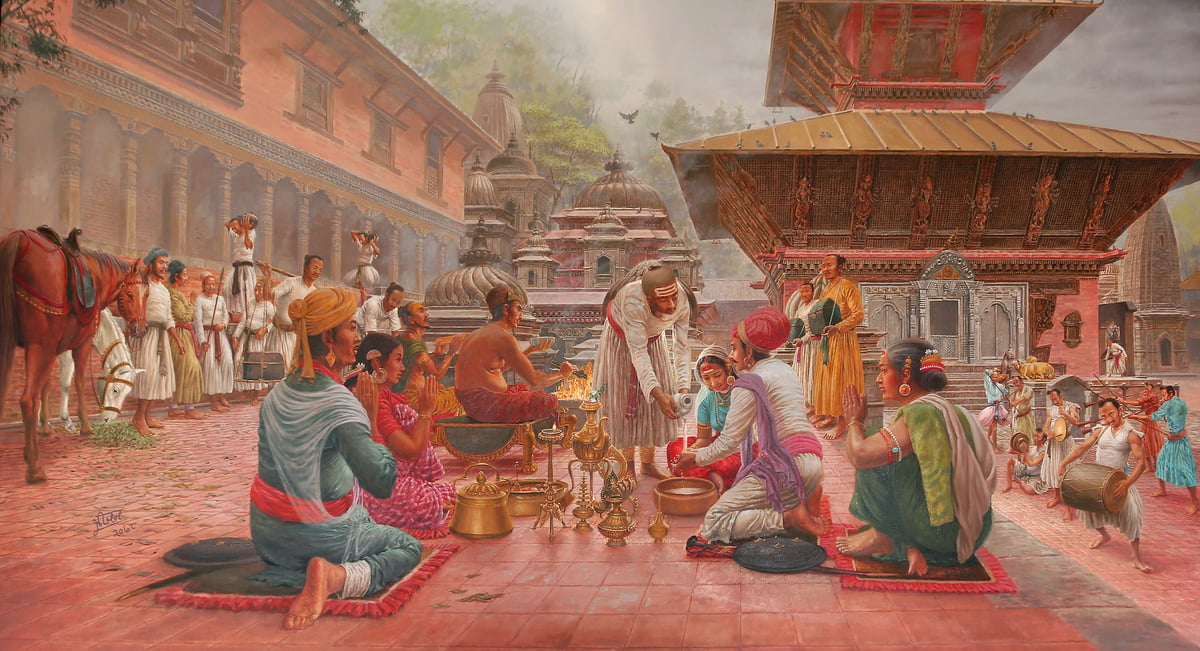
Contrary to popular belief, Nepal as a nation with different boundaries was founded way before the unification by Prithvi Narayan Shah. From the time of the Gopal dynasty before the birth of Buddha and after, Nepal has seen many dynastic rulers including Kirat, Licchavi, Verma, Thakuri, and Malla, each with their significant contributions to nation-building.
Unfortunately, much of history before the Shah dynasty is not talked about. Discounting the Shahs, the Malla era is perhaps the best recorded. But even then, not much is known of its rulers before Pratap Malla.
Historians credit Jayasthiti Malla of establishing this dynasty with the unification of Kathmandu Valley. However, our documentation and archaeological research of the early Malla period is scant, and thus a king whose great deeds have created a legacy of Nepal’s culture and socio-economic foundations, is not given his due recognition.
This painting by artist Shreejan Rajbhandari is based on the research of the late historian Dilli Raman Regmi and the event is noted in Gopal Raj Vamsavali, a 14th-century hand-written manuscript of Nepal. It is an artistic tribute to a king who established the longest reigning dynasty which is still integral to Nepal’s identity today.
Jayasthiti Malla was a man of noble but obscure lineage who came from Simraongadh, Tirhut in present-day Tarai. His rise to power indicates the strong historical ties between Kathmandu Valley and the southern plains at the time.
When the Muslim sultanate of Bengal invaded Tirhut, King Harshinga Deva of Simraongadh died while trying to escape. His queen Devala Devi, who had ties with the Bhaktapur royalty, fled along with her son Jagat Singh and took refuge at the Bhaktapur palace under the protection of King Rudra Malla. But Rudra Malla died shortly after without a male hei and his infant daughter Nayak Devi was declared heir to the throne.
The young queen was married to a prince from Banaras, but he too soon died, after which Devala Devi seized the opportunity to marry her son Jagat Singh to the widowed queen, and thus became part of the Bhaktapur royal family. Nayak Devi later gave birth to a daughter, Rajala Devi, who became a full claimant to the throne.
With a son who was prince consort and an infant granddaughter who was heir apparent, the future of Bhaktapur was fragile with no strong leadership. Nepal with its many small warring kingdoms was in constant strife.
Moreover, in 1349, Kathmandu faced the first Muslim invasion by Shamsuddin Ilyas, the Sultan of Bengal. The valley was brutally attacked, looted and destroyed. The city was ransacked and temples and monuments were plundered including Swayambhu and Pashupati. The Sultan’s invasion lasted seven days and the only temple spared was Changunarayan because the invaders could not locate it.
Amidst all this chaos, Devala Devi was looking for someone with the right traits to lead and bring stability to the kingdom. She found Jayasthiti Malla and brought him to Bhaktapur after being impressed by his insight and dynamic personality.
Devala Devi then betrothed her eight-year-old granddaughter to Jayasthiti Malla in 1354. This union led to Jayasthiti Malla declaring himself the king consort of Bhaktapur after the death of Devala Devi. Eventually, he defeated the Raja of Patan, Jayarajuna and took control of the city. A stone inscription (1392) at the completion of the Kubeswor temple in Patan shows his sovereign status in the city.