A major discrepancy between Nepal government and foreign records of the number of Nepali children adopted in North America and Europe has exposed a trafficking ring that involves various child welfare agencies in Kathmandu.
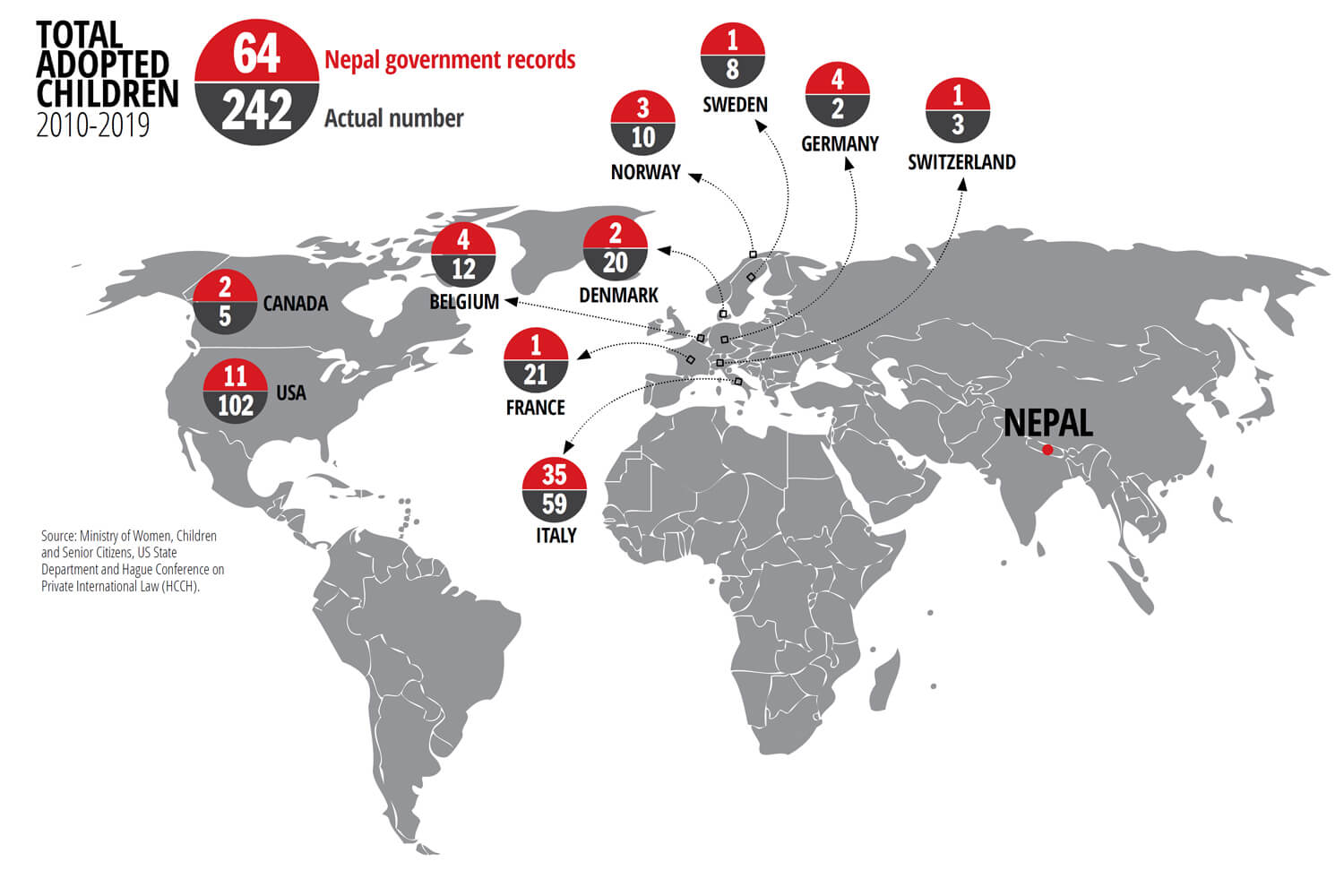
The Ministry of Women, Children and Senior Citizens has records of only 64 children from Nepal sent for adoption to ten western countries from 2010 to 2019. However, a list submitted to the Hague Conference on Private International Law (HCCH) by the US Department of State and the nine other countries reveals that 242 Nepali children were taken for adoption in those nine years.
The ten countries are the United States, Denmark, France, Norway, Switzerland, Canada, Germany, Belgium, Italy and Sweden. There are 178 more Nepali children adopted internationally than the government has records for. Why the discrepancy?
“The data we have is authentic,” maintains Ministry spokesperson Gyanendra Paudel. “We have no idea how the details in other countries showed more numbers.”
Read also: Baby bajar, Anagha Neelakantan
But for Manju Khatiwada at the National Human Rights Commission (NHRC), this is a clear case of child trafficking. She says: “The traffickers produce fake documents and influence both the government officials and parents to smuggle the children abroad.”
Official adoptions by foreign nationals have virtually stopped after reports of corruption and payoffs were publicised in the media ten years ago. But there is a high demand for adoption, especially in western countries, and a plentiful supply of poor Nepali parents who cannot support their children, and this differential drives trafficking. Some parents are also tricked by traffickers into giving up their children.
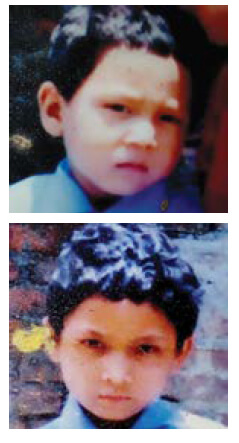
Manju and Bhimsen Khadka from Sindhupalchok used to sell roasted corn by the roadside in Kathmandu. One day ten years ago, a neighbour named Sarita Shrestha and her husband took pity on their three boys, and offered to place two of them, Rajkumar and Balkrishna, aged 8 and 6, at a children’s shelter.
The parents agreed because it would relieve the burden of feeding and educating them. But once the children were taken from them, the shelter’s management repeatedly refused to allow Manju and Bhimsen to visit them, and even started issuing threats.
“I begged them to at least let me see my sons just once, but they said they would finish me off,” Manju Khadka recalls tearfully. The parents lodged a complaint at the NHRC, which started an investigation, and found that Rajkumar and Balkrishna had already been adopted in Italy.
Says NHRC’s Khatiwada: “It is clear that the parents were tricked into thinking their sons would be educated, but they were instead stolen and sold by the shelter, which prepared original-looking fake documents at the Nepal Children’s Organisation in Naxal.”
The NHRC notified the government, saying Bal Mandir had sent the children to Italy for adoption, and recommending that Nepal’s adoption laws and policies be amended to plug the loopholes. It also said a public awareness campaign was necessary to warn parents about child trafficking.
Read also:
Child predators, Sunir Pandey
Looking for a home, Mallika Aryal
After malpractices were uncovered in the 2000s, the Nepal government tightened laws on adoption. According to the ‘Terms and Conditions and Process Required for Approving Adoption of a Nepali Child by an Alien – 2008,’ prospective foreign parents cannot choose the child they want to adopt.
Foreign couples wishing to adopt a Nepali child must apply through a registered international agency or their embassies in Nepal, filling out forms offering details about the age, gender and other particulars that they seek in a child. A joint secretary-led ‘Family Matching Committee’ is then assigned to find the child from shelters. Clause 14 of the Terms and Conditions stipulates that these adoptions will take place on a first-come-first-serve basis.
However, the Hague Conference on Private International Law (HCCH) documents make clear that many adoptions have skipped the whole process. The documents show that Denmark received 20 Nepali children through adoption from Nepal in the last nine years. But government records in Kathmandu show only two children had paperwork to leave for that country. The mismatch is even starker for France, for which government records here show only one adopted Nepali child, but the HCCH records 21 Nepali children adopted by French families.
Numerically, the United States shows the biggest discrepancy. The State Department report reveals that 102 children were adopted from Nepal in the last nine years, but the government’s records here show only 11.
According to the Bureau of Consular Affairs of the US Department of State, an American citizen wishing to adopt a child should be at least 25 years old, and in the case of couples both husband and wife should agree to adopt the child. Prospective parents should not have any criminal background and should meet the criteria of the country from which they seek to adopt. The fact that 91 Nepali children adopted by Americans have no records in Nepal prove that they were transported outside of legal channels. HCCH records show that Norway, Canada, Switzerland, Belgium, Sweden and Italy had similar inconsistency with Nepal government records.