
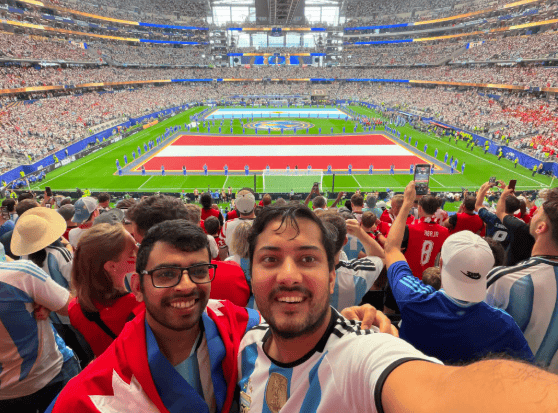
The Jhamsikhel restaurant screening the 2026 World Cup Argentina vs Austria match exploded on Monday night. It was a sea of blue and white striped jerseys, there was wild cheering and many orders for more beers.
At this point in the sport, any semi-serious football fan accepts Lionel Messi as the GOAT, he is indeed the Greatest Of All Time. But there are a select group in Nepalis who have followed him his whole life at Barcelona, PSG and now Inter Miami. For them Messi is just divine.
“I support Messi because he isn’t the flashiest, the tallest, the loudest or the most muscular and yet he has stapled himself as the greatest athlete in the world,” says long-time Barcelona fan Aryan Tamrakar, following the World Cup from Cleveland in the States. “This is not just because of all his statistics. It’s because he does things that the score can barely capture.”
The fascination of Nepalis for Argentina actually pre-dates Lionel Messi. It started with Maradona, and his performance in various World Cups when Nepalis watched the matches on grainy black and white TVs in the backwaters. The star Argentinian player’s humble beginnings, his style and swagger helped, as did the fact that Maradona could almost pass off for a Nepali.
In fact, Nepalis have been fans of Argentina even though this country’s Gurkha soldiers in the British Army took part in the Malvinas War, and saw action against Argentinian troops. The British skilfully used the image of the ferocious fighters from Nepal in a psywar campaign. Colombian author Gabriel Garcia Marquez added to the reputation by describing the Nepali warriors as bloodthirsty.
One reason that Argentina, Maradona and Messi have been popular in Nepal despite the two countries being at the antipodes could also perhaps be that Nepalis like backing underdogs because the country is an underdog itself compared to its giant neighbours.
Messi himself has been at the top of his game for 20 years now, and fans have grown up watching him deliver again and again.
“I started watching football properly since the 2010 world Cup in South Africa and one man was the talk of the footballing world,” says Rishav Rupakheti, who has followed Messi ever since. “He led a historic Barcelona squad to European and domestic success. At the 2014 World Cup I was already a massive fan. I remember his last minute goal against Iran as the point where I truly started to appreciate Leo’s greatness.”
“Every international tournament as a Messi Argentina fan was heartbreak until 2022 when he finally realised his dream,” continues Rupakheti. “It was euphoric, emotional and surreal to finally witness Messi lift the ultimate prize. It has been quite the roller coaster.”
Baibhav Parajuli is so much of a fan that he was called Messi through his high school days playing football, and he waited to have his first taste of alcohol until he visited Barcelona in north-eastern coastal Spain. Parajuli sums up Messi’s popularity: “Simply because there is not a more beautiful player who has ever played the game.”
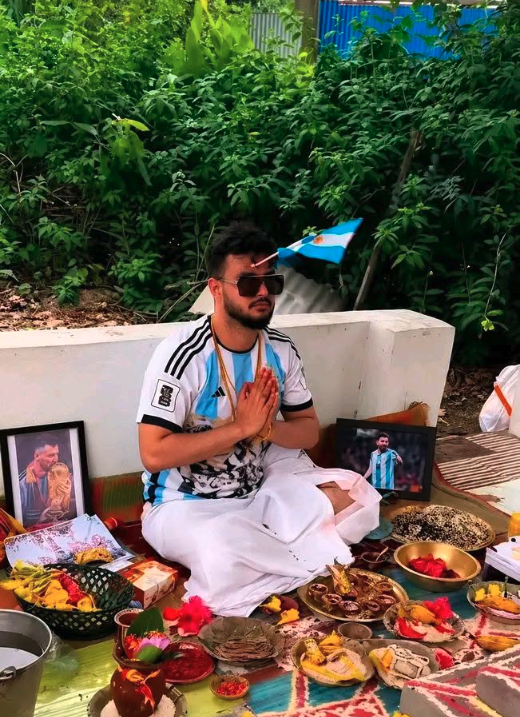
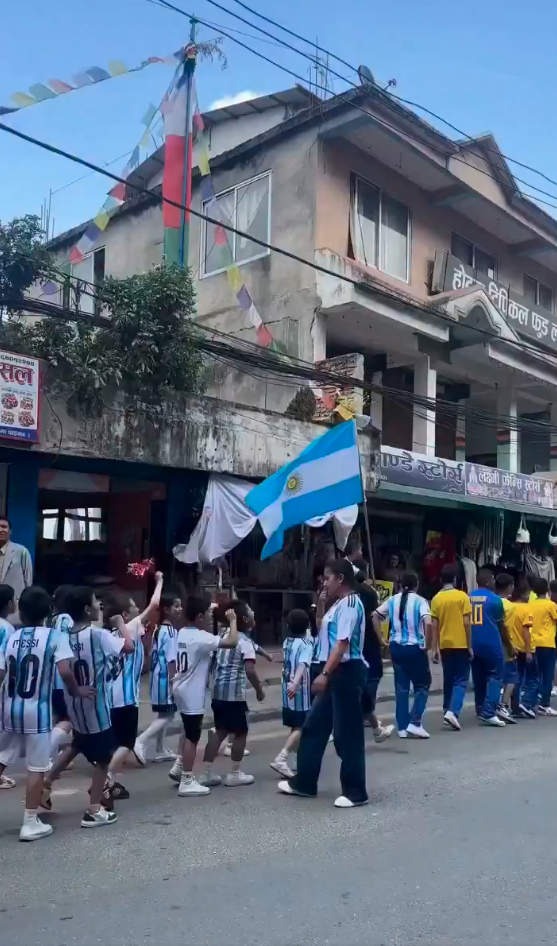
On recent social media post, a man from Jhapa has gone viral for holding a puja praying that Argentina wins the World Cup again. Another video features a long line of school-aged children all clad in Argentina jerseys parading through Dolakha screaming ‘We Want Argentina.’
Commentators are perplexed, calling it the ‘Height of nonsense’, a ‘Gaijatra’, and a waste of parents’ money. Others are happy that the kids are having fun.
MAN OF MATCH
For ecstatic Nepali fans, Lionel Messi’s fifth goal at the 2026 World Cup for Argentina against Austria cemented his GOAT branding. It summed up his genius and his efficiency: from the initial pass to the finish it was an improbable goal that combined creativity, vision and sheer will.
In the sixth minute of added-on time, Messi received a high ball at the half way line, going seamlessly into a dribble towards the right wing. As Austrian defenders tracked back, Messi cut onto his left foot and whipped in a bouncing pass perfect for #9 Julian Alvarez to run on to.
Alvarez’s shot was saved but rebounded to an Argentinian - who passed it to Messi. Messi controlled the deflected pass with the outside of his foot, pulled off one of his signature feints to beat the keeper and a defender, and took a shot.
The shot was blocked but Messi pounced on the rebound, sliding to kick another shot through a defender’s legs and into the goal. As he wheeled off to celebrate, the Austrians in bright red jerseys fell to the floor in exhaustion.
Earlier in the same game, the Argentine had already missed a penalty and scored one. This means that Messi, who turned 39 on Wednesday, has scored all of Argentina’s five goals at the World Cup so far. It also made him the highest scorer in the history of the World Cup, with 18.
Although French star Kylian Mbappe is right behind him at 16, also in excellent form, and more than a decade younger. After the game Messi was his usual humble self about the achievement. “It’s an honour to be up there, but in the end, it’s just a statistic and doesn’t mean anything,” he said. He acknowledged the difficulty of the opponent and the tournament as a whole, and kept the focus on the team.
“When this group gets together, it enjoys competing, training, and the day-to-day work. And we enjoy seeing the people like this, being able to give them this kind of joy.”
By winning the world cup in 2022, plus a couple Copa Americas either side in 2021 and 2024, Messi silenced the one criticism which was that despite all his brilliance for Barcelona he wasn’t able to do it for the national team. So now he seems to be playing with an ease and no pressure - although of course he would love to go back to back and win this world cup as well.
And yet the data is telling as well. Messi produces 1.45 goals or assists per 90 minutes played, putting him six standard deviations above the average attacker in top soccer leagues. This is as rare as someone 8 ft 3 inches tall.
Argentina next plays Jordan on the 28 of June, having already qualified for the Round of 32 as top of Group J. Messi will likely play limited minutes or maybe even be rested, to keep him fresh as Argentina coach Lionel Scaloni gets a chance to test out his non-starters.
This group stage has been a slow burn, with so many teams and with constant matches but with any one nation playing only once in a week. It has been a warm-up of sorts before the knockouts start on 29 June.