
There is a feeling of déjà vu in Nepal as the country goes into a Covid-19 lockdown all over again one year later. The only difference this time is that the disease threatens to be much worse.
On Monday, the three district administrations of Kathmandu Valley announced a week-long lockdown 29 April-5 May as the country suffers a rising trajectory of infections and deaths similar to neighbouring India.
In fact, data shows that the rate of increase in the number of cases may be even higher in Nepal than India’s national average, and public health experts warn that the implications are even more dire because of a comparatively less developed health infrastructure.
“Both the government and the public ignored all the warning signs, the government did not respond in time and the people got complacent and gathered in crowds without masks,” explains Sher Bahadur Pun, virologist at Teku Hospital. “We are already experiencing what we did during the peak last year. It is anyone’s guess what will happen in the next few weeks, but one thing is for sure: it will get much worse.”
Under the lockdown rules, all public and private cars will be off the roads for a week starting Thursday. Everyone entering Kathmandu by air or road will have to go into mandatory quarantine. Restaurants, bars, pubs and public functions are suspended. Marriage ceremonies cannot have more than 15 guests.
Exceptions will be vehicles for food, water supply, ambulances and other essential services, medical personnel, journalists with press passes. Food shops will be allowed to open till 10AM and 5-7pm only.
Passengers on international flights can go directly to the airport by showing tickets and visas, but there is no mention of domestic flights in the order by the district administrations.
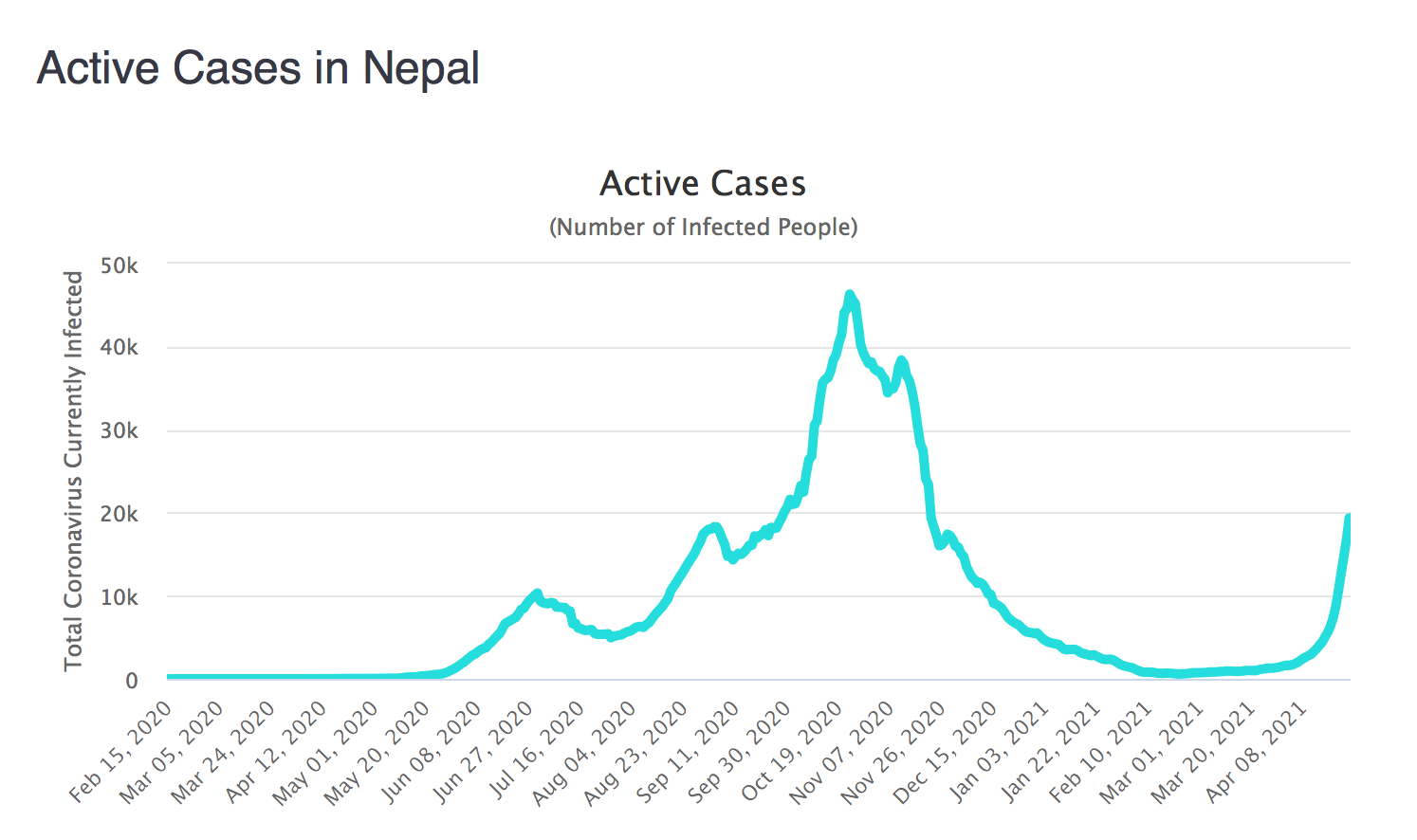
The country’s second wave is now clearly visible in a graph of active cases, which rose from a low of 550 on 21 February to nearly 20,000 by Monday.
Nepal recorded 3,556 new Covid-19 cases on Monday of 13,293 PCR and RDT tests, and the total number of cases has now exceeded 300,000. The positivity rate has risen to more than 30%, compared to less than 4% in February. This figure was down to 28% even at the peak of the first wave.
Of the total positive cases, 1,912 were in Kathmandu Valley, with 1,567 in Kathmandu, 223 in Lalitpur and 122 in Bhaktapur.
The rate of infection is much steeper in this second wave, and it is also more lethal and affects younger people. There were 12 additional deaths from the coronavirus in the past 24 hours, bringing the official total to 3,176.
Last year this time, Nepalis were worried about being infected. This time, the main concern is finding ICU beds and oxygen cylinders. Another difference is that this time, working age people are patients requiring ICU and ventilator support.
“Before it’s too late we need to be prepared with treatment and management guidelines for children with Covid, as they may require a new set of health professionals and infrastructure,” adds Pun.