
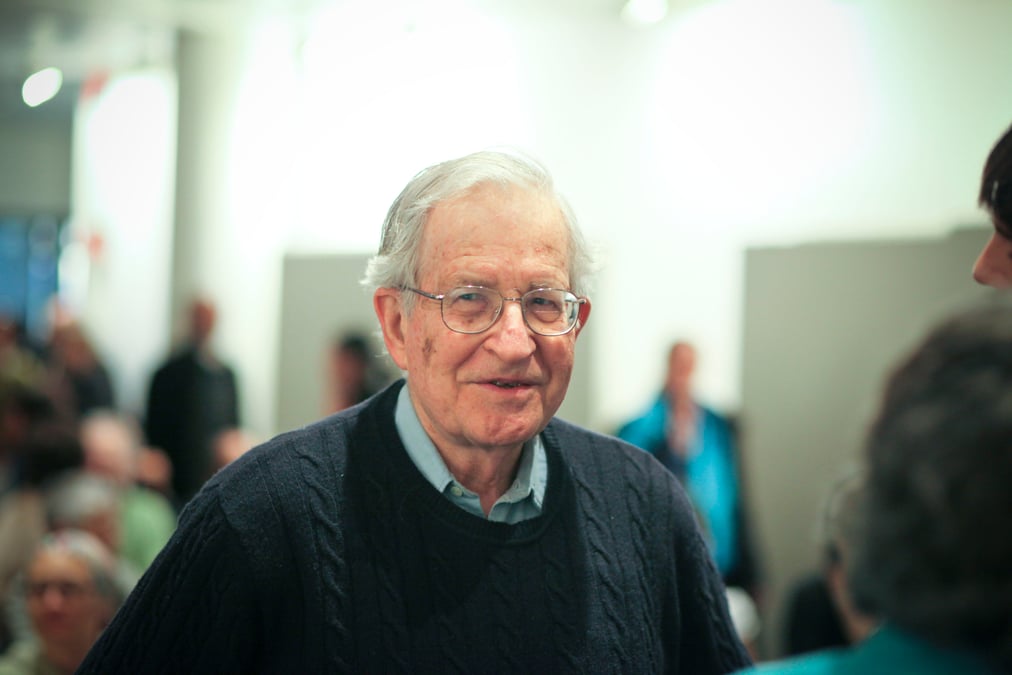
I once asked Noam Chomsky how he manages to remember so many facts and figures and hold audience attention. He replied that he did not convey any new information, that his talks are based on materials already in the public domain, he simply joins the dots.
Chomsky teaches us that it is not necessary to be loud and sensationalist in order to be heard. His clear and courageous moral compass over decades is a most valuable lesson.
On 17 June, some media reported that Chomsky, 95, had died after a stroke he suffered last year. He was in hospital in Brazil, and his wife has since said he is continuing treatment at home.
Noam Chomsky was already a legend when I first met him over two decades ago in December 2001 when he visited Pakistan for the inaugural Eqbal Ahmad Memorial lecture series.
Eqbal Ahmad had been an anti-Vietnam War activist in the US in the 1960s and later taught at Hampshire College and was among Chomsky's circle of friends, which included other legendary figures like Howard Zinn and Edward Said.
He had returned to Pakistan after the death of Gen Ziaul Haq in 1988 and was prominent in the peace and anti-nuclear weapons movements in the region. He died in May 1999, on the first anniversary of India's nuclear test, that Pakistan had followed.
In November 2001, Chomsky did a lecture series in India. Another fellow-traveller, the well-known physics professor and activist Pervez Hoodbhoy invited Chomsky to Pakistan for the Eqbal Ahmad Memorial lecture series. These events were organised months earlier, and Pervez was initially worried about whether there would be an audience.
The 11 September 2001 attacks had just taken place and Chomsky cut through America’s outrage to point out that the attacks were historic not for their scale but because of where they took place, mainland America, which had not been attacked before.
Also, this was not the first, but "the second 9/11". The earlier, “far more serious" 9/11 was the one in 1973, he said, the violent coup against the elected government of Salvador Allende in Chile.
Many in America were uncomfortable with such statements, but in progressive circles here and around the world, his popularity soared.
I asked the organisers if I could follow Chomsky around Pakistan for a documentary. They agreed to let me tag along to his room at the Avari Hotel in Lahore. Noam Chomsky and his wife Carol had arrived in Pakistan to a celebrity welcome that discomfited them. Chomsky politely conveyed that we were welcome to film his public events but that he and Carol were uncomfortable being followed around by a camera.
We put our equipment away until he entered the venue where he was speaking. He walked through the packed hall to a standing ovation. A few days later, he addressed a larger audience at another packed venue, an indoor stadium in Islamabad. In both places, people listened in pin drop silence as he spoke, low key and without histrionics.
There was a shameful exception, when he spoke at the Nieman Foundation for Journalism at Harvard University when I was an international Fellow there in 2005-2006. In that intimate setting, another international fellow and her husband, both from Israel, kept interrupting Chomsky, despite being admonished by the moderator and other fellows.
Chomsky didn’t lose his cool, but I heard later that he vowed never to come back to Lippman House. I was glad to hear that the Nieman Fellows prevailed upon him to return in 2017 and that it went smoothly.
In September 2006, John ‘Jack’ Trumpbour, a Research Director at the Center for Labor and a Just Economy (CLJE) at Harvard Law School invited Chomsky as a featured speaker for the launch of a collection of essays, The Selected Writings of Eqbal Ahmad (Columbia University Press), September 2006.
I was a speaker, along with Margaret Cerullo, Eqbal's colleague from Hampshire College and one of the book's editors. Stuart Schaar, Eqbal's college buddy from the 1950s at Princeton University was also a speaker. Like Chomsky, he has paid the price for his support of the Palestinian cause, sidelined in the mainstream academia as Eqbal himself was.