
If the frequent collapse of the provincial coalition in Kosi is any indication, all is not well in the power dynamics in Nepal’s nine-party governing alliance.
This week, Kedar Karki of Nepali Congress (NC) became the fifth Chief Minister of Kosi Province since elections last November. Karki passed the floor test in the provincial assembly, but with help from the opposition UML. The UML had failed to get enough votes for its own chief minister candidate which precipitated the new election.
This was an embarrassment for Maoist prime minister Pushpa Kamal Dahal who had got the coalition at the centre to back fellow comrade Indra Bahadur Angbo. And it was also a blow to NC president Sher Bahadur Deuba.
A dissident faction of the NC not happy with party president Sher Bahadur Debut’s conjugal relationship with the Maoists, got UML backing to support Karki’s chief ministership. Eight NC members from Koirala’s camp and 39 from the UML, which has the majority seats in Kosi provincial assembly, supported Kedar Karki.
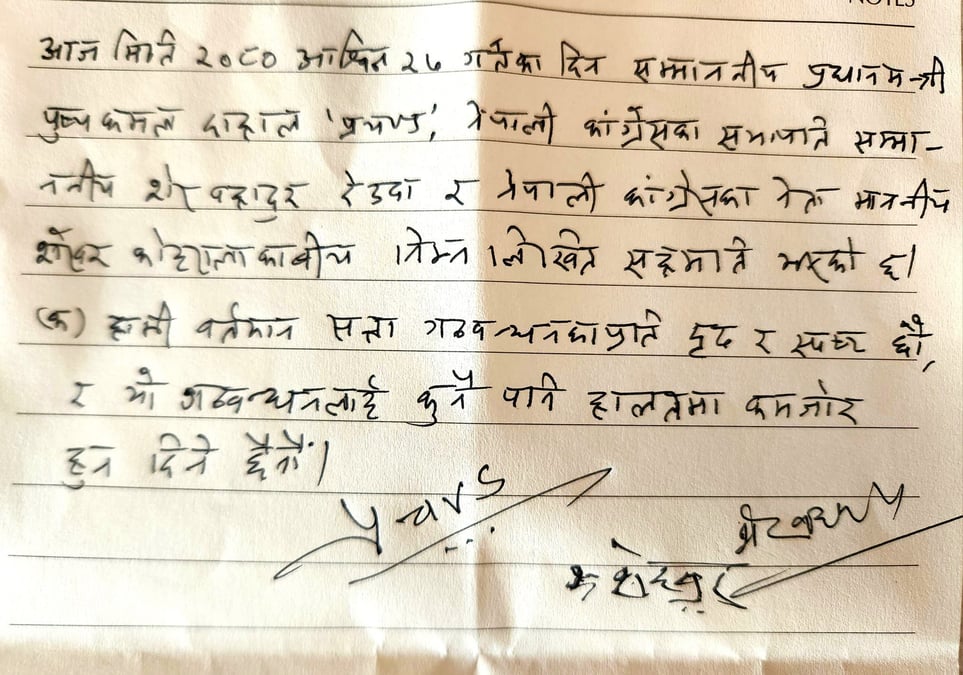
What followed was even more intriguing. Prime Minister Dahal and Deuba summoned Shekhar Koirala and tried to convince him to backtrack on Kosi. He refused. But they did manage to convince him not to mess with the coalition setup in return for allowing Karki to be Kosi Chief Minister.
And since Nepali leaders are not best known to keep their word, the three put their deal in writing on a crumpled piece of paper, torn from someone’s copy book, and signed it (pictured).
Kathmandu interfering in Kosi is not new. In fact, the former Kosi Chief Minister Hikmat Karki of the UML was actually backed by the Maoists, despite its alliance with the NC at the centre. Rescinding that support is what led to the current instability.
The background to this back-and-forth is the ethnic debate about whether the province should be called Kosi or Kirat. The matter is such a hot potato that Province 1 was the last of the seven to finally vote on a name (Kosi) last year.
The region’s indigenous groups want a name that reflects their identity, but the various ethnic groups are not united in what that name should be. Prime Minister Dahal made matters more complicated by saying that Kosi should be changed to Kirat.