
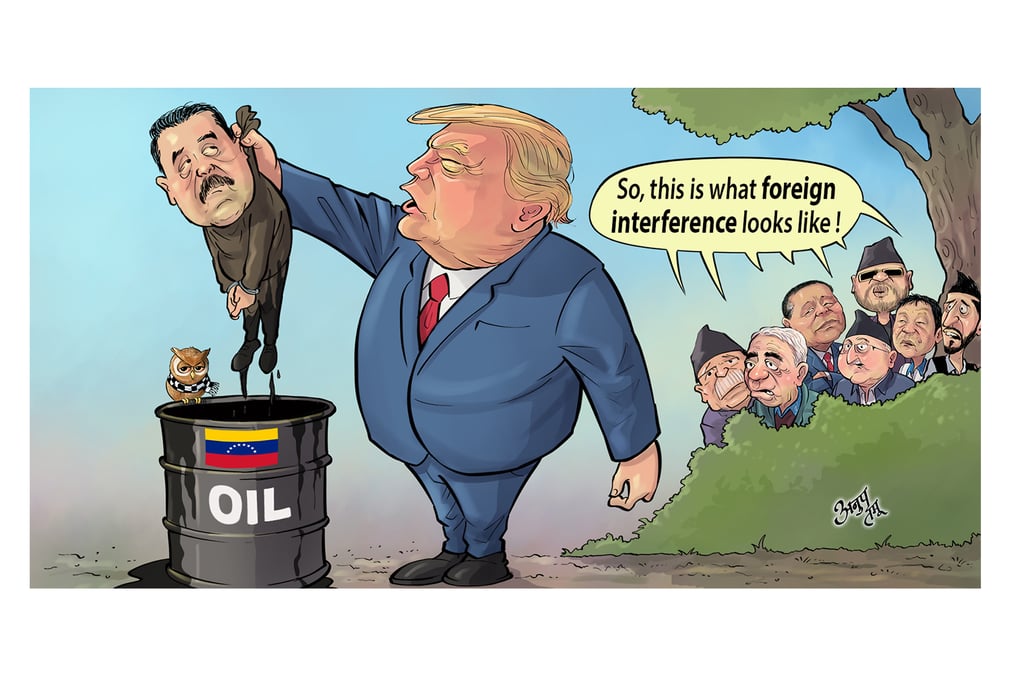
The American military action in Venezuela and the abduction of President Nicolás Maduro Moros may redefine Nepal’s geopolitics as it juggles between three world powers, India, China and the United States.
Nepal’s interim government is busy preparing for elections on 5 March, and it was late issuing a statement on the American intervention in Venezuela, but the country may have to re-evaluate how it deals with its immediate neighbours and the global power.
“How does Nepal avoid being the next Ukraine or Venezuela? Small countries shouldn’t go around irritating big neighbours. And when big neighbours really get upset, they usually put up a moral fig leaf justifying their miltary action,” says energy economist Dipak Gyawali. “What we see with Venezuela today is bereft of such moral content, essentially banditry which in today’s day and age is unacceptable. Neither the rising new powers nor much of the Global South will take this lying down.”
International relations experts have said that there is now a new world order in which rules-based diplomacy has been thrown out of the window, and the world has been carved into America leading the western hemisphere, Russia is allowed to do what it wants in Ukraine and Europe, and China’s sphere of influence is now the Indo-Pacific.
Foreign affairs expert Nischal Pandey says there is a lesson for smaller nations like Nepal: “We have to be aware of the sensitivities of the major powers in the vicinity.”
There is also a lesson for smaller resource-rich countries not to give an excuse for intervention with poor governance and political instability due to inequity. In Venezuela’s case it was throttling democracy and not using its immense oil-wealth to uplift its people.
Nevertheless, the Trump administration’s abduction of a sitting president of a foreign government regardless of the dictatorial nature of his regime and Venezuela’s volatile internal politics, is illegal and breaches the international order that has been in place since after World War II and its devastation on humanity.
While Trump’s intervention in Venezuela, and threats against Colombia, Cuba and Greenland have brought international condemnation, here in Nepal it has not been taken as seriously as it should.
Says Amish Mulmi, author of the book All Roads Lead North: Nepal's Turn to China: “Some of the reaction on social media has been that of glee over the fall of a dictatorial Communist government on the other side of the world. However, the government statement about fully respecting the principles of sovereignty and the Charter of the United Nations is a strong statement that makes clear Nepal's position on the matter.”
“The abduction of Maduro is a clear sign of Trump's America ensuring its sphere of influence through might and a warning to toe the line,” Mulmi adds. “It also infringes on the sanctity of borders and the preservation of sovereignty. Trump's actions reek strongly of a bygone era of imperialistic control and resource capture.”