
 MIN RATNA BAJRACHARYA |
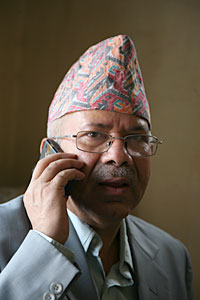
When Prime Minister Madhav Kumar Nepal goes on a goodwill visit to New Delhi next week, he will need to allay fears that he is heading a tottering government that can fall at any time. More importantly, he will have to do a lot of explaining to prove that he is indeed in charge.
When Nepal took the oath of office in May at the head of a 22-party anti-Maoist front, nobody expected much from his ragtag alliance. Circumstances had pushed him centre-stage. He became the prime minister because NC strongman Girija Prasad Koirala didn't want to head a wobbly coalition with the largest party of the parliament (the Maoists) in the opposition. Probably Koirala also calculated that Nepal would be a willing accomplice to rehabilitate his daughter in the corridors of power.
Nepal's only strength is that he is politically too weak to be of any challenge to anyone inside or outside of his party. It appears that he exercises little control even over his own party colleagues in the cabinet, let alone other coalition partners. Nepal may be in Baluwatar, but his ministers in Singha Darbar do their own thing.
Home Minister Bhim Rawal got his job because some influential donors of Nepal found him most trustworthy to implement the Special Security Plan (SSP) they had spent millions of dollars to devise. Since security 'experts' have designed the scheme and prepared its details, SSP has no political component.
It's easy to identify "109 armed groups" operating in the country. But to establish reasons behind their phenomenal growth and plan methods of countering their influence would need the savvy of a politico. A donors' darling, Rawal has more faith in parachuting consultants than his own party cadre. All that Nepal can do to temper Rawal's fascination with technocratic quick fixes is to urge him to exercise restraint.
The two powerful ladies in the council of ministers have their own bases of strength. Defence Minister Bidya Bhandari is the widow of UML-ideologue Madan Bhandari and represents the conservative clique in the party that doesn't want to give any space to the Maoists. The foreign minister is the heir-apparent of the Koirala Clan and believes that the Maoists must somehow be accommodated to ensure the longevity of government. Both do pretty much as they please, seldom bothering to inform the prime minister of their intentions.