
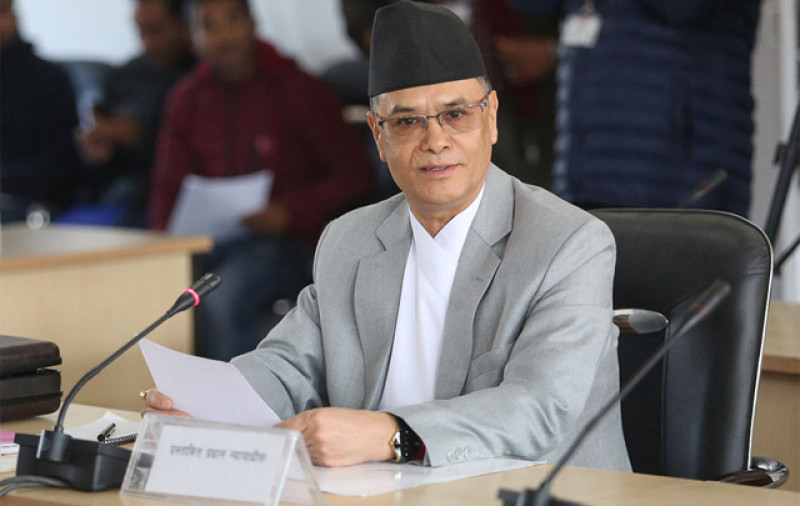
Even though Nepal’s political parties do not seem very keen for the moment to impeach controversial Chief Justice Cholendra SJB Rana, the mutiny against him is spreading among justices and lawyers.
Chief Justice Rana’s alleged pressure on Prime Minister Sher Bahadur Deuba to make his brother-in-law a minister earlier this month and other purported misdemeanours have halted proceedings in the Supreme Court as judges and lawyers go on the warpath.
Things have got so volatile that on Friday lawyers for and against Rana had a fistfight outside the Nepal Bar Association as it was announcing an intensified agitation against the chief justice. A video clip of the scuffle went viral on Nepal’s social media.
नेपाल बार अगाडि वकिलबीच कुटाकुट
— Setopati (@setopati) October 29, 2021
प्रधानन्यायाधीश चोलेन्द्र शमशेर जबराका समर्थक र विरोधी वकिलबीच शुक्रबार नेपाल बारभित्रै कुटाकुट भएको हो। pic.twitter.com/lCX8qdJBNJ
Video: SETOPATI/TWITTER
What is happening to Nepal's Supreme Court?, Santa Gaha Magar
The row over the chief justice has cast a spotlight on the transactional relationship between Nepal’s executive and judicial branches, and deliberate and blatant attempts by the political leadership and the chief justice to violate the principle of separation of powers.
Public and judicial outcry ensued after news emerged that the Chief Justice had demanded ministerial appointments for two of his people as the coalition government was deliberating a much-delayed Cabinet expansion earlier this month.
Deuba agreed to one cabinet position, appointing Rana’s brother-in-law Gajendra Hamal as the Industry, Commerce and Supplies Minister.
Deuba and Rana both refuted allegations of bargaining, but not very convincingly. Even Deuba’s own party members said appointing Hamal was wrong.
As the outrage spread, Hamal resigned less than 48 hours into his ministership, but this only added fuel to the fire as many saw it as an admission of the chief justice and the prime minister scratching each others’ backs.
To be sure, other members of the ruling five-party coalition have not shown much interest in registering an impeachment motion in Parliament against Rana. In fact, Parliament was conveniently prorogued on Friday, citing the opposition UML’s disruptions of proceedings. The UML’s K P Oli, who had to step down as prime minister after the Supreme Court ruled in July that his dissolution of the House was unconstitutional, is also opposed to impeachment — saying that five other judges who passed that verdict should also resign.
Old wine in old bottle in Nepal's politics, Shristi Karki
For the past week, justices and lawyers have been boycotting full court meetings called by Rana, as well as cases in the Supreme Court and other courts across Nepal, bringing the judicial process to a standstill. As it is, only the Chief Justice-led single bench has been conducting hearings at Nepal’s top court.
On Friday, the Nepal Bar Association issued an ultimatum to Chief Justice Rana to resign by 3 November, otherwise, it would undertake escalating protests including further boycotts of hearings, preventing Rana from entering the Supreme Court premises and even street rallies.
On Thursday, Rana repeated in an interview with BBC Nepali that he would not step down just because some justices were calling for it. “I was appointed through a constitutional process, and I can only be removed through a constitutional process,” said Rana, possible convinced that the political parties would not move to impeach him.
However, second-tier leaders of the Nepali Congress on Friday issued a statement calling on their party to protect judicial independence, the rule of law and separation of powers. ‘The Nepali Congress cannot remain silent in the controversy involving the chief justice when there is so much opposition to him from within the Supreme Court and the legal system,’ the statement by 12 NC members including Gagan Thapa, Sarita Prasai, and Dhanaraj Gurung said.