
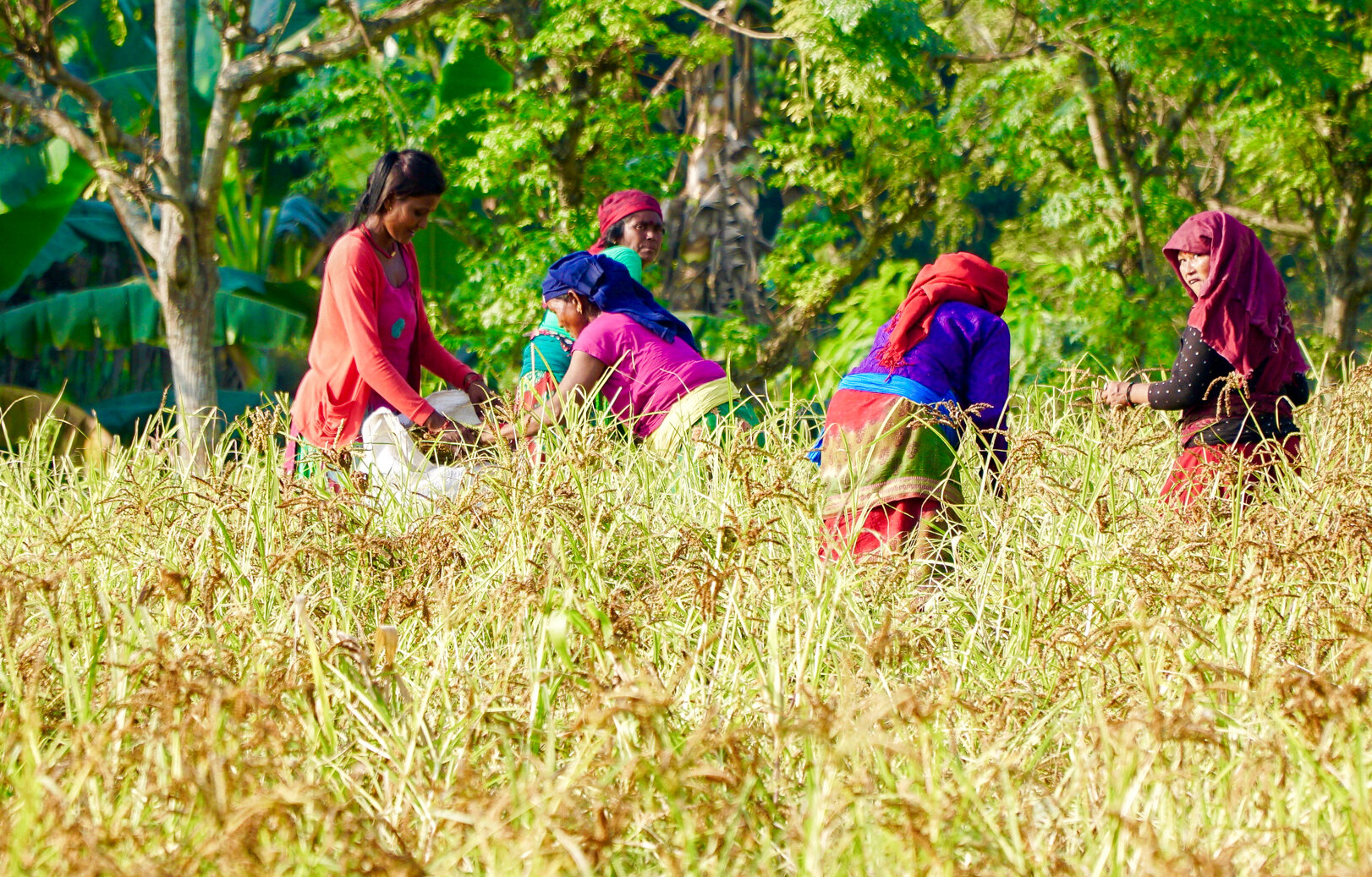
Agriculture expert Yamuna Ghale was on a research visit to Dolakha district when she heard the women livestock farmers complain that their goats had weak legs and could not stand properly. She then learnt that the women had noticed new kinds of grass in their neighborhood which they had been feeding their livestock.
Ghale, who is a member of the Nepal Agricultural Research Council (NARC), immediately made the connection — this was an invasive species of grass that was growing in the mountains because of global warming, and was not good for livestocks.
"Commercial farming is mostly done by men, and such farmers tend to source commercial feed or grass for their livestock, but women farmers keep a few animals at home. They feed these animals whatever they can find in the vicinity,” Ghale explained. “This is one of the examples of how climate change has a differential impact on women."
Recent evidence shows not only that the mountains are warming faster than the global average, but rural women in Nepal are more vulnerable to the changes brought by the climate crisis. However, Nepal's state policies related to climate adaptation do not acknowledge this disproportionate impact. And even when they do, they do not offer solutions.
The Ministry of Forests and Environment has put together a draft of a Gender and Social Inclusion (GESI) and Climate Change Strategy and Action Plan, but it is yet to be implemented. Experts say that the biggest gap lies in putting those policies into action.
Due to rising water scarcity, women need to travel farther to fetch water. According to Nepal Labour Force Survey 2017/18, 61% women are involved in subsistence farming, whereas only 47% of men are. Women also have limited access to timely weather forecast information which affects their options for farming, they lack independent sources of income, and may be unable to access credit.
Although women carry out most of the agricultural work, very few women own the land they farm. This reduces their decision-making capacity, even though high outmigration of men has increased their responsibility. Women are engaged in labour intensive activities like collecting water, firewood, fodder for animals, and farming.
Pandemic offers chance to revive farming, Krishna Paudel
Women in mountain communities find that adapting to climate change is even more challenging. There are new kinds of pests and weeds, and the soil is harder, malaria and other vector-borne diseases are moving up the mountains. The frequency of floods and landslides have also increased, leading to job and food insecurity.
"The most affected are the poorest women in the most remote mountains because they don’t have access to resources, information, or have the skills to adapt. This makes them more vulnerable and are disproportionately affected because of inequalities in the distribution of rights, assets, resources and power," says Chanda Gurung Goodrich, climate and gender expert at ICIMOD.
Out of Nepal’s seven policies related to climate change, only three acknowledge gender issues, with only one of them suggesting adaptation measures specifically targeted at women. In fact, Climate Change Adaptation and Disaster Risk Management in Agriculture is the only policy to have integrated gender across key areas. Nepal's latest climate change policy also acknowledges women as a vulnerable group, is lacking in action plans for implementation.