
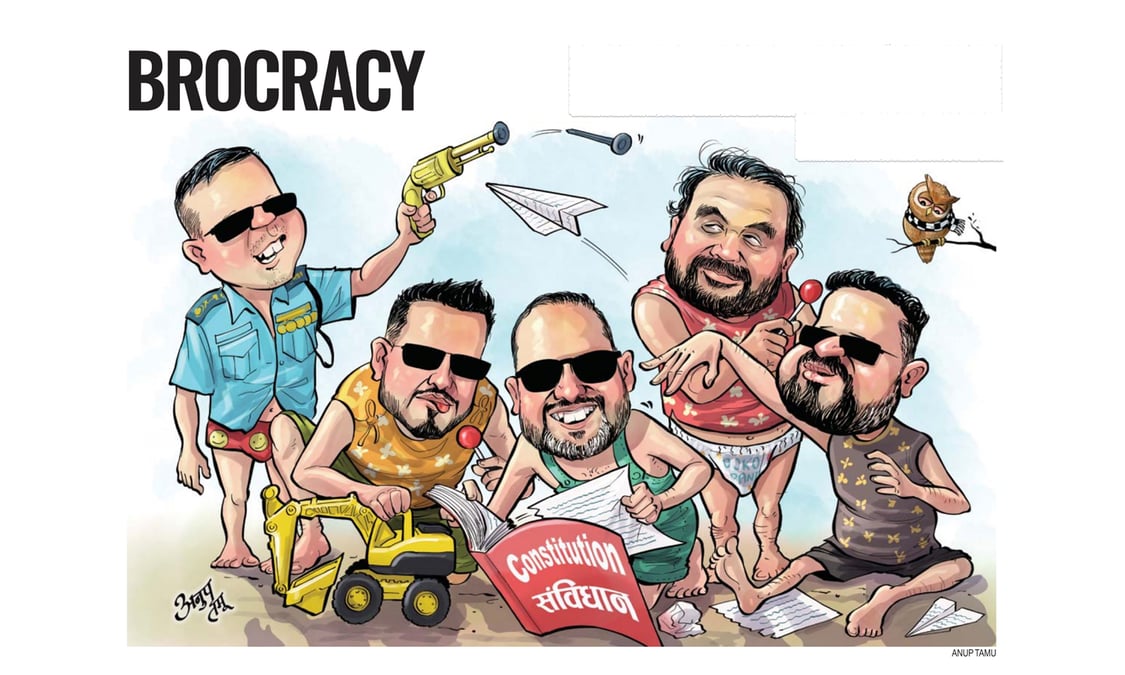
Prime Minister Balendra Shah’s government that was elected four months ago, riding a wave on the Discord platform is now itself ridden with discord.
The Prime Minister, his small inner coterie of advisers and a Parliament in which his RSP has a near supermajority seem to be pulling in three different directions.
Nepal’s public sphere is abuzz with reports of a growing rift between the Prime Minister and his Finance Minister Swarnim Wagle. In budget planning, and in strategy meetings the PM held with business leaders last week, Wagle was conspicuously absent
RSP chair Rabi Lamichhane is trying to patch things up, and held a retreat at a Kavre resort with Wagle over the weekend which the Prime Minister did not attend.
Even before the election there has been no love lost between Shah and Wagle. One is a populist former rapper who shuns foreign officials, the other is a voluble Harvard and LSE-educated economist who is approachable to the international community.
The latest tension was over disagreements on tax structure in the budget, particularly a discrepancy that led to the Finance Bill to be altered several times, and the 3% ‘equity tax’ on private education and healthcare.
After the taxes went into effect at the start of the fiscal year last week, there was widespread public backlash. So, Prime Minister Shah on Wednesday bypassed the Finance Ministry to announce via X that the taxes were withdrawn. He added that the decision had been made in consultation with Wagle.
“This has exposed the disconnect between the party, Parliament, and the executive office,” says Bidushi Dhungel of the National Democratic Institute. “This is a worrying sign for stability and sustainability of any government.”
She adds, “One would assume, from a governance perspective, that the RSP would have had discussions seeking alignment on fundamental theoretical and ideological principles as well as consensus guiding a political document like a budget, especially something as major as a tax on basic services.”
Prime Minister Shah himself seems amused by all the speculation about a rift in the party, and reacted on his handle with a laughing emoji on a rumoured Cabinet reshuffle.
There is no doubt that the prime minister likes it his way, or the highway. Most major decisions in the past months have not been taken by his ministers, but by his inner circle who are buddies like chief adviser Kumar Ben and political adviser Asim Shah (editorial, page 2).
“The factionalism was evident ever since Balendra Shah joined the RSP, so a partnership of convenience can only go so far,” explains political analyst Indra Adhikari.
“If you look at the ministers who have fallen out, they are from Rabi Lamichhane’s faction and have comparatively more political acumen,” she adds.
The passport procurement issue spotlighted just how directly the Prime Minister’s unelected and inexperienced advisers are involved in matters of state.
Says Adhikari: “In a democracy, policymaking and implementation needs consensus-building. Leaders must expect opposition, be able to digest criticism, must collaborate and communicate with leaders and the public. Bypassing this shows an authoritarian streak.”
In a recent series on the Setopati site, sources revealed that PMO advisers tried to force the head of the Passport Department, the Attorney General’s office, and the CIAA to bypass the Finance and Foreign Ministries to cancel a German company contracted to print passports.
“What is happening with the PM’s inner circle seems similar to what we’ve seen in the past with old party leaders,” says Dhungel. “They surrounded themselves with yes-men so decision-making was done in an echo chamber. We are seeing the same thing now.”
“There is still time to reflect and rectify this so that his circle is made wider to include people with a solid understanding of political processes and institutions,” she adds.
Even as his inner circle has his ears at all times, there is frustration within the party and RSP lawmakers about the lack of communication with and access to top RSP leadership.
Increasingly, RSP lawmakers are becoming critical of the party’s handling of the eviction of landless, the hefty increases in traffic fines, police brutality against youth activists and intimidation of the mainstream press by blocking their gates.
For now, both Prime Minister Shah and Chair Lamichhane need each other, so there is no danger of the party splitting. Lamichhane has found himself playing the mediator’s role, despite being impatient with the prime minister’s parallel government of powerful advisers.
But public has led many to question the stability of the government and the longevity of RSP as a party that will continue to include Shah and his loyalists.
“Nepal has not had stable leadership because previous governments have not been able to complete full terms despite a majority due to power struggles and ego clashes,” says Adhikari. “The RSP is not doing any better than legacy parties.”
Reports of their high-handedness towards leaders of independent institutions like the Attorney General’s office as well as the CIAA have been condemned by critics as ‘thuggish’.
“RSP is being held to a higher standard than what previous governments,” Dhungel says, “The party’s base might be tolerant of the government’s performance for now, but some GenZ activists have already stopped giving this leadership the benefit of the doubt."
She adds: “At the same time, the government has also been very effective in maintaining a strong narrative of action and performance through social media. The battle will be between this narrative in the virtual space, versus accountability from the government in real life.”