
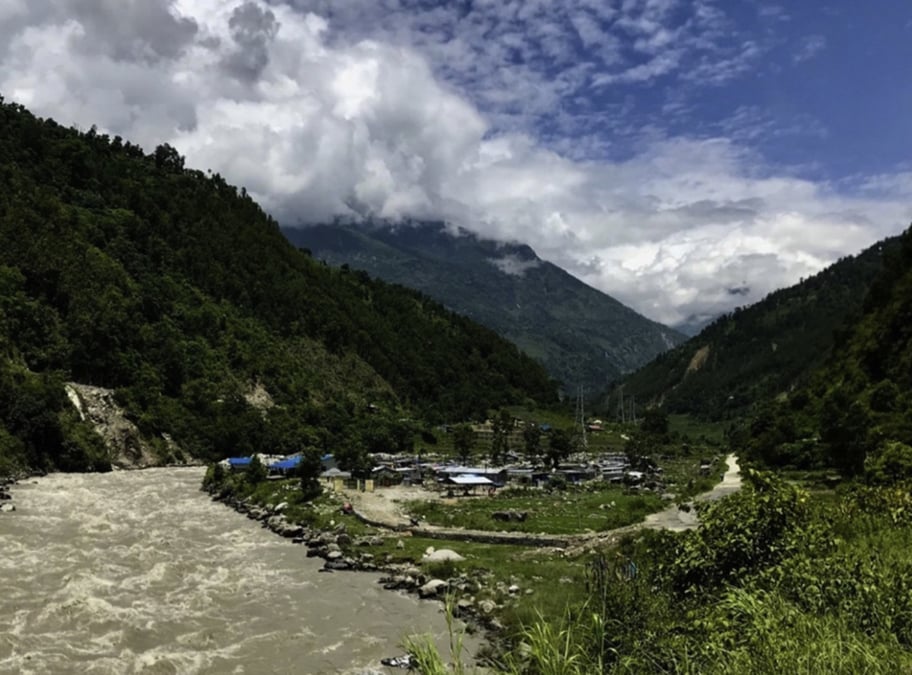
A Tamang settlement on the banks of the Trisuli, Khalte, with its 257 households, no longer exists. It was swept away in seconds by the wall of mud and debris that came down the Trisuli on 26 August. This was not unexpected, in fact many had warned about it.
The earthquake that struck central Nepal on 25 April 2015 razed the mountain villages of Tiru, Gogane, Haku and Mailung in Rasuwa district. Landslides triggered by the 7.8M quake and subsequent aftershocks rendered the ancestral homeland of the indigenous Tamang people uninhabitable.
Around 250 households left behind their homes, steep terrace farms and ancestral shrines to seek safety in the valley below. They were moved temporarily to Khalte by the Trisuli River, which later became permanent. That placed them directly in the path of the next catastrophe.
As early as 2021, anthropological research on the Tiru community had explicitly warned that Khalte was an trap. Researchers and geologists noted that while it provided proximity to roads ad markets, the settlement was right next to a river prone to mountain floods.
Local elders had also voiced deep anxiety about living along the floodplains, fearing that the river would one day claim what little they had left. Yet, year after year, government plans for an integrated resettlement in a safe place was stalled.
Displaced families were caught in bureaucratic delays, a debt trap from purchasing unsuitable land, land-broker scams, and political inertia. On 8 July 2025, a glacial lake burst in China and sent swirling flood waters down the Trisuli, killing 18 people. Although not as big as this year’s flood, it was a warning of what could happen.
And sure enough, it did.
Tamangs are one of Nepal’s major indigenous communities, with ancestral homelands along the Himalayan foothills around Kathmandu Valley. The communities have long maintained strong connections with their land, settlements, livelihoods, culture, language, traditions and social cultural ties.
Historically marginalised and often living in geographically remote areas, Tamang communities have faced longstanding disparities in access to land, services, infrastructure, educational access, economic opportunities and decision-making spaces.
These historical and structural inequalities are even more evident during disasters as shown by the 2015 earthquake, in which up to 34% of the nearly 9,000 people who were killed were from the Tamang community.
Their ability to relocate, recover and rebuild safely has often been shaped by access to resources, secure land and political and institutional support. That is why the survivors of the earthquake were forced to settle in Khalte in Nuwakot.
There was nothing ‘natural’ about this disaster. Global warming, which melted the permafrost on Langtang Lirung and destabilised the slope was anthropogenic. The resettlement of earthquake survivors along the river’s hazardous floodplain was due to the socio-political reality of Nepal.
When a vulnerable indigenous community is relocated from a high-risk mountain slope to an equally high-risk riverbank, and left there for over a decade despite clear scientific warnings the deaths point to chronic structural failure.
The plight of the refugees of Khalte exposes a deep disconnect between state rhetoric and indigenous reality. While the community’s experience is defined by unequal vulnerability, repeated displacement, and suppressed voices, the state’s response represents a parallel narrative of institutional unaccountability, bureaucratic apathy, and the deliberate sidelining of indigenous rights.
Ultimately, the loss of life at Khalte on 26 August was not an act of nature, but of malgovernance.
Disaster response and recovery in the aftermath of the flood must address the underlying risks, respect community choices and ensure that those who have been displaced are not placed in harm’s way again.
A community member from Khalte, now staying at a holding centre in Nuwakot, says that residents had raised concerns about the safety of the relocation site after the 2015 earthquake. They knew the area was exposed to risks, but, said: “The government did not listen to our voices. We were forced to live there.”
Two days before the Rasuwa debris flash flood, there was a landslide and he was on his way to the ward office to report the damage when the bigger disaster struck. “That is the reason I survived,” the survivor said. Within seconds, the settlement was swallowed up by the wall of mud.
NO RETURN
The Khalte community’s voice is louder and clearer this time. They do not want to return to Rasuwa. They want to rebuild their lives in Nuwakot. After being displaced twice, their choice of where to live must be heard, respected and meaningfully considered in any future resettlement decision.
If we truly care about disaster resilience, the government and development humanitarian agencies must:
• Grant Safe Land Rights: Stop placing displaced Internally Displaced Persons (IDPs) on vulnerable public riverbanks or floodplains.
• Listen to Local Knowledge and Scientific Study: When researchers and locals flag a relocation site as a high-risk flood zone, action must follow before lives are lost.
• Provide Long-term Economic Opportunities: Displaced indigenous communities need self-reliant livelihoods, not decades of uncertain, semi-permanent displacement.
Khalte and its Tamang community’s tragedy must serve as an urgent wake-up call: relocation without proper safety is just a delayed disaster and indigeneous community participation should be at the centre of the recovery process.
Sarmila Tamang, a DRR Practitioner, is with the National Society for Earthquake Technology (NSET) - Nepal.
Watch video here.