

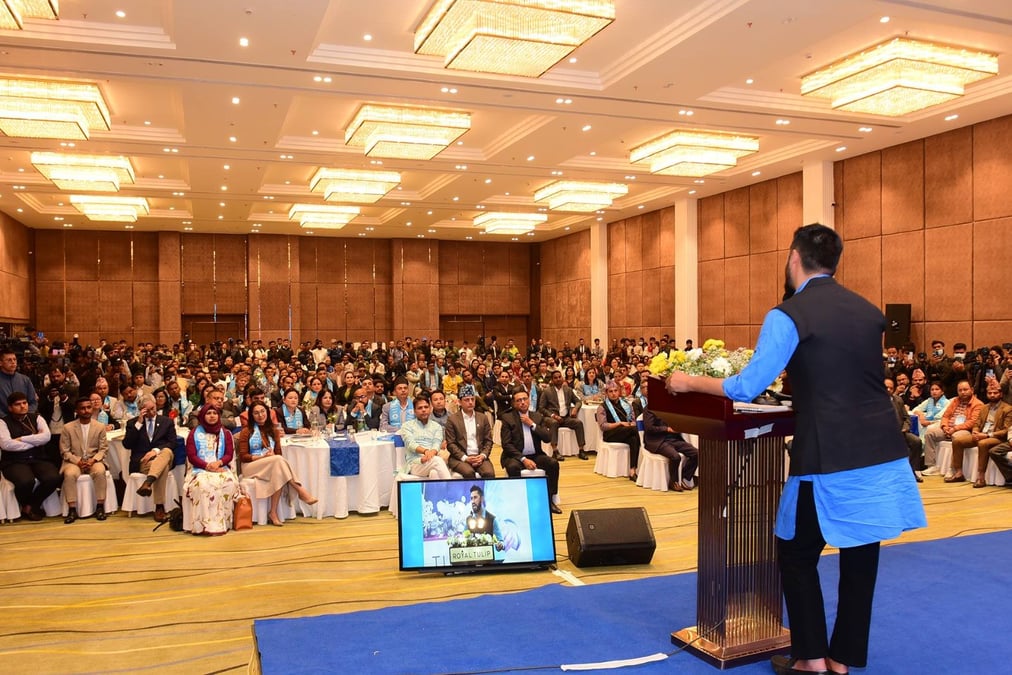
This week, the RSP held a two-day closed orientation camp for its newly elected members of Parliament. The party has also decided to assign parliamentary and Cabinet roles to leaders only after the new MPs are sworn in on 28 March.
This means the new prime minister and his cabinet of 15 ministers are likely to be installed closer to the Nepali New Year, and the expectation is that it will also usher in a new era of governance and politics in Nepal.
Between now and then, there is much speculation regarding who will become new ministers and from which camp—Balendra Shah's or Rabi Lamichanne’s. Meanwhile, the final argument in the petition against the Rabi Lamichanne case revision is set for Thursday, with a verdict expected on the same day.
“In the past, parties did anything to form coalitions and to keep them from splitting ministries and appointing anyone they wanted to, even going against the spirit of the Constitution, but the RSP doesn’t need to partake in any such activities,” says political analyst Indra Adhikari.
Adhikari notes that governance failures in the past was often the result of coalition governments formed through political bargaining that meant the primary party often had to compromise on their agenda.
“But nothing is stopping the party from fulfilling its election manifesto,” she says. “And if they aren’t able to deliver, we know Nepalis are prone to protests, so another revolt is also a possibility.”
Journalist and author Mohan Mainali agrees that the everyday Parliamentary proceedings should go smoothly for new government because of their majority.
But there are questions as to what a near two-thirds majority allows the RSP to achieve in Parliament. Its 182 seats in the Lower House allows the party to enact and amend laws without hurdles and bypass Upper House’s request for Bill revisions. But the RSP has no presence in the National Assembly, and that means that its majority in the Lower House is not enough to amend the Constitution.
“The Constitution poses no obstacles for the RSP to work on improving governance, development and delivery,” says Mainali. “If they do show some performance, it will be easier for them to go into the next election and ask for a two-thirds majority to also amend the constitution,” he adds.
The last coalition government of the UML and Nepali Congress before the GenZ protests had been built upon a primary agreement to make amendments to the Constitution. So, depending on the nature of amendments, the RSP might find some support within the National Assembly at a time when some of the older parties, such as the Nepali Congress, have committed to supporting the new government as well as internal party reforms.
“What we need is a structural overhaul, from our laws and foreign policy to economy and security apparatus, and for this the RSP needs to champion collaboration and consultation for the sake of nation building,” says Indra Adhikari. “So it all comes down to the understanding and judgment of the RSP’s leadership. If they try to go at it alone, it will lead nowhere.”
To be sure, the provincial government could also clean up their act before the next local and provincial elections, which would help the older parties to regain some of their lost footing and rebuild trust.
As it stands, RSP lawmakers will also have to learn to work with each other. Mainali notes that the RSP not being bound by one clear ideology might lead to future problems, including the rumoured animosity between party president Rabi Lamichhane and prime minister-in-waiting Balendra Shah.
“Parties that came before the RSP had an ideology, whether they followed them or not, but the RSP is made of different kinds of people,” says Mainali. “If they are not motivated by a common goal of achieving something tangible in the next five years, it might be difficult for them to stay together.”
Adds Adhikari: “Balendra and Rabi don’t seem to be compatible. Rabi has already failed when it comes to the matters of governance, and Balendra won’t carry that burden. Additionally, there is a struggle between the two in terms of party hierarchy.”
Speaking at the closing of the two-day orientation, from which Balendra Shah was noticably absent, Rabi Lamichanne said that the RSP’s image as intolerant needs to be changed, and that the country is not heading towards totalitarianism but is in the hands of good, new people.
Regardless of the assurance, the general public has seen Balendra Shah and Lamichanne’s disposition in the last several years, and analysts are worried that their personalities and ambition might lead to an environment of increased intolerance.
As it stands in absence of a strong opposition, the responsibility falls on the media and the civil society to be the watchdog and play an effective check and balance role.
“Seeing how Balendra has ignored the media so far and Rabi has made inflammatory remarks in the past, they are probably more intolerant than the likes of Trump and Modi,” says Mainali. He notes that the party does not just have technical human resource and cyber army but a large number of dedicated supporters.
The media must thus continue to build trust by highlighting good work, educating the public on the importance of impartial journalism in democracy and debate any Bill purposed in Parliament, Mainali adds.
Says Adhikari: “The media should praise the government when they do well, motivate them, but it should also point out wrongdoings without fear, and provide recommendations to do better. Otherwise, absolute power corrupts absolutely, which we have seen happen happen in America with Trump and in India with Modi, where extremism has taken over and democracy has been curtailed.”