
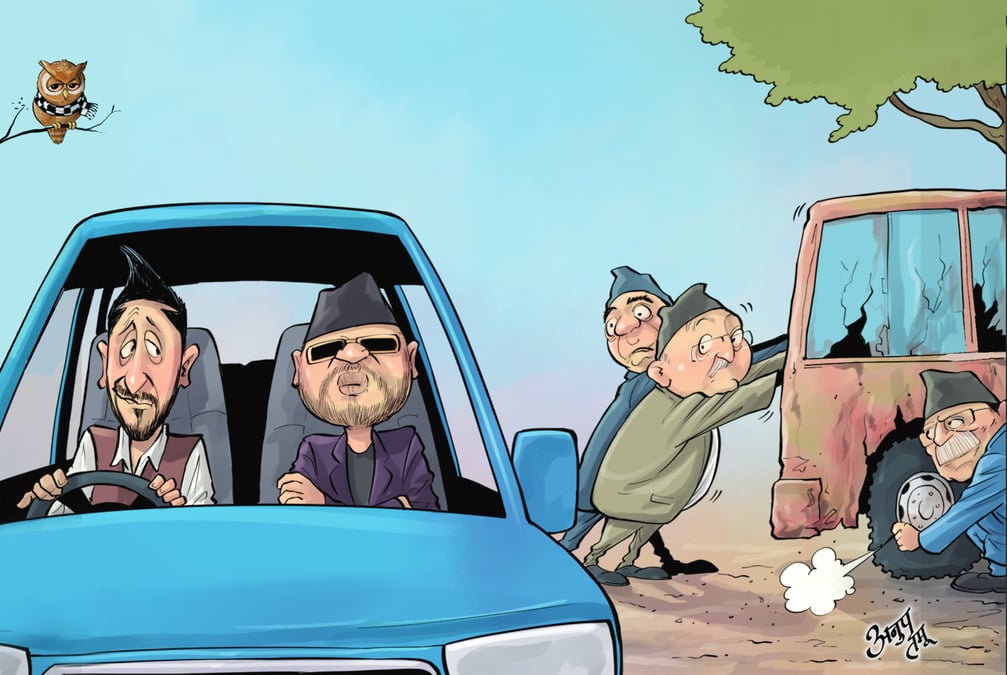
In December we headlined an analysis in this paper that the election was going to be a fight between Old and New. With just a month to go for polls, it is now looking more like New vs New.
The symbolic Balendra Shah vs K P Oli struggle has now been replaced by a face-off between Shah and Gagan Thapa, the new leader of the Nepali Congress (NC).
The Tarai with its vast vote bank has become the battleground for this fight with Shah contesting against Oli in Jhapa and Thapa standing in Sarlahi. And social media is the arena for this epic clash of personality cults.
Which means that instead of finding solutions to problems like health, education, jobs, inflation and social welfare, it is all about optics and stunts. AI-generated and algorithm-driven memes are influencing people’s choices.
“This is not democracy but a very morphed form of political consumerism where political men are selling their brand, and people are lapping that up,” says political scientist Sucheta Pyakuryal.
“Democracy is a way of life, it is not one size fits all, it doesn’t bully opposing voices, it is civilised, personable, tolerant.”
To be sure, Shah and Lamichhane claim to represent GenZ aspirations for cleaner and more efficient government, much like they did in 2022. But elections are expensive, and that is the root of corruption. Shah driving around Nepal in a flashy Defender SUV loaned by a noodle tycoon is proof to some that despite all the rhetoric of ‘new’ it is the same old crony-driven politics.
Author Mohan Mainali says party cadre used to mobilise voluntarily during campaigns, but Nepal’s elections have long stopped being about issues and ideology,
“But political parties lost their morality, and when their actions opposed their avowed principles, the spirit of elections was lost too,” Mainali says. “Cadre and crowds have to be rented, making elections more expensive, and it looks much worse this time around.”
Parties both old and new have moved so far away from what they promise in their manifestos, that it makes little sense to have them. All this means that this election is not so much about what the new candidates can do, but a protest vote against the tried, tested and failed legacy parties.
And that decision is made on the basis of ‘who’ rather than ‘what’. Who wins in Jhapa 5, for example, will determine the future course of Nepal. The winner there will eliminate one prime ministerial candidate, and then set up the possibility of a contest with Gagan Thapa.