
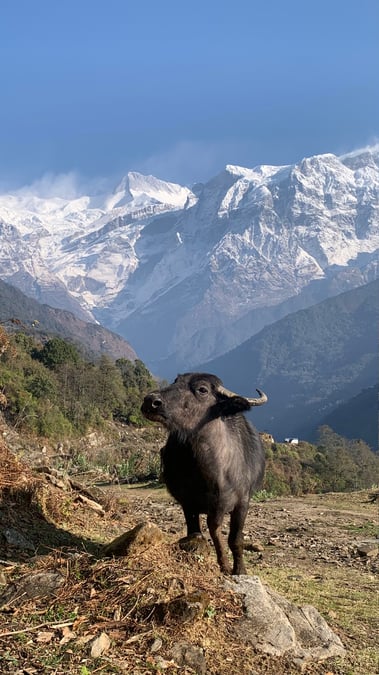
Following the visit of Prime Minister Pushpa Kamal Dahal to China earlier this month, there was talk that export of buffalo meat to China was on the agenda. If so, not enough homework was done before Nepal raised the possibility.
Some traders in Kathmandu claim there is a growing demand for buffalo meat in China, and there have been reports of slaughterhouses in the eastern Tarai where buffalo meat is processed specifically for the purpose of smuggling it to China through various routes.
Chinese media do report the seizure of undocumented buffalo meat inbound to China from Vietnam, there is no evidence that the contraband is originally from Nepal.
Finding out if there is indeed a growing demand for water buffalo meat in China is not easy. The annual Chinese customs import data categorise buffalo meat (not visceral organs like liver, intestine, tongue, etc.) together with other cattle raised for meat under the category 'meat of bovine animal'.
Furthermore, an average Chinese person does not distinguish between buff and beef as separate products. For the average Chinese, beef/牛肉 (shuǐ niú ròu) is interchangeable with buffalo meat. Shuǐ/水 means water in Mandarin.
With the growth of China's economy and rising living standards, the demand for bovine meat is indeed shooting up. Due to the limited arable land and the local bovine population, ever larger quantities of beef/buff need to be imported every year.
China was already importing $2.52 billion worth of beef in 2016, and this grew to $17.76 billion in 2022. The top five source countries were Brazil, Argentina, Uruguay, New Zealand and Australia.
The export of beef from Nepal is prohibited, but water buffalo meat export to China could be economically viable. But a great deal more homework needs to be done on the legal or technical infrastructure aspects.
The General Administration of Customs of China (GACC) has strict rules for imports of 18 food items, including meat products. These not only relate to how the meats are produced or manufactured, but also ensure that the food safety management system of the exporter country is equivalent to Chinese standards.
Which means that even a state-of-the-art Nepali slaughterhouse following safety and hygiene practices in frozen meat production has little to no chance of exporting to China unless the GACC has certified it.
Furthermore, there are exhaustive GACC standards in the evaluation and confirmation process, which include confirming legal provisions, animal and plant diseases, competence of food safety supervisory, overall safety and hygiene control in food production, processing, transportation and storage, competence in export food safety, food protection, traceability and recall system, emergency response preparedness, technical support capabilities, so on and so forth.