
India and Pakistan are twins separated at birth. Tensions between them have been at a hair trigger ever since independence and has erupted into full scale conflict at least four times in the past 80 years.
The 22 April terrorist attack in Kashmir that killed 25 Indian tourists and a Nepali citizen, threatens to escalate tension between the two nuclear-armed nations. India has squarely blamed Pakistan for the attacks, and Prime Minister Narendra Modi has given his military “operational freedom” to respond. Pakistan has said it has credible intelligence of an Indian military strike and its officials have promised a “full spectrum” response — a code for a nuclear retaliation.
For Nepal, the killing of its national in the Pahalgam attack comes as another stark reminder that in conflicts from Afghanistan to Iraq, from Ukraine to Israel, Nepalis are getting caught in the crossfire. The last time full-scale fighting broke out between India and Pakistan on Kargil in 1999, at least 22 Nepalis fighting for the Indian Army were killed in action.
Three of Nepal’s immediate neighbours (China, India, Pakistan) have nuclear weapons, and they do not have good relations. With China supplying weapons, missile technology and other support to Pakistan, this triangular friction could set off a regional conflagration.
Research at Rutgers University has calculated that even a week-long tactical nuclear exchange between India and Pakistan would throw up so much smoke and debris into the atmosphere that it would block out the sun for years, and lead to a collapse of the global food system. This does not take into account the radioactive fallout that prevailing winds would blow up to the Himalaya, contaminating glaciers that are the sources of Asia’s main rivers.
The impact of climate breakdown on High Asia was already ringing alarm bells about its shrinking ice cap reducing the dry season flow of water downstream. Water was going to be the next strategic commodity, geopolitical experts warned, and the next wars in Asia would be over water.
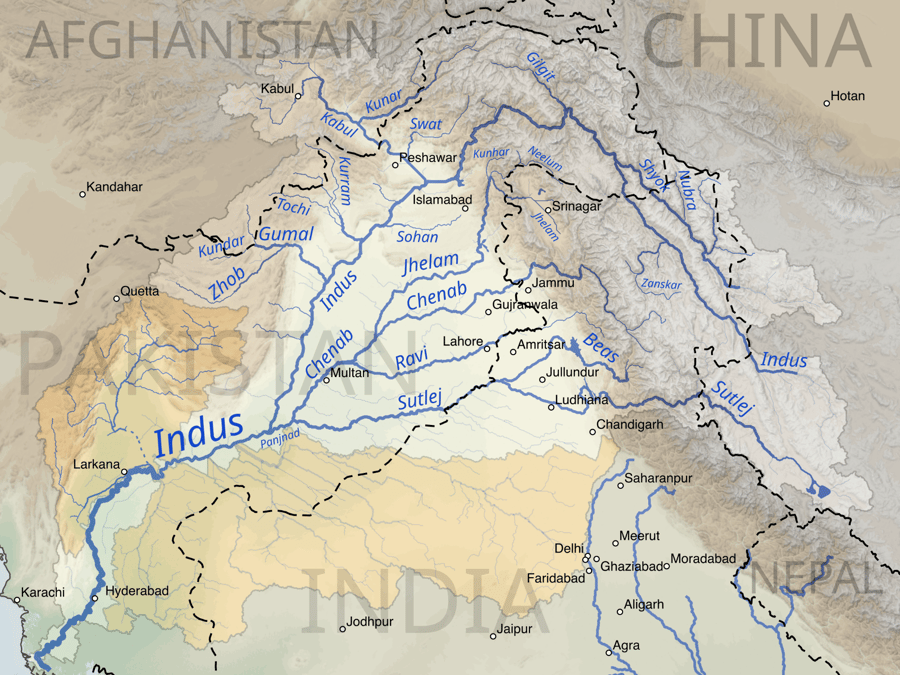
That water war is already happening. India retaliated to the Kashmir attack by suspending the Indus Waters Treaty of 1960 mediated by the World Bank that has withstood at least three wars between India and Pakistan. The treaty gives India control over the three eastern tributaries of the Indus (Beas, Ravi and Sutlej), while Pakistan got water from the Indus and two of its western tributaries (Indus, Chenab and Jhelum.