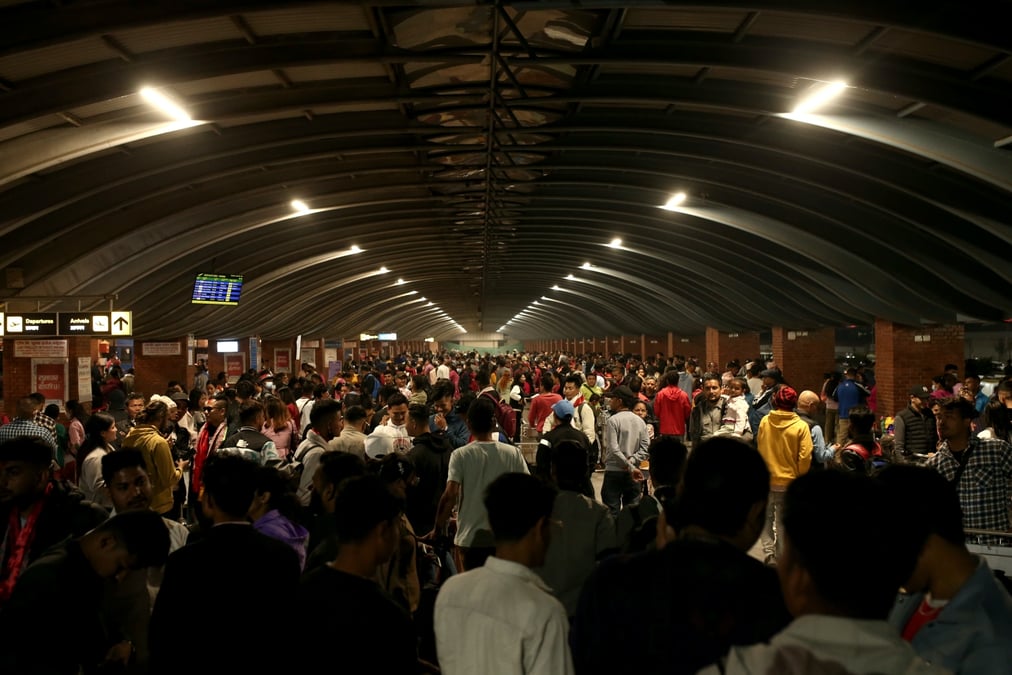
Last year, 775,000 Nepalis left for employment abroad, and another 100,000 students flew out to study overseas. Nearly a million young Nepalis left in 2021-22, and that figure does not even include those who went to India.
This is the largest mass exodus of young Nepalis in the country’s history. No country can sustain such a sustained haemorrhage.
There are few Nepalis left in villages, and those in cities seem to be mostly waiting for documents to leave. Every day, 3,000 Nepalis leave on student visas from Kathmandu airport. The 2021 census put the country’s absentee population at 2.1 million, and that appears to be a gross underestimate.
“The youth are not keen to stay at home, and their parents do not want them to stay here either,” says sociologist Ganesh Gurung. “It seems as if the entire nation is on the move.”
Read also: Migration not a wish, but necessity for Nepalis, Shristi Karki

An increasing number of Nepalis are leaving to study while working: primarily in Australia, Japan, Europe, and North America. Those who leave face bureaucratic hassles trying to get no-objection certificates, and when they come back they get the run around trying to obtain an equivalency for foreign degrees so they can work here.
Last month, six young Nepalis from Rasuwa left their studies, jobs, and businesses to seek employment in Croatia. “With luck, I can get a PR (Permanent Residency) in some other European country, Croatia is just a stepping stone,” said Bhuvan Neupane, one of the six.
Elsewhere in Nuwakot’s Bidur village, Binod Poudel is hoping to go abroad and has handed his passport to a foreign employment agent. “All my friends have left Nepal,” he says. “What am I supposed to do here?”
Aakriti Timilsina is a high school graduate, and has given up on college in Nepal and is preparing to study in either Canada or Australia by working part-time there.
Read also: Nepal’s hard working students overseas, Sonia Awale
A recent study by the online platform Studyportals revealed that Nepali students make up 14.3% of international students across the world.
Sociologist Dinesh Prasain notes that a lack of employment and meaningful earnings are the primary reasons for the young to leave. Basic items have become unaffordable even in fixed-income households.
But there are other push factors as well: peer pressure, falling living standards, and a growing hopelessness that the future will be better because of corruption and political disarray.
At the end of the Maoist insurgency in 2006, there was expectation that stability would yield a peace dividend. But Nepali politics remains in the stranglehold of tried, tested and failed leaders. Volatile and populist behaviour of new elected leaders has disappointed many young people, while some parties resort to religion and bigotry.