
Imagine it is the year 2070 AD. You board a train in Janakpur at 7:37AM, enjoy scenic views between tunnel stretches, and arrive into Kathmandu Central Station’s cavernous underground hall at 8:43AM.
You take the escalator up to the South Exit and emerge on to the front steps of what was once Narayanhiti Palace, gazing on to a broad plaza and Darbar Marg beyond. You stroll along dust-free streets to New Road, take care of business and hop onto the Metro back to Central Station to catch the 12:46PM West-Nepal Express.
After a four-minute ride through a tunnel, the train stops briefly among the high-rise bank and office buildings that long ago replaced the ageing factories and vehicle service centres at what was once Balaju Industrial Estate.
At mid-day the station is quiet, unlike in the mornings and evenings when it is crowded with tens of thousands of people who come by train to work from outside the valley. After several tunnels and quick stops in Bidur, Galchhi, Charaundi and Shaktikhor, you reach Bharatpur at 1:35PM. You finish work in Chitwan and catch the 5:30PM East-West train to Janakpur, reaching home at 7PM.
This may sound like a dream, but dreaming is important for long-term planning.
On 27 August 1893 industrialist Adolf Guyer-Zeller was hiking in the Swiss Alps with his daughter when he imagined riding a train from the pasture at Kleine Scheidegg to the mountain viewpoint at Jungfraujoch.
By 1896 he had permission and financing in place and began construction. The project was completed in 1912 and still brings thousands of daily visitors to Europe’s highest train station, 3,435m above sea level.
Railroads are the backbone of Switzerland’s train network, putting much of the mountainous country (one third the size of Nepal) into commuting distance to the largest city Zurich, while transporting across the Alps tens of million tons of freight a year between Switzerland’s larger neighbours. The country's first rail masterplan was prepared by British engineers in 1850, and big parts of today’s network was built over the next 60 years, at a time when Switzerland’s GDP was comparable to Nepal’s today.
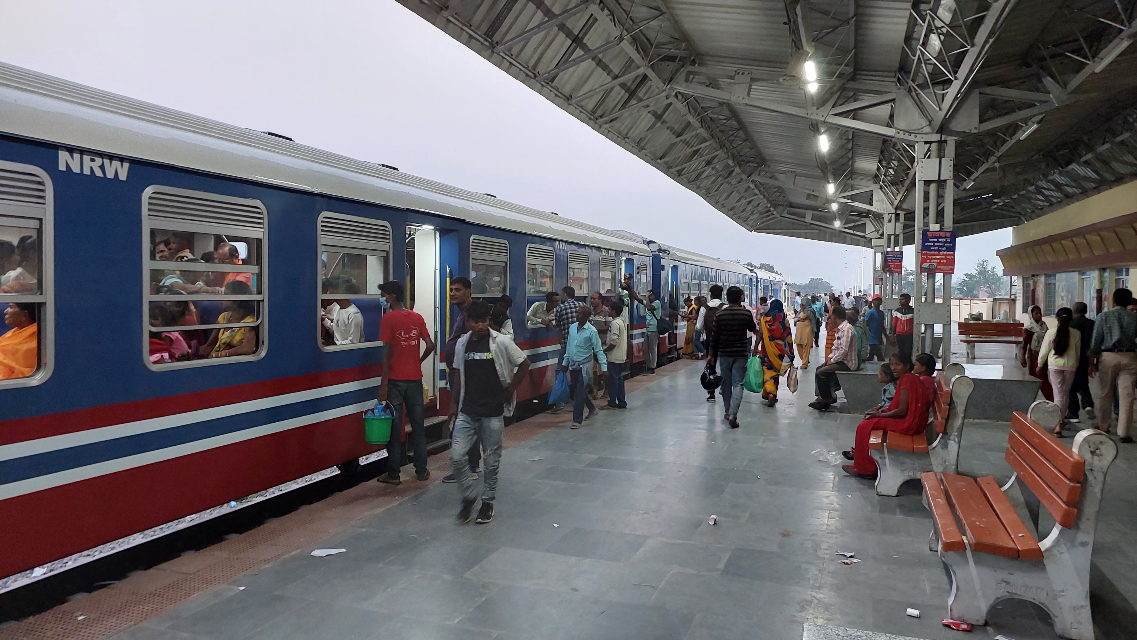
In Nepal, railroads are back in mainstream discourse with the opening of the updated railway from Jaynagar past Janakpur to Kurtha. Nepalis now have firsthand experience of how trains can cheaply transport thousands of people at a time.
While railroads have high up-front costs and need phased construction with long-term financing, they are right for Nepal’s future for a number of reasons:
Electric trains will use clean domestic energy instead of imported fossil fuels.
Railroads carry more people (and freight), faster and more safely using a narrower right-of-way than roads. Railroads thus have less impact on agricultural land, slope stability, and even urban vitality compared to multi-lane roads clogged with traffic.
Travel by train is smoother than by road, allowing passengers to read, write and do other productive activities while traveling, without the risk of congestion delays faced in road traffic.
Trains make it feasible for people to commute daily from 50-150km away, reducing the pressure to migrate to large cities for education and work.
As the world reduces fossil fuel consumption to mitigate climate change, air travel will necessarily become rarer and more expensive, as it does not have ready clean-energy options. Nepal’s neighbours have extensive railroad networks; direct transboundary trains could bring to Nepal large numbers of tourists without relying on air travel.
Nepal’s location between large and growing economies means there is the potential for trans-Himalayan freight trains to partially displace sea-shipping and air freight between the two countries.
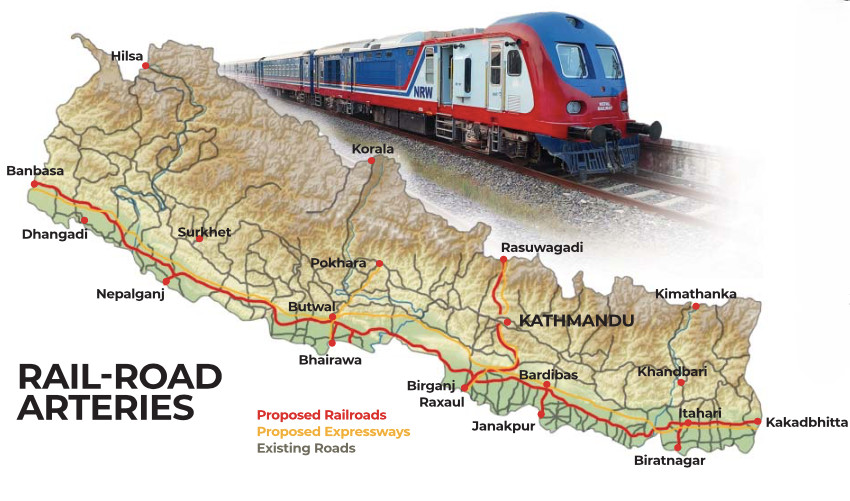
Several potential railroad projects in Nepal are in the pipeline. These include a freight connector from Jogbani border to Biratnagar, expansion of the line from Kurtha to Bardibas, as well as more ambitious projects including a train from Raxaul to Kathmandu, and a train along Mahendra Highway, with side-connectors to Biratnagar, Bhairawa-Lumbini, and Nepalganj.
Most ambitious is the proposal to bring trains from across the Tibetan Plateau to Kathmandu via Rasuwagadi-Bidur, with 98% of the track in tunnels or on bridges.
There have been proposals for possible extensions to Pokhara and Lumbini, but without clarity on alignment. In addition, there have been several proposals for a metro rail system for the Kathmandu Valley.
What is missing from the discourse on individual railroad lines is the longer term thinking of what a 50-year masterplan for Nepal’s network should look like. The individual lines considered so far need to be part of this larger future network, with design decisions for the individual lines based on the masterplan.
Preparing a five-decade Railway Masterplan for Nepal needs to be led by National Planning Commission (NPC) in consultation with stakeholders in Nepal and experts abroad. Several questions need to be addressed early in the master planning process:
First: What kind of ultimate railroad network would address Nepal’s domestic needs in the context of long-term plans for land-use, agriculture, industry and urban growth? Which cities should grow, and what should be their catchment areas? Where should agricultural land and forests be protected (and thus no stations built) and from where will products need to reach the market? Should the east-west railroad connect the towns along Mahendra Highway or run further south? Why?