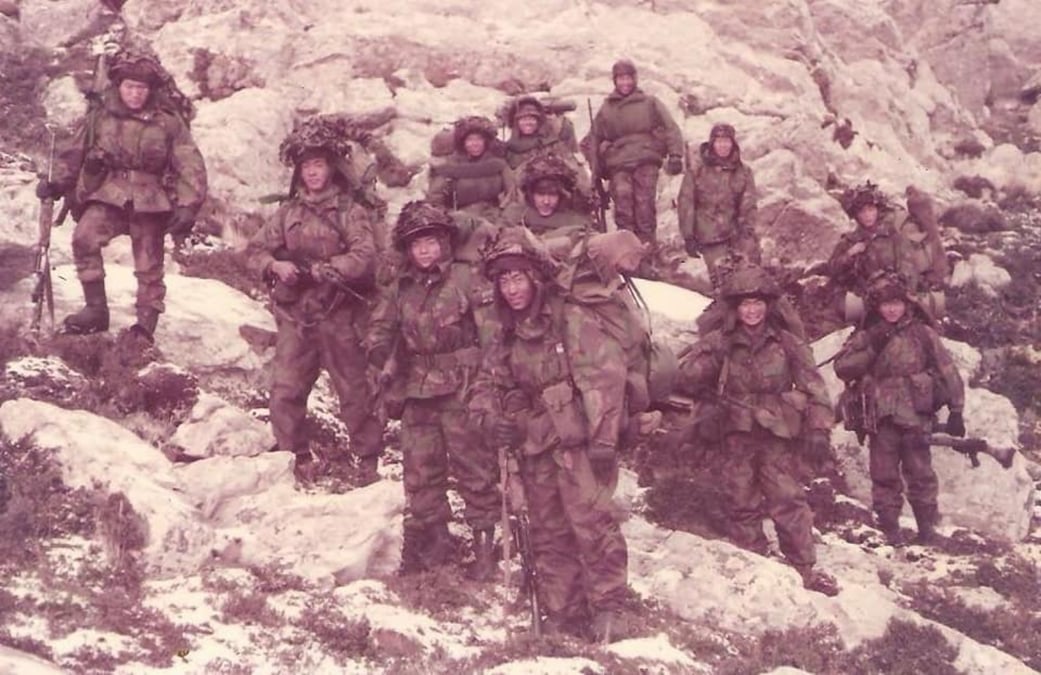
Nepal’s Gurkha soldiers have a well-deserved reputation worldwide for uncommon valour and loyalty. However, what happened in Hawaii in 1986 and the long struggle for fair pay and pension shows that the formidable fighters from Nepal also do not tolerate injustice.
The Hong Kong-based 1st Battalion of the 7th Duke of Edinburgh’s Own Gurkha Rifles was in Hawaii for jungle warfare training exercises at the Joint Pacific Multinational Readiness Center when they beat up their commanding officer, Major Corin Pearce.
The Gurkhas said Pearce had insulted them, and 111 soldiers were dismissed. Pearce suffered broken ribs and a head injury, and was himself also discharged.
The incident got worldwide publicity and enforced the belief that the Nepalis were not treated fairly in the British Army. It also led some retired soldiers to begin a decades-long struggle for compensation at par with their British peers.
Retired British Gurkha soldier Shankar Rai in his book Triumph and Tears revisits the Hawaii incident which he witnessed, and also his experience in the Falkland Islands/Malvinas war in 1982.
He has lots of grievances: unequal treatment and injustice from the British Army towards himself and his comrades. This is an indignant and disillusioned account of the good, the bad and the ugly of being a British Gurkha, which he says let him down despite his service and belief in it.
The book could also be a cautionary tale of how one person on a power-trip can tarnish two centuries of the shared history of Nepal and the UK, as well as ruin the lives of those involved. It also is proof that loyalty should never be taken for granted.
Four years after defeating the Argentinians in the Falklands, several companies and platoons of Gurkha rifles were stationed in Hawaii in 1986 for joint US-UK ‘Exercise Union Pacific’ military exercises. The goal was to ‘perfect the art of marine warfare in collaboration with the US Marine Force’.
The rules were that a British Gurkha company commander needed to have the rank of major and pass a Nepali language test. Captain Pearce was the son-in-law of a British Brigadier on extra-regiment employment, and this rule was waived. He was appointed Acting Major.
Pearce didn’t bother to learn Nepali language or culture, and from Rai’s account took every chance to belittle and embarrass the Gurkhas as poor, stupid, rude, backward, and lucky to be there. He writes: ‘After Captain Pearce reached Hawaii, he began to project himself as a master and the Gurkhas as servants, to show off to the Americans.’
The author also recounts other slights, such as only receiving a fourth of the rations they were due during hard training, being forced to train even when some of the soldiers had high fever, and claims to have ‘civilised’ the Nepalis.
Pearce had been to eastern Nepal before the training and seen the grinding poverty. He kept telling the Gurkhas how lucky they were to be in the job, and that they were making ‘more money than Nepal’s prime minister’.
During the final farewell party in Hawaii, Pearce set up tables to form a saluting platform, and asked the Gurkha pipe and drum band to march around him while playing. The enraged soldiers could not take it anymore, and after the party an inebriated group ran Captains Pearce and Chandra Kumar Pradhan out of their tents and beat them up. Both officers broke ribs, and the major needed 15 stitches on his head.
‘This sorry and unseemly episode is considered to have been entirely at odds with the Brigade of Gurkhas’ tradition of loyalty and gallant service in the British Army. It is regarded as an isolated and untypical event, which will not be permitted to detract from the high esteem in which the Brigade is held,’ reads the report of an investigation.
Most of the 1/7 company soldiers were dismissed whether they had been involved in the assault or not. The author describes the shame that followed, with dismissed soldiers returning to Nepal with lost face.
‘I burned with humiliation, and life scared me,’ writes the author, whose father told him that he was ashamed to call him his son. ‘Many of my friends’ girlfriends left them and married other people. Rifleman Khem Gurung (21162015) of Itahari committed suicide,’ writes Rai, adding that those dismissed were blacklisted, and could not get other jobs.
They tried to pursue legal action against the British Government, but backed down when they could not afford expensive hotshot lawyers, and would not have the money to cover the British government’s legal fees in the likely case of a loss in court.
Gurkhas who had served for four years in the UK were allowed to move there, an option that many of those dismissed in the Hawaii incident took, including the author, who now lives in Oxford.
Rai pours out his hurt and emotion in the book. Towards the end, he writes: ‘I depend on small jobs for livelihood. In the remaining time, I actively raise the issue of the victims of the Hawaii incident. We are burdened with insults, hatred, and contempt for a lifetime. It was harsher than a court martial, too heavy to bear.’
The is a slim book, and is a quick, engaging read of an incident 30 years ago, and Rai writes with a soldier’s precision. Even though the anger shows even after all these years, there is no over-dramatisation in the narrative.
The first part of the book is about sailing across the South Atlantic in the QEII, which had been converted into a troop ship to take the Gurkhas to war. The soldiers from landlocked Nepal were mostly sea-sick, but were happy to get two cans of beer a day. Barclays Bank even had a branch on board.
Rai’s descriptions of the friendships he developed in the Company and on the battlefield are poignant. They braved Argentinian bombs, dug trenches and fought through the rain in the Southern Hemisphere winter. There are vignettes of sharing tea with fellow Nepalis, seeing comrades fall, and finding pictures of wives and children in the pockets of dead young Argentine soldiers.
Behind the prestige, honour and myths of being a Gurkha soldier, it seems this is just another job with nepotism, horrible bosses and bad pay. But such is the desperation that up to 20,000 young Nepalis still apply for 300 openings in the British Army every year.