

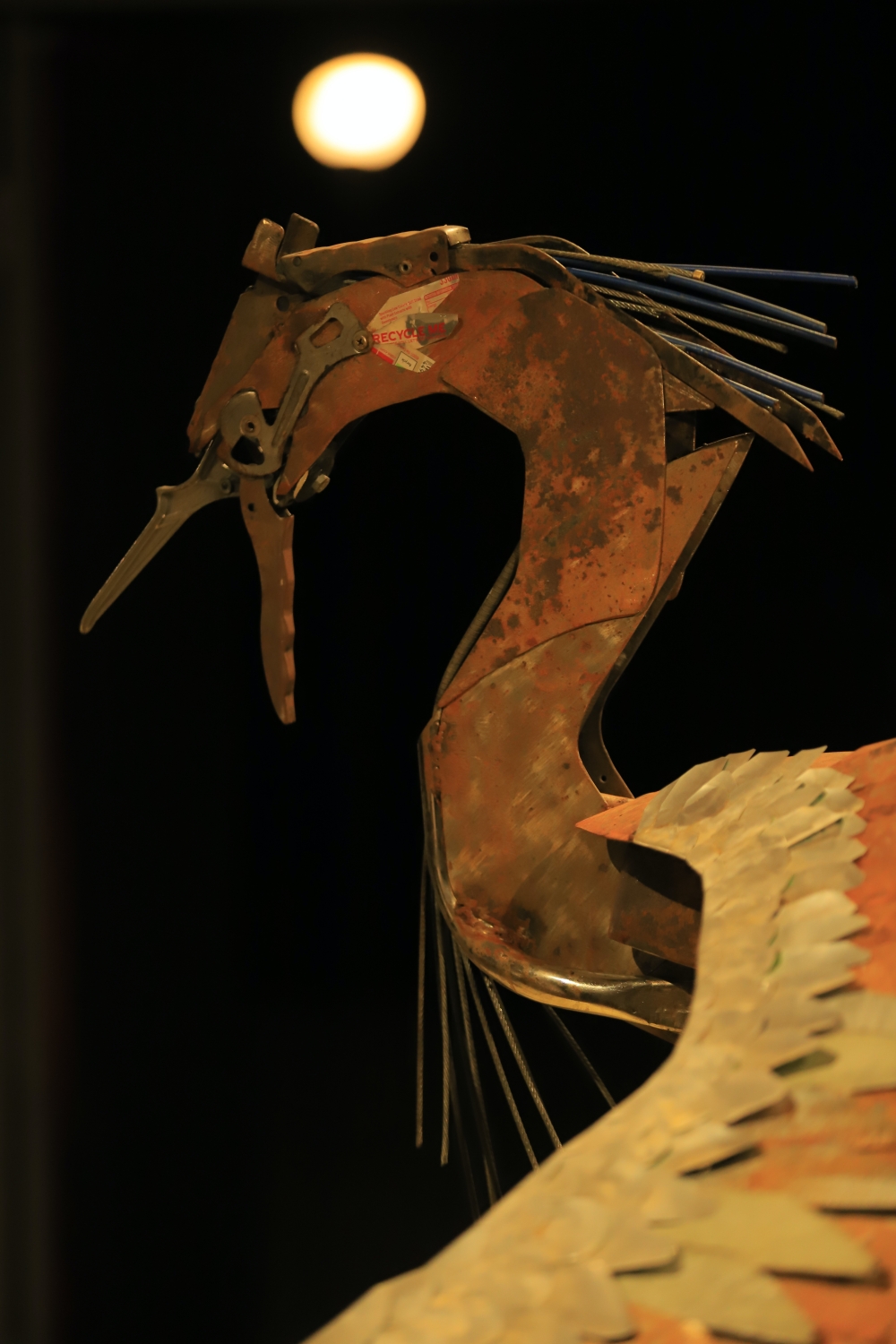
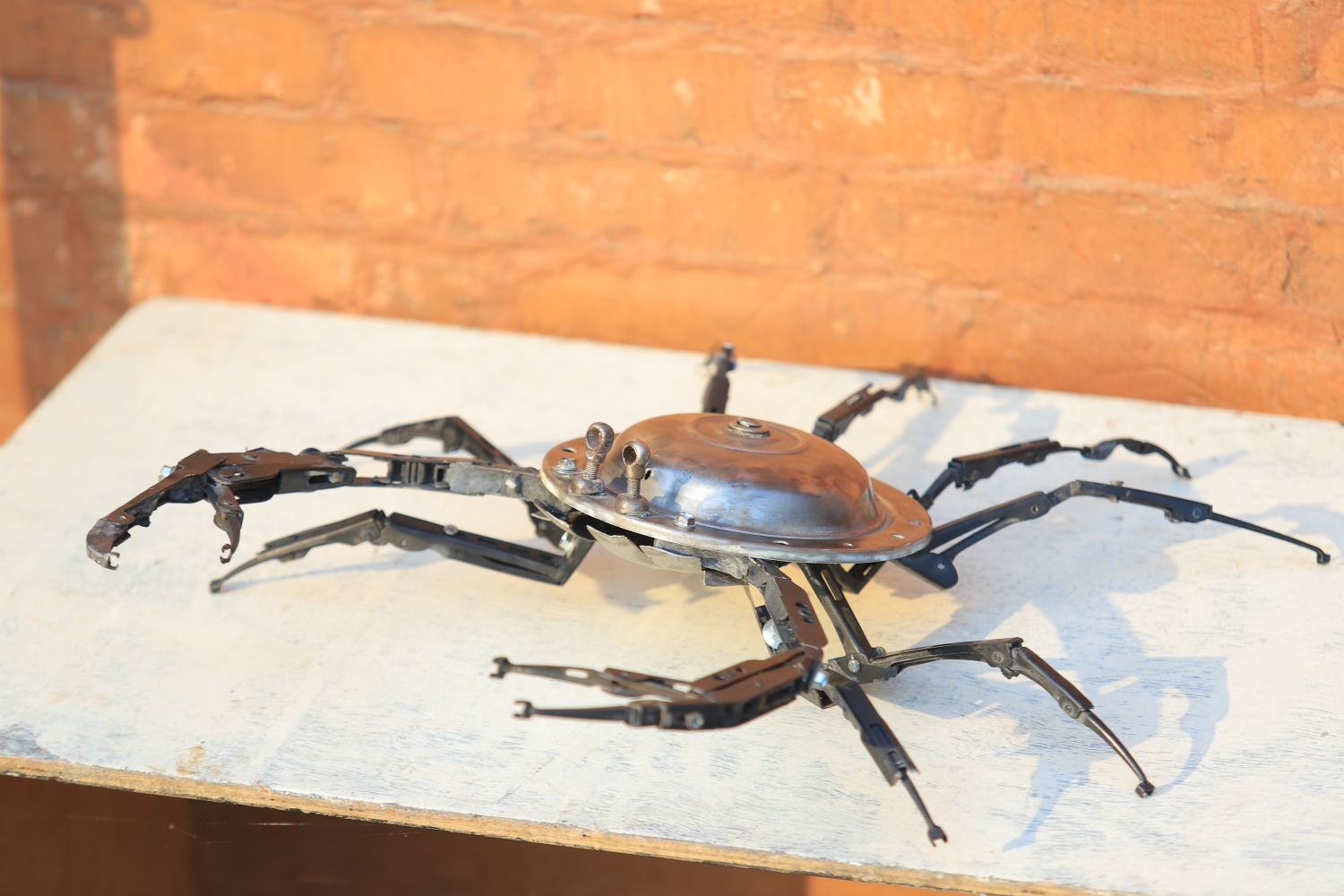
A mighty metal bird, ‘Heron on Hunt’ spreads its wings and unhinges its mouth hungrily. It looks down at ‘The Defending Crab,’ which has windshield wipers for legs and opens its pincers defiantly at the heron, daring it to attack.
The crab shell is made of a ceiling fan, the blades of which have been cut up to form the bird’s wings.
“The story is that you are what you eat,” says artist Saurab Koirala, whose solo exhibition ‘Metamorphosis’ at Taragaon Next has sculptures made of material retrieved from garbage warehouses.
Koirala was in the studio when protestors ransacked the adjacent Hyatt Hotel on 9 September. The windows of the iconic museum designed by architect Carl Pruscha in the 1960s were all shattered, but the studio survived. He used the broken glass to make fins for his fish sculptures and wings for insects.
Metamorphosis is a reference to the transformation of trash into art, but it is also fitting because many of the repurposed items are of insects: a firefly, a dung beetle, a spider, a dragonfly, a queen ant.
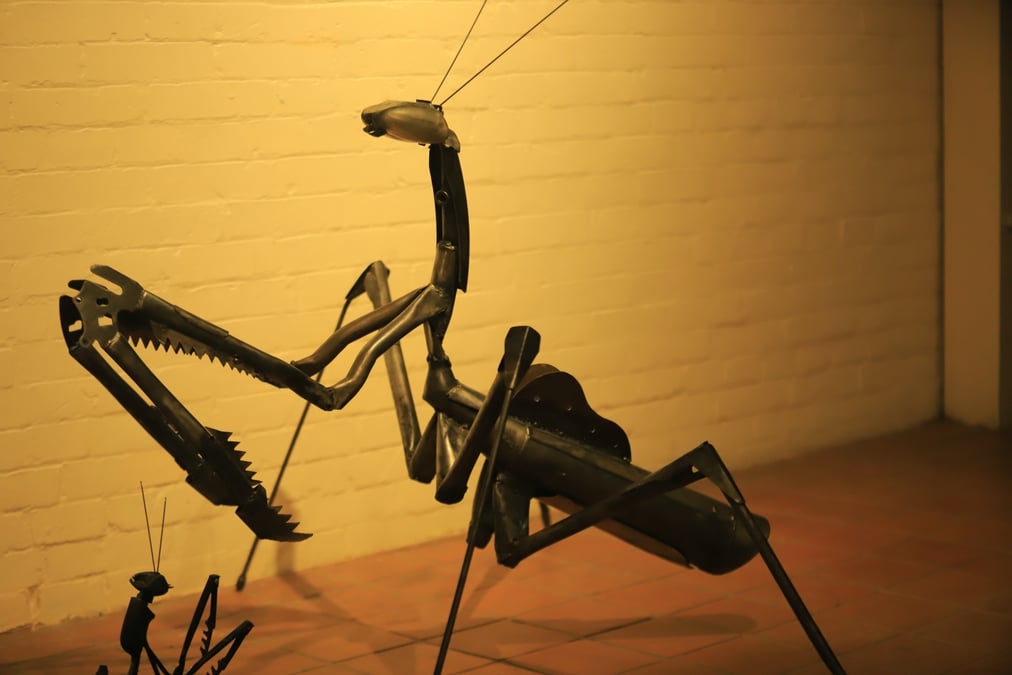
The most striking are the pair of praying mantises, the smaller one is black, made of windshield wipers, and the larger grey one is made of a motorcycle silencer, bicycle parts, and a fluorescent tube holder.
About the unrealistic size difference, Koirala notes that each piece is made of a component that defines its size. For the larger grey mantis, the defining piece is the silencer that makes up its torso.
“The mantises are mating,” Koirala explains. “The female mantis will cannibalise the male afterwards, and the dragonfly witnesses the whole scene.”
It is possible to look at each installation and immediately recognise what it is meant to be, but on looking closer we see what the parts are made of, and how. The exhibition is from Koirala’s Taragaon Next residency program sponsored by the Saraf Foundation.
Koirala thinks of himself as primarily a painter and a caricature artist, and not a sculptor. His mother was a teacher, and would make miniature animals, gods, houses for her students.
“Seeing how happy she was doing that made me want to do it too, although she did not want me to be an artist,” Koirala recalls. Some of his mother’s creations are also on display at the exhibition.
Koirala got more experience working with 3D models digitally in his work at Incessant Rain animation studio, especially animals. This seems to have given him strong visualisation skills that he has put to use in the art pieces, using minimal bending and cutting.
Koirala participated in the WastArt Competition in 2018, where his Danphe sculpture made from colourful coke and soda cans was so striking that it became a part of the permanent collection at the Sagarmatha Next Art Gallery in Syangboche. Koirala worked in the studio in Khumbu, fashioning yaks and bees out of trekking trash.
“My back hurts,” he grimaces as he opens the doors to the studio, an unassuming shed a short walk from the exhibition which is littered with metal spare parts for future art. He has gone through three whole bicycles with a power saw.
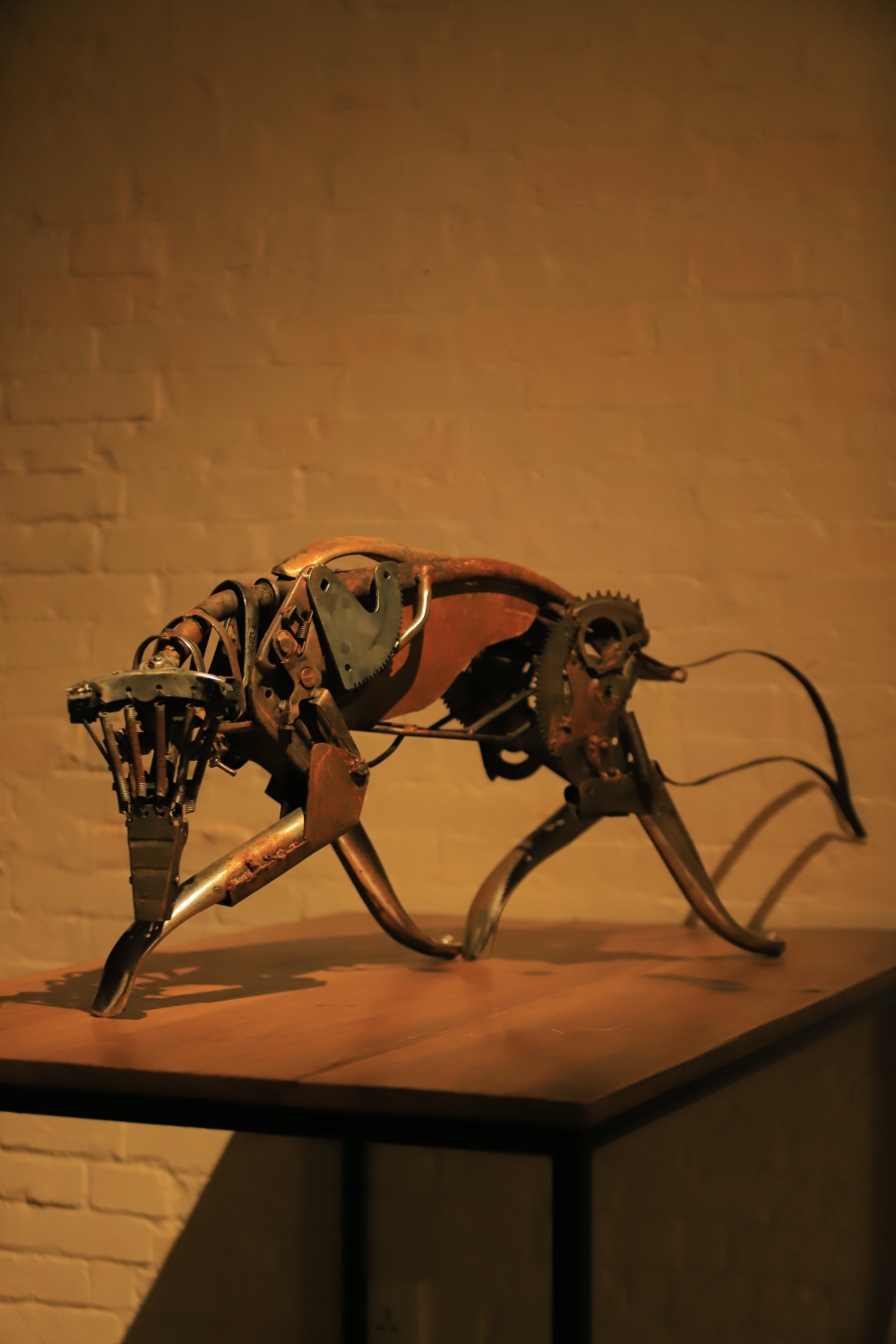
Koirala seems to want to alter the scrap as little as possible, and it is uncanny how well some of it fits the pieces. The aerodynamic curved fuel tank of a Bajaj Avenger motorcycle becomes the abdomen of a gigantic queen ant. A mosquito repellent becomes the green body of a spider. A stapler and a coconut turn into a snail. The steel legs of a rolling office chair curve exactly into the legs and paws of a fox in motion.
“I did not want the animals to be in static poses. I wanted to capture dynamic movement,” says Koirala. Fittingly, most of the parts he has chosen have come from vehicles: bicycles, motorcycles, scooters, car horns, air filters.
While Koirala’s work in his Sagarmatha Next residency was about waste encroaching into nature in the mountains, his work in Metamorphosis is a nostalgic memory of a happy childhood in Biratnagar.
‘There used to be abundant dragonflies in my hometown,’ writes Koirala in his description. “As kids, we would catch them and tie threads to their tails and fly them like kites.”
The message about the degradation of nature is more valid than ever. The world is seeing the mass extinction of insects, and uncontrolled urbanisation of polluted Kathmandu Valley means only ants and some spiders survive.
Artist in Studio #9: Metamorphosis
Till 30 January
10AM-5:30PM