
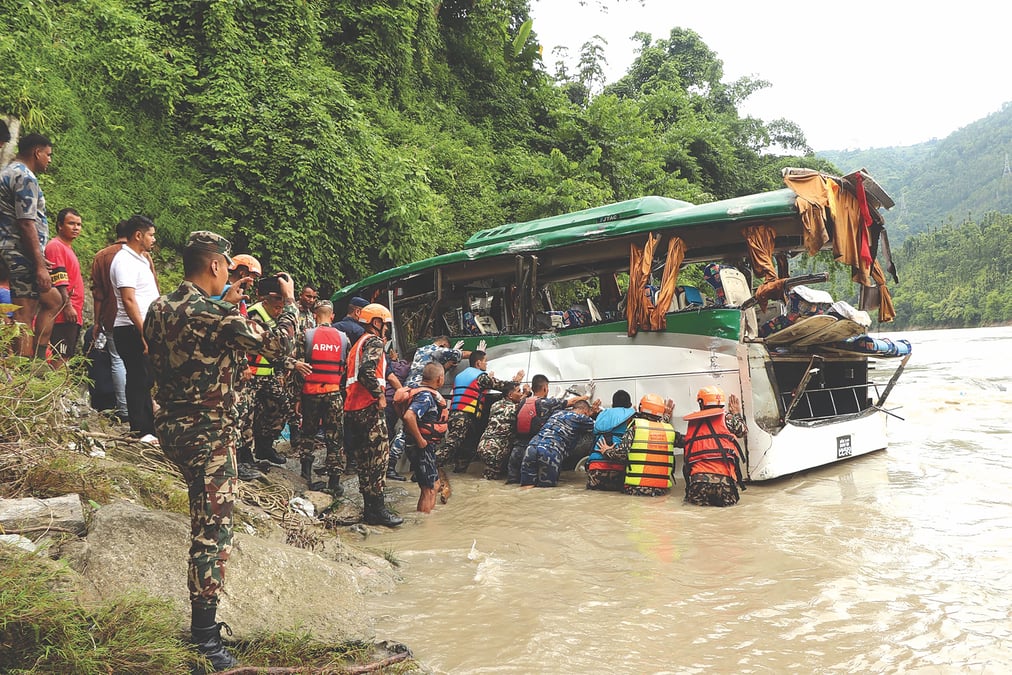
Nearly 24,000 people died on Nepal’s roads in the last 10 years. In comparison, 17,000 people were killed in the 10 years of the Maoist armed conflict. Covid killed about 12,000 Nepalis.
Nepal’s highways are deadlier than war or pestilence.
Numbers are numbing. But although this epidemic of fatalities is now one of the biggest causes of death nationwide, it gets scant attention from governments, the public and media.
Nepalis have come to accept death on roads as a part of life. All three levels of government shirk from responsibility, calling them ‘accidents’. And road mortality has become so commonplace that the mainstream press buries the news.The relentless slaughter on our roads is the result of political disinterest, governance malfunction, and public apathy. Nepalis are not dying on roads, they are being killed.
“Road traffic accidents are getting more frequent and there is a direct correlation with the failure of national governance,” says transport expert Chandra B Shrestha. “Local and provincial governments have neither the capacity, nor clarity of their roles. Budgets are poured into building substandard roads.”
Shrestha analysed the tragedy this month on the Chandragiri road that killed a doctor, his parents and two children. Only his wife, a physician, survived because she got out of the car to put a rock behind the wheel of their hatchback that stalled on a steep section.
He says the incline was too steep, the rough surface did not allow it to gather enough speed for the gradient, and the thick dust did not provide adequate traction for the tyres.
Most of the euphemistically called ‘roads’ in Nepal are similar death traps. They are not wide enough, do not have the required radius on excessively steep curves, no attention is paid to drainage, and houses are allowed to be built without the required set-back.
“There is no design or planning to begin with, there is a total absence of any engineering,” says Shrestha. “This should be criminal. These are not accidents, but almost deliberate deaths.”
And like all crimes, the perpetrators can be tracked by following the money. Inevitably, it leads to corruption linked to infrastructure budgets to build roads regardless of priority or quality for kickbacks or votes. And when a bus falls off a road, there is no political will to investigate the root cause in the political economy and lack of accountability.
Apart from faulty highway engineering and absence of safety features, the other factors in road fatalities include driver negligence, carelessness, over-speeding, overloading, and lack of maintenance of vehicles.
Two-wheelers, which used to be confined to cities, have now added a new challenge to highway safety. Motorcycles are involved in 68% of road traffic accidents in Nepal.
“Young people over-speeding in their heavy 600cc bikes are a danger to themselves and others. Moreover, we have found a notable increase in youths driving under substance abuse,” says DIG of Police Bhim Prasad Dhakal, explaining that strict monitoring of drinking and driving has led to an increase in drug use.
Highway deaths make news, but injuries are a major cause of physical disability in Nepal. The numbers are shocking: just last year more than 30,000 people were injured in road crashes. Nearly 6,000 of them had severe spinal or brain trauma needing complicated surgery, rehabilitation and lifelong care.
As Nepal’s road network expands, and with inadequate attention to highway safety as well as lack of timely treatment of trauma victims and rehabilitation, it will be the poorest Nepalis who will pay the price. And they are the section of society already marginalised and excluded by governments, the public and the media.
“Road crashes perpetuate the vicious cycle of poverty,” says Raju Dhakal of the Spinal Injury Rehabilitation Centre in Sanga. “From expensive medical bills to rehabilitation to lost years of productivity, it represents a huge loss for the nation. Our health system needs to be revamped, and investment is needed for preventive, curative, palliative and rehabilitative care.”
The main cause of highway deaths: corruption
The epidemic of fatalities and injuries on Nepal’s highways are no accident, they are a criminal offence
It is ironic that for something that is considered a vote bank, there is no accountability when it comes to the maintenance of roads to ensure their safety. All 77 districts in Nepal are now connected to the road network but bad roads are a given in this country.
Under federalism, true devolution of power is yet to be exercised but heavy earth-movers are clawing through the mountains in a misguided notion of ‘development’. A fatalistic society accepts road ‘accidents’ as a price to be paid.
This is one case where corruption kills, yet rarely is power held to account, or wrongdoing punished.
“Road maintenance is not sexy or attractive enough, there is no political or monetary incentive, and there is no budget allocated either for road maintenance,” says transport expert Chandra B Shrestha.
Shrestha was a district transport planning adviser in the 1990s, and says Nepal expanded its road network but left sustainability out of the equation. “Asset maintenance is not even an afterthought,” he says. “What this means is that our roads are non-functional and not cost-effective, among other things.”
Every 14 deaths per 100,000 are caused by road fatalities, which is now the third biggest cause of death in the 15-29 age group. Three times more men die on the roads than women.