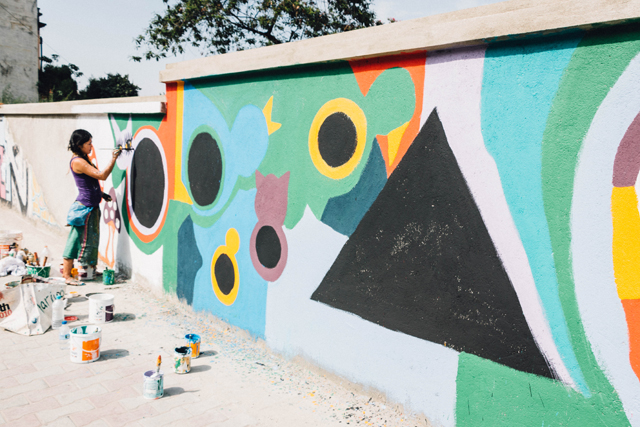
After the earthquake, street artists coloured Kathmandu’s walls with messages of hope.
Over the last two years, Nepal’s vibrant street art has received worldwide exposure and admiration for the personal and political messages. Many promising painters have been featured in international exhibitions and the media.
After the 25 April earthquake there has been an explosion of art along Kathmandu’s roads with messages of loss and hope.
Shraddha Shrestha painted Hijo, Aaja (Yesterday, Today) in Kantipath with the help of her friend Matt Rockwell depicting two sets of couples, one crying and the other holding shovels and a pickaxe. “I wanted to convey that yesterday we were mourning, but today we have to get back to work,” Shrestha told Nepali Times.
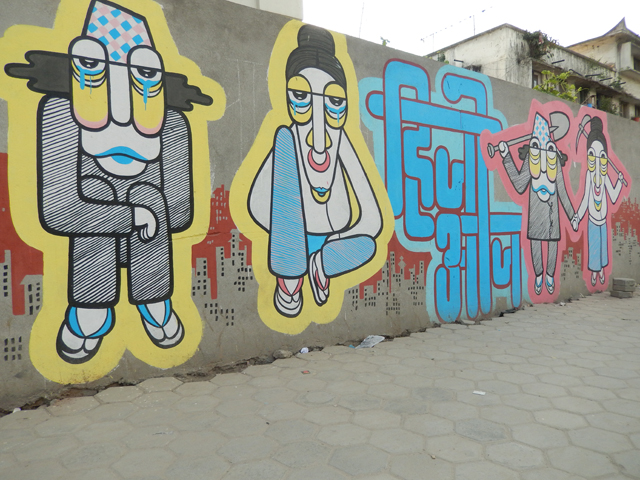
Shraddha Shrestha’s ‘Hijo, Aaja’ on Kantipath suggests Nepalis should stand up and start rebuilding their country. Photo: Stéphane Huët
Passersby stopped to admire her work, and a policeman explained the painting to others who didn’t understand the images. “In other countries, it’s illegal to paint the streets, but here I was supported by a uniformed officer,” Shrestha laughed.
Hatemalo Abhiyan (Chain of Hands) is a team of fine arts students led by artist Bhishan Rajbhandari. The group is currently painting a three-storey mural of Kasthamandap (pic, top) on a wall in Babar Mahal to commemorate the temple after which Kathmandu is named, and which killed 12 people when it collapsed.
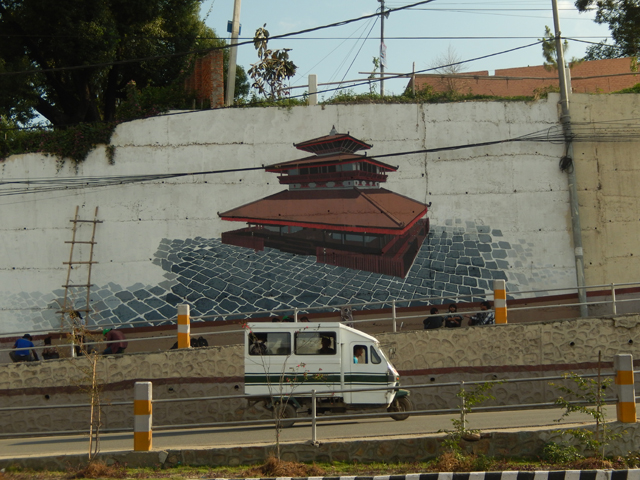
The Kasthamandap painted in Babar Mahal is the first of a series of nine murals representing the collapsed temples of Kathmandu Valley. Photo: Stéphane Huët