
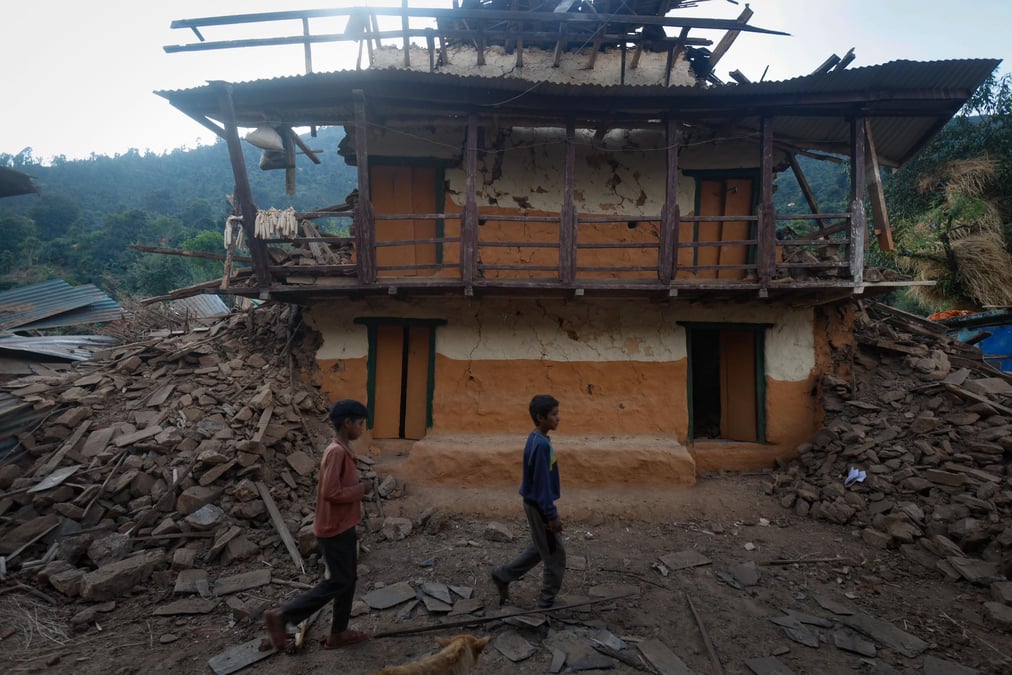
The deadly midnight earthquake last Friday in Karnali Province occurred in an area where seismologists had long predicted the next Big One.
This was the ‘seismic gap’ that this newspaper first wrote about in its 9-15 January 2004 edition commemorating National Earthquake Safety Day and the 70th anniversary of the 8.5 magnitude 1934 disaster.
The subduction of the Indian plate into and below the Eurasian landmass leads to accumulated stress in the rock strata deep beneath the Himalaya. This tectonic tension builds up over time, and if it is not released periodically the result could be a megaquake that could result in a rupture leading to 6m or more of horizontal surface displacement.
Read Also: Deadly earthquake hits W Nepal, Nepali Times
Seismic experts now say that the 3 November event was not the massive one that was expected. At 6.4 it was a moderate quake with a shallow epicenter, which is why the destruction was limited to a relatively small radius although the shaking was felt as far away as Delhi and Kathmandu.
The disaster also exposed Nepal’s demographic shift. Of the 157 confirmed dead so far, many were women because most men have migrated abroad for work. There was also a class and caste element, as the flimsiest homes belonged to the poorest families.
Disaster management experts like to say that it is not earthquakes that kill people but buildings. Indeed, quakes are not ‘natural disasters’ but mostly man made. Proof of this was the 25 April 2105 earthquake which killed nearly 9,000 people in central Nepal as substandard buildings collapsed.
Read also: Grief-stricken survivors are cold and hungry, Sagar Budhathoki
Tragically, this also was proven in last week’s disaster when fragile stone and mud plaster homes collapsed with the very first jolt. Newer buildings with reinforced concrete columns withstood the shaking, but had the intensity and duration of the quake been longer they would have also crumbled.
Seismologists say the Jajarkot quake was not strong enough to release all the tectonic stress -- which could mean it was either a precursor to a bigger one to come, or it has made the region safe for another decade or so.
There is no way to predict it either way. What we know for sure is that the next one is not a question of ‘if’ but ‘when’. It is better to invest now in preparedness than in counting bodies and the number of collapsed buildings after a disaster.