
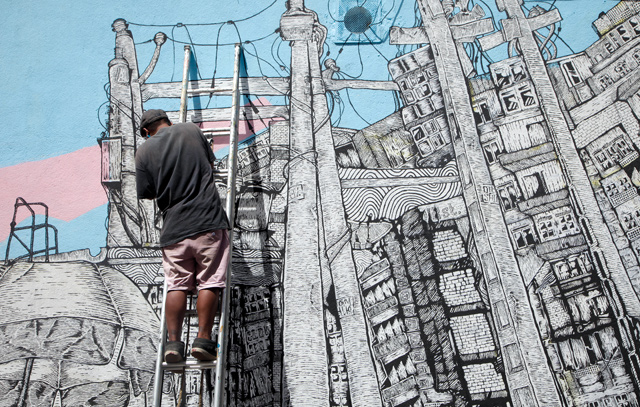
Previously festooned with billboards for big brands, the wall opposite the Russian Embassy in Baluwatar now showcases a black-and-white artwork of crumpled transmission lines over a cramped city depicting unplanned urban growth.
Probably inspired by Kathmandu’s own chaotic growth, street artist Dibyeshwor Gurung thought this wall would be an apt medium to put out his message: “If everyone leaves, there won’t be anyone left behind to untangle the mess.”
Like Gurung’s wall, there are many other examples of outdoor art in Kathmandu, and the city’s walls are getting a makeover with ArtLab’s PRASAD Street Art Festival this month.
Political slogans and advertisements are being painted over with bright, tongue-in-cheek artwork with themes ranging from migration to portraits of local heroes to inspire youths. The street art festival tries to conjure up the country’s current present socio-political milieu.
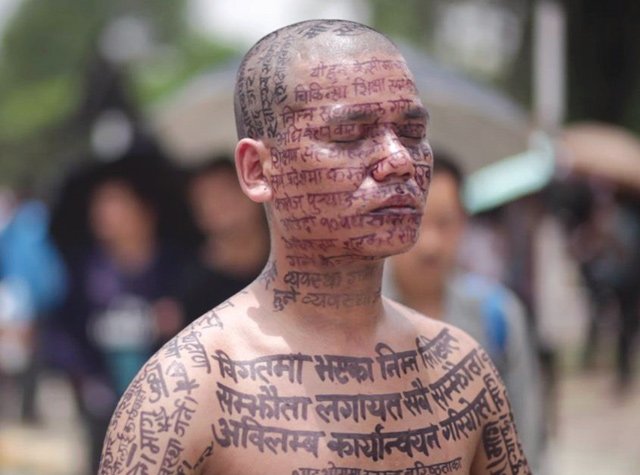
An upcoming art festival (see box above) has the city itself as its theme and, in so doing, Kathmandu’s art scene is using public spaces to engage with a wider audience, and hopes to be a strong catalyst for change, both of the cityscape and by arousing social consciousness.
“The average member of the public is intimidated by these white cubes called art galleries. Street art challenges this notion, making art accessible to the public,” says Sangeeta Thapa of the Siddhartha Art Gallery.
Earlier this year, Kabi Raj Lama’s ‘Irritation Machine’, a satire on Nepal’s frequent changes in government, drew the public to an exhibition in the Nepal Art Council. Titled ‘All Party-Meet’, Lama used stencil art to draw portraits of 13 Prime Ministers of Nepal in the last 22 years, in nine different venues across the Valley, to attract people to the exhibition.
Even Ishaan’s red-coloured walls with the phrase ‘Swadesh bachauna ke gardaichhu ma’ (What I am doing to save my country) sparked conversations on social media.
Ashmina Ranjit has been engaging in performance art, carrying a human skeleton on her back to represent the state of neglect of public health. ArtTree (pic, left) has accompanied protests supporting crusading physician Govind KC. The impact of such performances goes far beyond that of an indoor gallery exhibition.
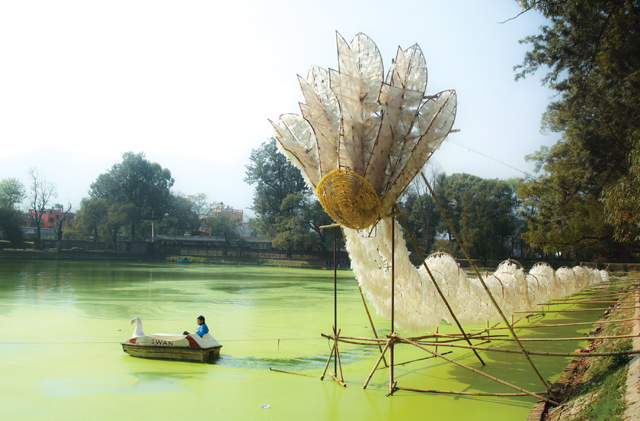
When art goes public, it wields the power to challenge the status quo. Ranjit says this power can also be used to highlight the spaces themselves. Historically Kathmandu was a city that emphasised open spaces for its festivals, gatherings and performances, but Ranjit says today those very spaces have shrunk. She says it is the duty of Nepali artists to help reclaim such open public places from being smothered by concrete structures.
Although the city houses magnificent sculptures by artist Thakur Prasad Mainali, like the one in the BICC garden dedicated to Mother Nature, it is increasingly becoming an eyesore.
“Art affects architecture. If you have art in the public sphere, it starts changing the face of the city and makes it unique,” said researcher and artist Promina Shrestha.
Many works of art by international artists in the Kathmandu International Art Festival 2012 were temporary outdoor installation art initiatives, to draw attention to environmental degradation and social issues.
Said Nischal Oli of Siddhartha Arts Foundation's Education Initiative (SAFEI): “Usually artworks are commissioned by governments to create cultural cities. In Kathmandu’s case, the city needs to get involved and artists need to be encouraged.”
Supported by SAFEI.
Kathmandu Triennale
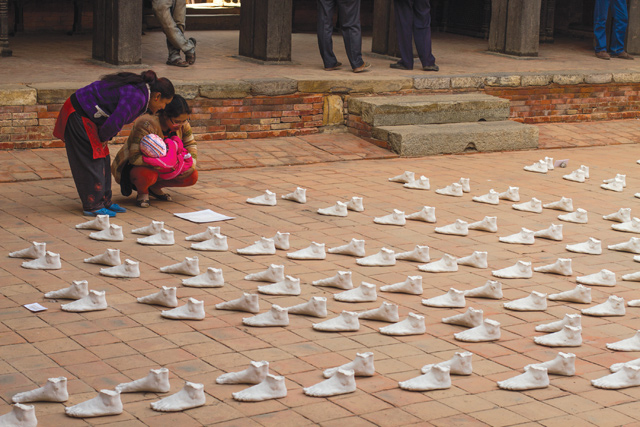
After two successful editions in 2009 and 2011, the Kathmandu International Art Festival 2017 is scheduled for 7 March to 9 April next year, with the theme ‘My City’. Belgian artist Philippe Van Cauteren will be the festival curator.
“The artists will create new works in the city, about the city, collaborating with the city,” said festival manager Nischal Oli.
The month-long event will feature works by 45 local and international artists. It will also have gala events, a three-day symposium, public performances, passive and guided tours, film screenings, master classes, and workshops (including for children).
Photo Kathmandu 2016
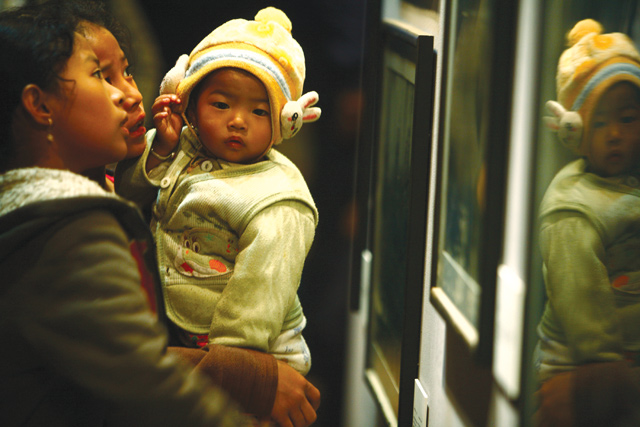
Kathmandu witnessed its first-ever international photography festival last year. Uniquely, it used public spaces like walls, streets and courtyards, and the exhibition was scattered in and around Patan where residents and visitors could interact with each other.
“The festival made people aware of places within Patan, and more than that it helped facilitate communication among different communities in Patan,” said Nayantara Gurung Kakshapati of photo.circle.
This year, Photo Kathmandu will take place from 21 October to 3 November, with workshops, exhibitions and talks by artists. The festival will showcase photographs around the theme of ‘Resilience’, looking at how people cope with disaster and conflict, with participants from countries such as Iran, Cambodia, Bangladesh, and Saudi Arabia.
Read also
Murals of hope,Stéphane Huët
Wide open spaces, Smriti Basnet